Home Blog Page 6

Churches Ethiopia: Inspiring and Blissful

0
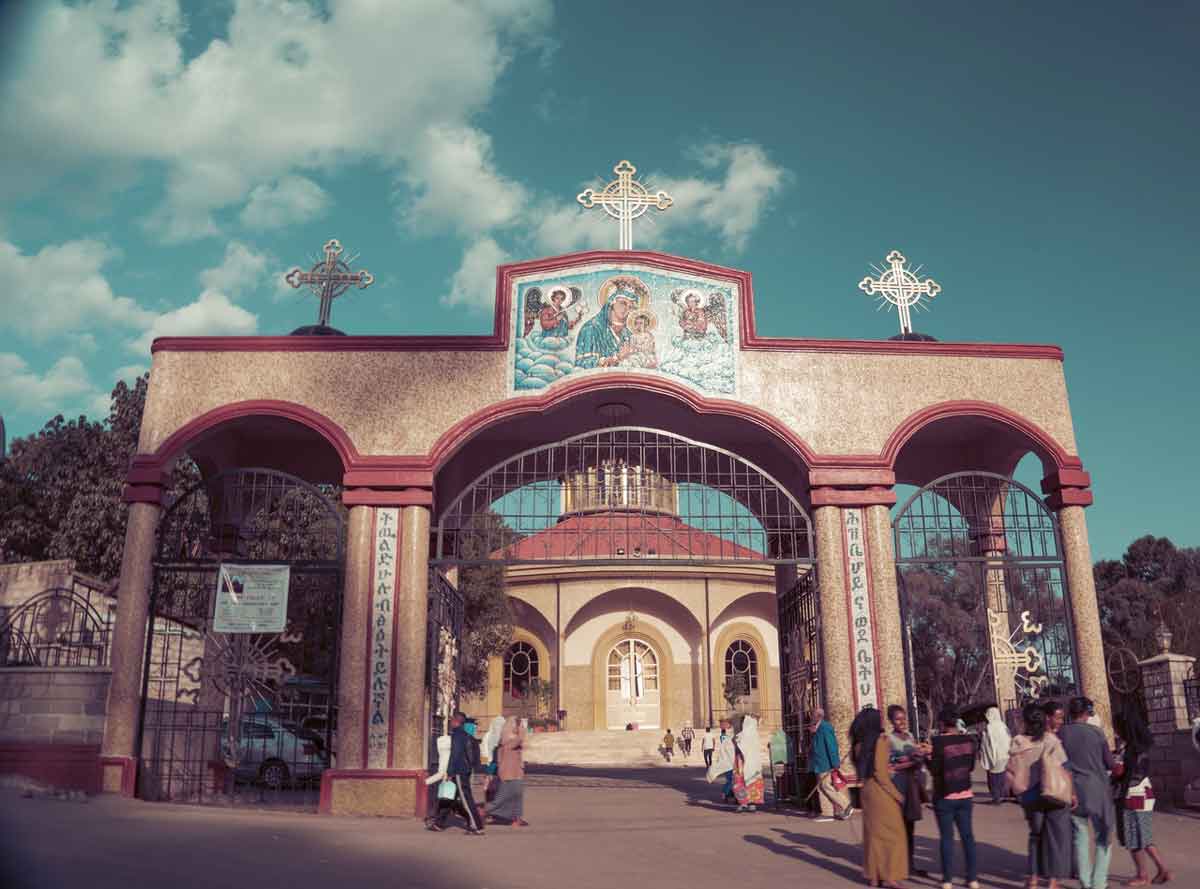
Ethiopia orthodox church

The Churches Ethiopia as a case of Ethiopian society is a wide range of topic that covers the ideas of the historical significance. “UNESCO” and “IMF” have recognized these as a major shaping element for the technology and medical knowledge we have today.

The Churches Ethiopia has a certain character that emphasizes the cultural and religious context of the Ethiopians or residents.

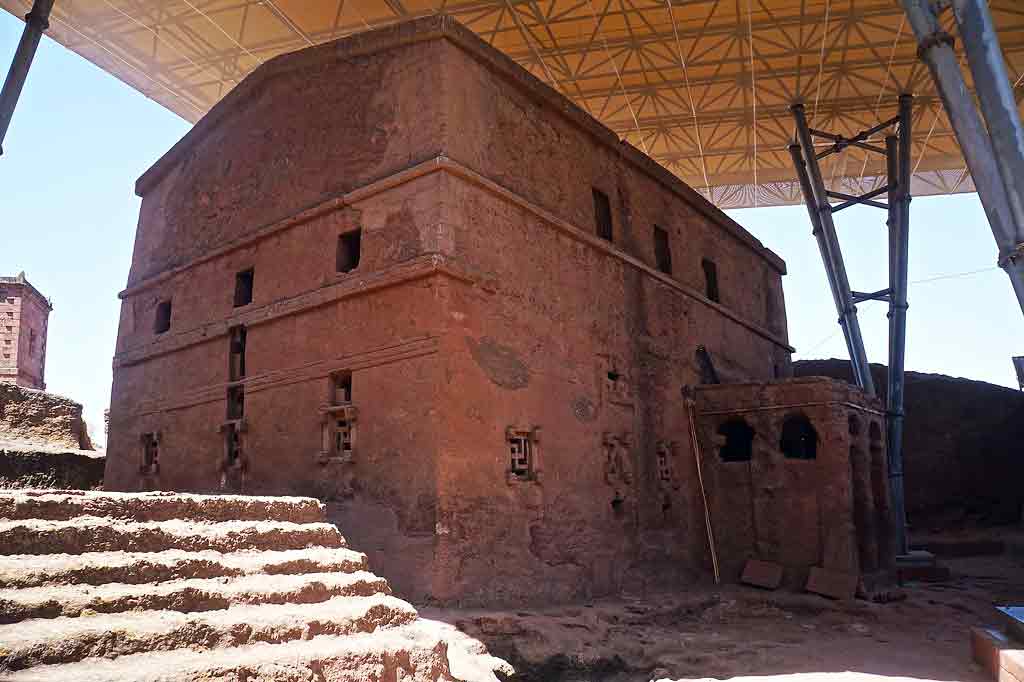
Ethiopian Churches Ethiopia including the most famous of all/rock-hewn “LALIBELA” Churches Ethiopia/ is an iconic church with a context that puts vernacular architecture in mind. As we go deeper into the topic types of Churches Ethiopia is briefly explained: Evangelical/Protestant, Orthodox, Catholic are the main categories with a number of followers.

How did Christianity begin in Ethiopia?

The major Churches in Ethiopia have a historical significance in such a way that they have different features which affected the physical, natural, social. Christianity spread in Ethiopia after king “ZEREYAKOB” invite missionaries to Ethiopia after he himself was converted and thought it would be a good idea to introduce it to the rest of the citizens.

The aim of this missionaries was to popularize the Christian religion, but later, the religion affected the political, economic, and environmental issues raised at the time. The first Churches Ethiopia was thought to have been built before the birth of Christ, but the oldest one with digital and physical evidence is the rock-hewn Churches Ethiopia of LALIBELA.

It is thought to be built by king LALIBELA himself which took him about 24 years. This church was one of its kind in construction techniques and the type of material used. King LALIBELA is said to have toured the world especially Jerusalem, and his major attempt was to create a second Jerusalem in today’s Lalibela and spread Christianity.

A first he had opposing partners who told him he was not supposed to do such kind of religious works since he is a major king and an emperor of Ethiopia but he still resisted all those negative critics and said he had a vision of a holistic city and church. Then followed the design and construction which took him as long as 24 years to build by himself.

The Churches Ethiopia still exists to date and is open to visitors which also has an influence as an economic factor. History of this Churches Ethiopia date from 7th to 13th century. When talking about the Churches Ethiopia, the major city that comes into mind is the city of Aksum.

Aksum’s civilization is the first of its kind and with certain structural elements is the first one up to date. So basically the major issue to be brought up whilst talking about the history of Ethiopian Churches Ethiopia is the influence of missionaries in Ethiopia starting from the 4th century and the willingness of the rulers like “ZAGWE” dynasty to incorporate and implement the ides of Christianism and holiness to the whole country and in turn, use that as a unifying element for the people.

TIMELINE

The timeline in which this artistic and at the same time holistic Churches Ethiopia was built was from the 7th to 23rd century. This timeframe usually works for the “orthodox” religion but since the Churches Ethiopia include protestant and catholic Churches Ethiopia, discussing them is a better choice.

The protestant Churches Ethiopia was built after the missionaries from Europe migrated to Ethiopia to speak about Christ/renaissance. These people went from place to place and preached about their proposal to everyone they found which in today’s WORDS is setting a foundation for a major base to the diversity of religions.

The Catholic Churches Ethiopia here is a major part of the catholic society which is led by the pope in Rome. The time frame is put at the 341 AD after the Ethiopian saint “FRREMINATOS” was anointed by the saint “ATNATIUS” of Rome. The Churches Ethiopia age for a long time and don’t have the issue of destruction since the materials they were built in was stone and strong structures.

The number of followers of this religion is put at 3rd place next to orthodox “TEWAHDO” and Presbyterian/protestant. So, these Churches Ethiopia were built in such timelines and the national heritage preservation association tries to organize and preserve these Churches Ethiopia for the purposes of holiness and tourism. According to a local demographic study, about 40% of the Ethiopians population follow Christianity which is in second place next to Islamic people.

What Are the Different Denominations in Churches Ethiopia?

Despite the fact that Christianity existed well before the standard of King” EZANA” the Great of the Kingdom of Axum, the religion took a solid a dependable balance when it was announced a state religion in 330 AD. Pinpointing a date with respect to when Christianity rose in Ethiopia is unsure. The soonest and most popular reference to the presentation of Christianity is in the New Testament (Acts 8:26-38[6]) when Philip the Evangelist changed over an Ethiopian.

Researchers, nonetheless, contend that Ethiopian was a typical term utilized for dark Africans and that Queen Candace served by this authority really administered in close by Nubia (present-day Sudan). “Candace” may likewise allude to the situation of “sovereign” as opposed to a particular individual, see Kandace. Judaism was drilled in Ethiopia well before Christianity showed up and the Ethiopian Orthodox Bible contains various Jewish Aramaic words. The Old Testament in Ethiopia might be an interpretation of the Hebrew with conceivable help from Jews.

As per church history specialist Nicephorus, the messenger St. Matthias later lectured the Christian Gospel to current Ethiopia subsequent to having lectured in Judea. Rufous of Tire, a prominent church history specialist, recorded an individual record as did other church students of history, for example, Socrates. The Grime Gospels are believed to be the world’s most established enlightened Christian compositions.

Spread of Christianity

The “SYRIAC” Nine Saints and “SADQAN” evangelists extended Christianity a long way past the troop courses and the regal court through devout networks and minister settlements from which Christianity was educated. The endeavors of” SYRIAC” the evangelists encouraged the Church’s development profound into the inside and caused grinding with the conventions of the neighborhood individuals.

orthodox church

The “SYRIAC” missions additionally filled in as lasting focuses of Christian learning in which the priests at long last started to interpret the Bible and different strict writings from Greek into Ethiopic so their believers could really understand Scripture. These interpretations were indispensable to the spread of

Christianity, no longer a religion for the little level of Ethiopians who could understand Greek, all through Ethiopia.

With the interpretation of Scripture into Ethiopic taking into consideration average citizens to find out about Christianity, a large number of the nearby individuals joined the “SYRIAC” missions and cloisters, got strict preparing through devout principle based around communalism, difficult work, order, acquiescence, and plainness, and caused the development of the Church’s impact, particularly among youngsters who were pulled in to the magical parts of the religion.

Recently prepared Ethiopian pastors opened their own schools in their areas and offered to teach individuals from their assemblages. Ethiopian rulers empowered this improvement since it gave more renown to the Ethiopian pastorate, drawing in many more individuals to join, which permitted the Church to develop past its birthplaces as an illustrious faction to an across the board religion with a solid situation in the nation.

By the start of the 6th century, there were Christian Churches Ethiopia all through northern Ethiopia. Ruler Kaleb, of the Aksumite Kingdom, drove campaigns against Christian persecutors in southern Arabia, where Judaism was encountering a resurgence that prompted abuse of Christians. Lord Kaleb’s rule is likewise critical for the spread of Christianity among the “AGAW” clans of focal Ethiopia.

In the late sixteenth century Christianity spread among trivial realms in Ethiopia’s west, as “ENNAREA “, “KAFFA” or Garo.

Christianity has additionally spread among Muslims. A recent report evaluated somewhere in the range of 400,000 Christians from a Muslim foundation in the nation, the vast majority of the Protestants of some structure.

EVANGELICAL CHURCHES ETHIOPIA

The EECMY was established on work started by Northern European evangelists in the late nineteenth and mid-twentieth hundreds of years. These evangelists moved their work in southern Ethiopia, where the Orthodox Christian impact was less significant. The methodology of the preachers and evangelists to embed a Protestant churches Ethiopia was one of advancement.

When Emperor Haile Selassie was hoping to modernize and advance advancement in the state, remote and local missions were probably the most gainful operators. Truth be told, Selassie wrote in his self-portrayal that he just “allowed missions in view of their endeavors in the field of instruction and wellbeing care.

Ethiopain church protestant wedding

It was through improvement that the Evangelical churches Ethiopia had the option to initially set up a nearness in the nineteenth and twentieth hundreds of years. Truth be told, as more individuals in power in the Orthodox Church started to scrutinize the legitimacy of outside missions in Ethiopian culture, and as the distinguishing proof of the Orthodox Church and the Amharic language as bringing together powers inside Ethiopia

started to develop, a significant number of the individuals who held high managerial positions owed their instruction to the mission schools and were hence hesitant to pass any enactment against them Thus, while numerous sociological and strict powers weighed against the Evangelical church and its missions in Ethiopia, the way that it was viable as a specialist of advancement helped its endurance through its expanding years.

CATHOLIC CHURCHES ETHIOPIA  

In the year of 341 AD., Saint Frumentius (Abune Salama Kesatie Berhan) was sanctified the main Bishop of Ethiopia by the incomparable Saint Athanasius, Patriarch of Alexandria, who was in association with the Bishop of Rome. In this way, the Bishop of Alexandria was the extension between the Bishop of Rome and the Bishop of Ethiopia.

At the point when the Church in Alexandria and in Ethiopia split from the Church in Rome in the 6th century, the Church which had been one became divided

Between the thirteenth – eighteenth hundreds of years, different steady minister endeavors had been done in Ethiopia to re-present Catholicism. Since there was at that point a Christian church in the country, a large portion of the evangelist endeavors was not worried about the transformation of the non-Christians, however, tying down the attachment to the Holy See of the current Churches Ethiopia.

However, these missions, in the long run, bombed because of the national-strict connection of the Ethiopians, specifically, the Coptic party, to their Miaphysite tenet, and the severe connection between strict and political battles.

The Portuguese journeys of revelation toward the finish of the fifteenth century opened the route for direct contacts between the Church in Rome and the Church in Ethiopia. Due generally to the conduct of the Portuguese Jesuit Afonso Mendes, whom Pope Urban VIII named as Patriarch of Ethiopia in 1622, Emperor Fasilides removed the Patriarch and the European evangelists, who included Jerónimo Lobo, from the nation in 1636; these contacts, which had appeared to be bound for progress under the past Emperor drove, rather, to the total conclusion of Ethiopia to additionally contact with Rome.

From 1839 Msgr. Justin de Jacobis, and consequently Cardinal Guglielmo Massaia, continued Catholic evangelist exercises. The Catholic people group at present found in Ethiopia are for the most part the product of the overwhelming work of the previously mentioned teachers, de Jacobis, and Cardinal Massaja.

Ethiopia church

ORTHODOX CHURCHES ETHIOPIA  

Numerous conventions guarantee that Christian lessons were acquainted with the area following Pentecost. John Chrysostom discusses the “Ethiopians present in Jerusalem” as having the option to comprehend the proclaiming of Saint Peter in Acts, 2:38 Possible missions of a portion of the Apostles in the terrains currently called Ethiopia is additionally revealed as right on time as the fourth century.

Socrates of Constantinople remembers Ethiopia for his rundown as one of the locales lectured by, for example, the Roman Catholic Church among others. Ethiopian Church convention tells that Bartholomew went with Matthew in a crucial went on for at any rate three months Paintings portraying these missions are accessible in the Church of St. Matthew found in the Province of Pisa, in northern Italy depicted by Francesco Trevisan (1650–1740) and Marco Benefial (1688–1764)

The most punctual record of an Ethiopian changed over to the confidence in the New Testament books is an illustrious authority immersed by Philip the Evangelist (particular from Philip the Apostle), one of the seven elders (Acts, 8:26–27):

At that point the heavenly attendant of the Lord said to Philip, start out and go south to the street that leads down from Jerusalem to Gaza. So, he set out and was on his way when he got a quick look at an Ethiopian. This man was a eunuch, a high official of the Kandake (Candace) Queen of Ethiopia accountable for all her fortune. (Acts, 8:26–27)

The section proceeds by portraying how Philip helped the Ethiopian treasurer comprehend an entry from the Book of Isaiah that the Ethiopian was perusing. After Philip deciphered the section as prediction alluding to Jesus Christ, the Ethiopian mentioned that Philip immerse him, and Philip did as such. The Ethiopic form of this refrain peruses “Hendeke” (ህንደኬ); Queen Gersamot Hendeke VII was the Queen of Ethiopia from c. 42 to 52.

Where the chance of gospel missions by the Ethiopian eunuch can’t be straightforwardly surmised from the Books of the New Testament, Irenaeus of Lyons around 180 AD composes that “Simon Backos” lectured the uplifting news in his country illustrating likewise the subject of his proclaiming just like the coming in the tissue of God that “was lectured all of you before. a similar sort of witness is shared by third and fourth-century authors, for example, Eusebius of Caesarea and Origen of Alexandria.

Coin of King Ezana, under whom Early Christianity turned into the set-up chapel of the Kingdom of Aksum.

Early Christianity turned into the set-up chapel of the Ethiopian Axumite Kingdom under lord Ezana in the fourth century when the organization and the holy observances were brought just because through a Syrian Greek named Frumentius, known by the neighborhood populace in Ethiopia as “Selama, Kesaté

Birhan” (“Father of Peace, Revealer of Light”). As an adolescent, Frumentius had been wrecked with his sibling Aedesius on the Eritrean coast. The siblings figured out how to be brought to the regal court, where they rose to places of impact and purified through water Emperor Ezana.

Frumentius is additionally accepted to have built up the principal cloister in Ethiopia, named Dabba Selama after him. In 2016, researchers unearthed a fourth century AD basilica (radio-cell based dated) in northeastern Ethiopia at a site called Beta Samite. This is the most punctual known physical proof of a congregation in sub-Saharan Africa.

lalibela prist

Ezana sent Frumentius to Alexandria to ask the Patriarch, St. Athanasius, to select a priest for Ethiopia. Athanasius designated Frumentius, who came back to Ethiopia as Bishop with the name of “Selama”. From that point on, until 1959, the Pope of Alexandria, as Patriarch of All Africa, consistently named an Egyptian (a Copt) to be Abuna or Archbishop of the Churches Ethiopia.

ROCK-HEWN CHURCHES ETHIOPIA

Strict noteworthiness and capacity

The Churches Ethiopia of Lalibela hold significant strict importance for Ethiopian Orthodox Christians as together they structure a journey site with specific otherworldly and representative incentive with a format speaking to the sacred city of Jerusalem. The site keeps on being utilized for day by day love and petition, the festival of strict celebrations like Geena, as a home to clergy, and as a spot which progressively unites strict disciples and pioneers each year.

Design

The temples are every one of a kind, giving the site a compositional assorted variety that is obvious by the human figures of bas-reliefs inside Bet Golgotha; and the brilliant works of art of geometrical plans and scriptural scenes in Bet Mariam.

Moldings and string courses isolate bigger auxiliary shapes into littler segments in huge numbers of the Churches Ethiopia.

Development

The development of holy places is thought to have occurred in 3 stages.

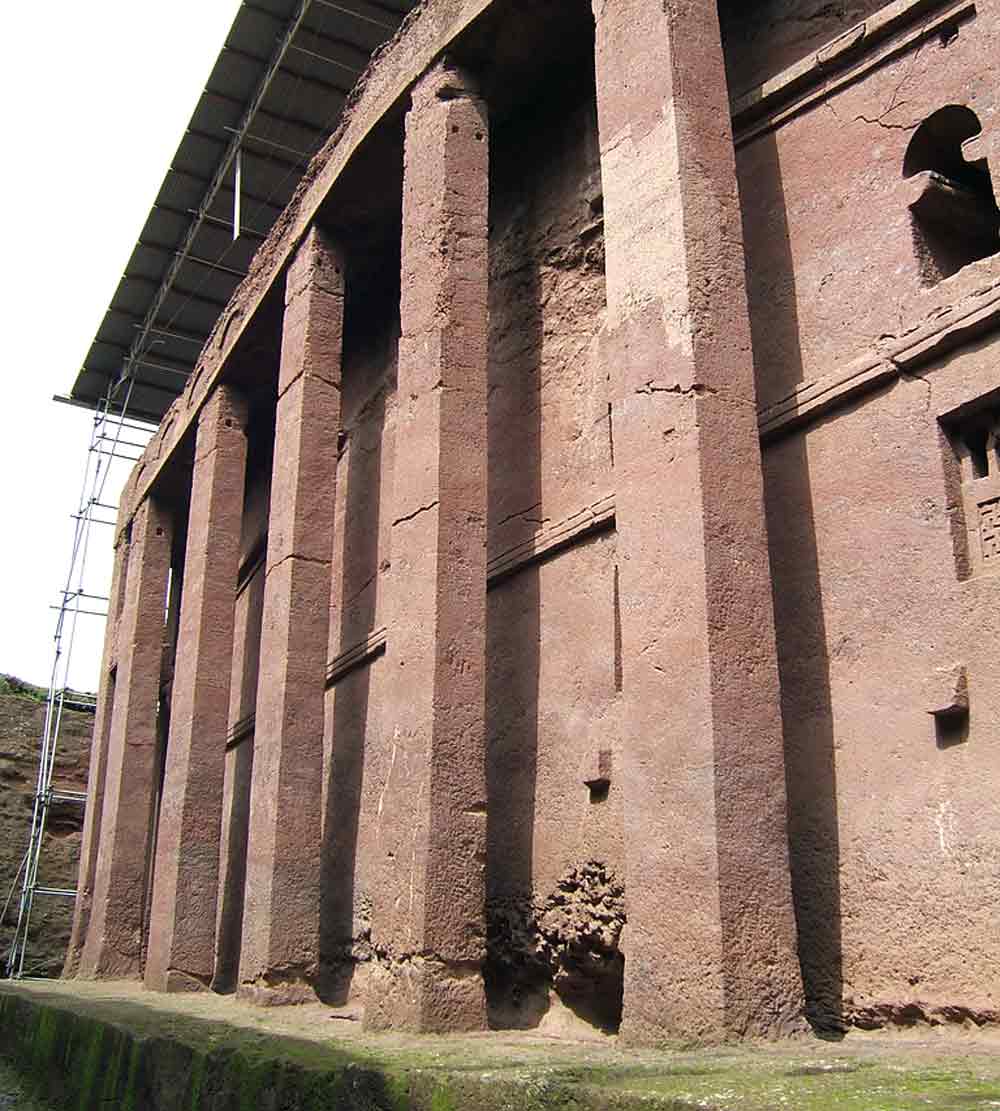
Every one of the 11 houses of worship was the aftereffect of a procedure utilizing the fundamental devices of mallets and etches to unearth channels encompassing the solid and semi-solid structures just as an arrangement of passages which associated two separate gatherings of the holy places with one another out of the coriaceous basalt.

Preservation

A few late protection and reclamation ventures have been actualized at the site, yet have been defective in execution. A task where the American Embassy is subsidizing the reclamation of Bet Gabriel-Rafael and in this manner Bet Golgotha-Mikael has seen issues develop between the different gatherings associated with the venture in regards to a comprehension of its full degree. There has been an absence of sufficient correspondence and sharing of data with respect to extending designs between the Authority for Research and Conservation of Cultural Heritage (ARCCH) and the neighborhood advisory group and church.

With financing from the EU, four safe houses were raised in 2008 to cover 5 of the site’s holy places trying to give a brief method of assurance for the structures until and all the long haul arrangement could be chosen upon. However, the safe houses have stayed set up now for far longer than they were intended to remain standing, and now thusly present genuine perils to the structures underneath as they take steps to fall because of their overwhelming load among different elements.

The ARCCH Director has shown that the safe houses must be evacuated, anyway, there are not yet any conclusive plans set up for their expulsion and what will be done afterward.

Lalibela Churches Ethiopia

During the rule of Gebre Mesqel Lalibela, an individual from the Zagwe tradition who administered Ethiopia in the late twelfth century and mid-thirteenth century, the present town of Lalibela was known as Roha. The holy person ruler was named on the grounds that a swarm of honey bees is said to have encompassed him at his introduction to the world, which his mom took as an indication of his future rule as head of Ethiopia.

The names of a few places in the advanced town and the general design of the stone slice houses of worship themselves are said to copy names and examples saw by Lalibela during the time he spent as a youngin Jerusalem and the Holy Land.

amharic bible

Lalibela, respected as a holy person, is said to have seen Jerusalem, and afterward endeavored to fabricate another Jerusalem as his capital because of the catch of old Jerusalem by Muslims in 1187. Each congregation was cut from a solitary bit of rock to symbolize otherworldliness and modesty. Christian confidence moves numerous highlights with Biblical names – even Lalibela’s stream is known as the River Jordan. Lalibela remained the capital of Ethiopia from the late twelfth into the thirteenth century.

The primary European to see these temples was the Portuguese traveler Pêro da Covilhã (1460–1526). Portuguese cleric Francisco Álvares (1465–1540), went with the Portuguese Ambassador on his visit to Dawit II during the 1520s. He depicts the one of a kind church structures as follows: “I exhausted of expounding more on these structures since I can’t help suspecting that I will not be accepted in the event that I compose more… I depend on God, in Whose power I am, that all I have composed is the truth.

Despite the fact that Ramuso remembered plans of a few of these houses of worship for his 1550 printing of Álvares’ book, who provided the drawings stays a secret. The following revealed European guest to Lalibela was Miguel de Castanhoso, who filled in as a warrior under Cristóvão da Gama and left Ethiopia in 1544. After de Castanhoso, over 300 years went until the following European, Gerhard Rohlfs, visited Lalibela sometime somewhere in the range of 1865 and 1870.

As indicated by the Futuh al-Habaša of Sihab promotion Din Ahmad, Ahmad ibn Ibrahim al-Ghazi consumed one of the houses of worship of Lalibela during his attack of Ethiopia. However, Richard Pankhurst has communicated his doubt about this occasion, calling attention to that in spite of the fact that Sihab advertisement Din Ahmad gives a point by point depiction of a stone slashed church (“It was cut out of the mountain.

Its columns were similarly cut from the mountain. just one church is referenced; Pankhurst includes that “what is uncommon about Lalibela, (as each traveler knows), is that it is the site of eleven or so rock holy places, not only one – and they are all inside pretty much a short distance of each other!”

Pankhurst additionally takes note of that the Royal Chronicles, which notice Ahmad al-Ghazi’s destroying to the region among July and September 1531, are quiet about him assaulting the famous houses of worship of this city. He finishes up by expressing that had Ahmad al-Ghazi consumed a congregation at Lalibela, it was in all probability Biete Medhane Alem; and on the off chance that the Muslim armed force was either mixed up or deceived by local people, at that point the congregation he put a match to was Gannata Maryam, “10 miles [16 km] east of Lalibela which in like manner has a corridor of columns cut from the mountain.

Conclusion, Churches Ethiopia

So, from the information I gathered, I conclude that the Churches Ethiopia is more diverse than they seem and is a topic that needs detailed study. The Churches Ethiopia have their own categories and physical features like the evangelical church has a European architecture module with free form and shape whilst the orthodox and catholic Churches Ethiopia have an old form of architecture and dome type.

Social features include weekend gatherings and holiday festivities like Merkel, Timket, and Fasika. As a whole Ethiopians Churches Ethiopia are the interesting facts of Ethiopia and shaping elements of the socio-cultural aspects.

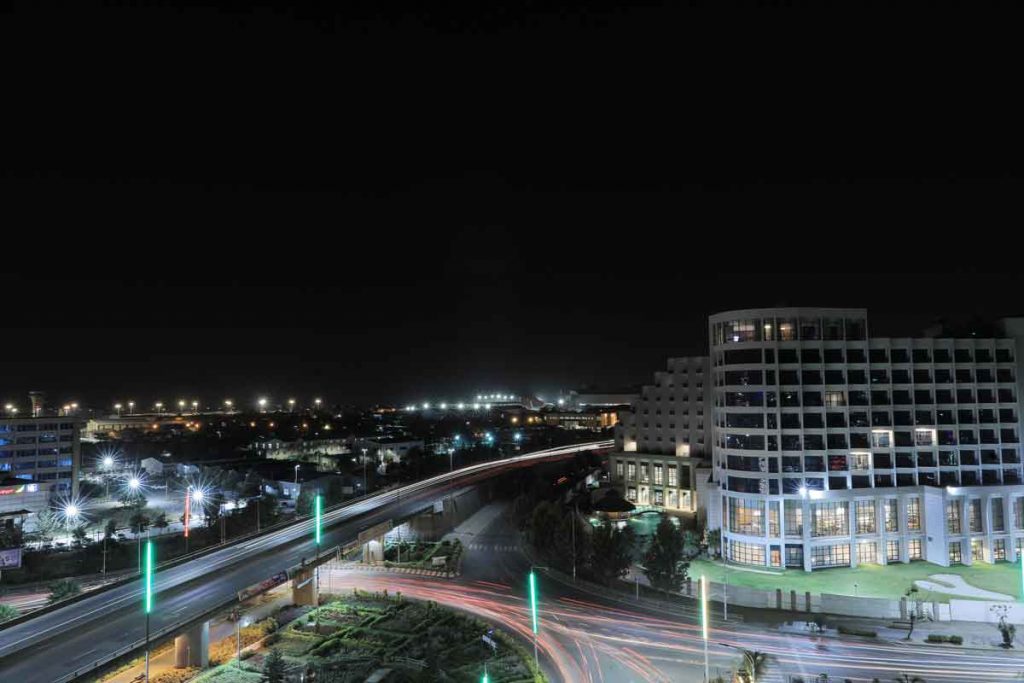
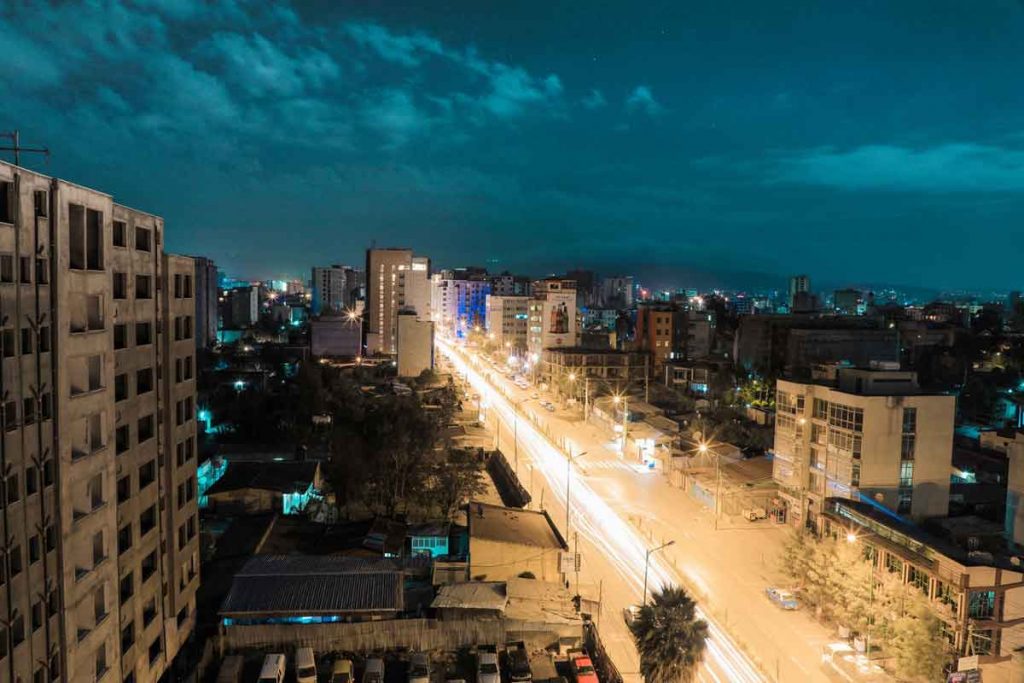
Addis Ababa in Ethiopia

0
Italian Invasion of Ethiopia -

Addis Ababa in Ethiopia, in Amharic meaning ‘New Flower’ is the capital and largest city of Ethiopia. It is well known for also being the diplomatic capital for Africa since both headquarters of the African Union (OAU) and the United Nations Economic Commissions for Africa (ECA) reside in it. With an estimated population of 3,384,569 million people, it’s engrossed with a diverse frontage of both history and commerce.

Addis Ababa in Ethiopia is valley land found between mountains, its precinct begins from the foot of Mount Entoto and grows radially inwards. It consists of 10 sub-cities, where Amharic is the official and common language to communicate.

Where Is Addis Ababa in Ethiopia?

Addis Ababa is located in the horn of Africa, in the eastern part of the continent, enclosed by Eretria in the north, Kenya in the south, Somali and Djibouti in the east and Sudan in the west.

What is the Addis Ababa in Ethiopia Elevation?

Addis Ababa is at an elevation of 2,355 meters (7,726 ft).

Where is Addis Ababa In Ethiopia?

Gps Coordinates of Ethiopia Adis Ababa: 9°01’29.89″ N 38°44’48.80″ E

Addis Ababa in Ethiopia Map

What is Addis Ababa in Ethiopia Population?

(3,384,569) according to the 2007 Census Ethiopia  

What is the Addis Ababa in Ethiopia Historical Development?

Unlike other countries in Africa, Ethiopia is an independent state. It was never colonized by Europeans, Thus, aiding the settlement of Addis Ababa in Ethiopia to have its unique feature. The city structure is based on Mount Entoto, as it became the inwards pivotal stance for the formation.

The establishment of the city has a royal lineage, as it was found around 1886 by Emperor Menelik II but envisioned by his wife Empress Taytu Betul. During this period, Menelik was King of Shewa province that used Mount Entoto as a military base and frequented to it often. His wife, Empress Taytu, grew fond of the area then later built monasteries around it. Not long after, Menelik built a 30-acre castle of his own, existing to this day.

The correct documentation of the how is still questioned but it’s said, that Empress Taytu, whilst standing on the peak of the Mount Entoto, looking at the beautiful green urban setting around envisioned a town which is anew from the scenery she was accustomed to; thus named it ‘Addis Ababa’ meaning ‘New Flower’ in Amharic. 

The settlement after occurred around ‘Filluwha’ a place where hot spring water naturally emerged, hence the meaning. Taytu built a home around it, which lead to the vicinity of settlement increasing. Later Menelik expanded his wife’s home into the Imperial Palace which to this day is the residing place to the reigning government. 

Italian Invasion of Ethiopia -
Italy in Ethiopia Addis Ababa

In 1896, Italians effortlessly fought to colonize Ethiopia in the battle of Adwa but lost embarking on the recognition of an independent state. Embarrassed by their defeat, Italy retaliated after 40 long years had passed. This time around they over through Haile Selassie as the ruler of Ethiopia and reigned from 1936 – 1941. For the conquered period of five years, Italy did not just invade the capital of Ethiopia but also neighboring countries, Somalia and Eritrea to formulate the expansion, Italian East Africa.

During the Italian-Ethiopian regime, vital changes to the urbanization and commerce of Addis Ababa occurred. One of which is the settlement and naming technique they had enforced on the city. They strategically zoned areas for development and embellished their characteristics of both cuisine and architecture.

Most commonly the vicinity of Piazza as the center of the city bluntly portrays the influence Italians exuded upon their 5-year stay. As the buildings and restaurants around there depict their cultural heritage and way of life. Another essential impact they had left was, formulating the open market, Mercato, which is now the biggest in the continent. 

What Should I Do in Addis Ababa in Ethiopia?

Having been the capital of both Africa and Addis Ababa in Ethiopia tourism potentials haven’t fully been explored nor exploited, as it’s a city rich in both culture and history but isn’t properly managed to render a way of exhibiting its capabilities. 

The city has more to offer in the universe of art and artifacts. Places like ‘Kechene Medhaniyalem’ and ‘Shiro Meda’ are based on these ideologies. The creative realm of the natives is expressed through clothing, furniture, and crafts; which also have become one of the major economic sources.

Sights to see in Addis Ababa are mostly limited to festivities, moments, or events. Some examples are; National Museum of Ethiopia (where the archeological findings of Lucy or ‘Dinkinesh’ are found), Unity Park (recently opened, view to the imperial palace and residing home to the current prime minister of Ethiopia, Abiy Ahmed), Meskel square (for festivities and gatherings), Mount Entoto (hiking, monasteries, and view of Menelik II’s palace), Addis Mercato (Africas largest open market), 6-Kilo Addis Ababa University (previous home of Haile Selassie) and the Holy Trinity Cathedral (famous burial site, as it’s the resting place for Haile Selassie, his wife Menen Asfaw, the former prime minister Meles Zenawi and so on).

Ethiopia is a country located south of the equator, belonging to the Southern hemisphere. It lays between tropic of cancer and the equator line, therefore due to its elevation has three different climatic zones, Kolla (tropical zone), Dega (cool zone), and Woina Dega (sub-tropical zone). 

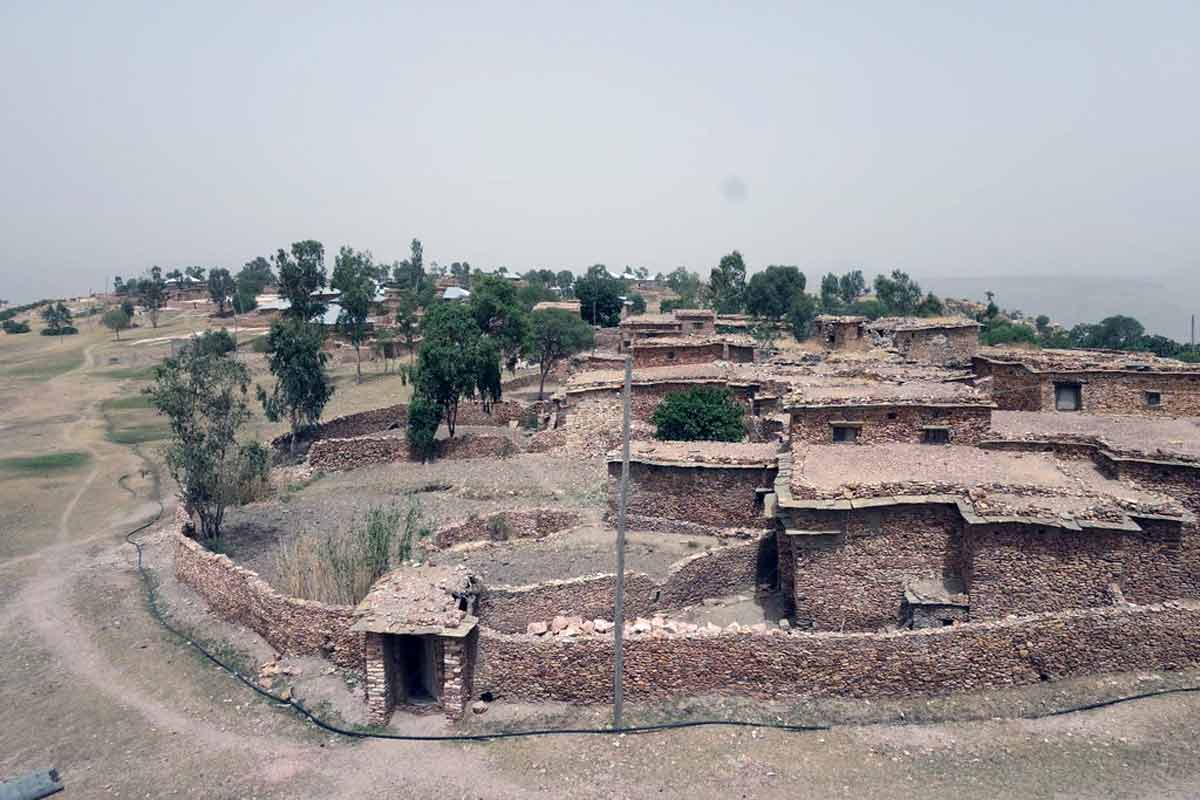
tigray landscape
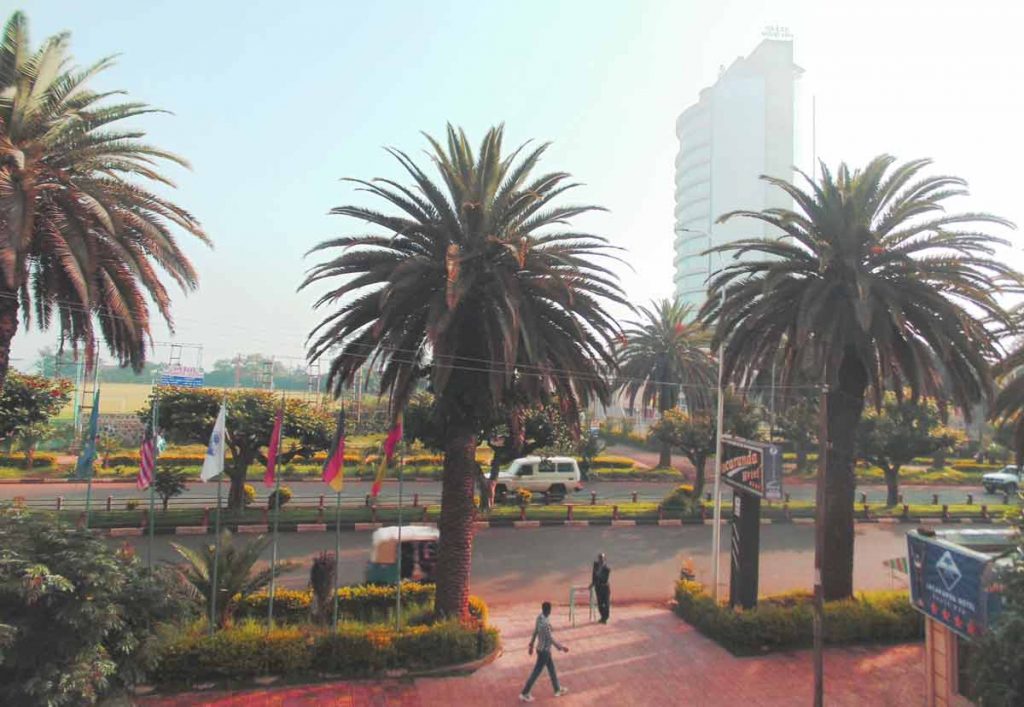
Addis Ababa in Ethiopia

What is the Addis Ababa in Ethiopia Weather Like?

Thus, Addis Ababa in Ethiopia, it’s is a grassland biome that has an elevation of 2,355 meters while it rises to 3,000 meters to the north, Mount Entoto. It has a temperate oceanic climate but due to its elevation difference, it’s a subtropical highland climate with precipitation that varies every month. 

Addis Ababa has a complex mix of highland climatic zones. Because of Ethiopia’s position near the equator and variation of elevation, the temperature in Addis Ababa is constant throughout the year. It consists of 4 different seasons, Keremt/ summer, Bega/ winter, Belg/ autumn, and Tseday/ spring.

Where Keremet/ summer consists of June, July, and August along with heavy rainfall throughout all the 3 months. Belg/ autumn consists of September, October and November having a spring season due to its marking of the end of summer and year, it’s mostly known as the harvest season. Bega/ winter consists of December, January, and February, it is a mostly dry and frosty season. Tseday/ spring consists of March, April, and May, these are very hot seasons of the year with rare rainfall.

Is Addis Ababa in Ethiopia Safe?

Ethiopia Addis Ababa is a safer city compared to other regions in the country and compared to other countries in Africa. Due to being engrossed in the culture and history, lesser violent crimes are likely to happen than that of petty theft and pickpocketing. Burglary, robbing, mugging, stealing, larceny, and break-ins are predominant causes of crime in the city. Nonetheless, the major crime of all not just in the city but the country is corruption, fraud, and bribery. 

What Are National Festivals in Ethiopia Addis Ababa?

Addis Ababa is home to various festivities that is more celebrated and more active around Meskel Square. Meskel Square is an open site around the Stadium of Addis Ababa in Ethiopia. It’s mostly used for public gatherings and commemorations, notably the orthodox holiday of Meskel, hence the name. Thus, due to places like Meskel square, Ghion, Stadiums and so on, the city is more vibrant and alive around holidays or festivities.

Meskel square was renamed ‘Abyot’ or Revolution square around the year 1974, after the fall of the monarchy. The expansion of the site commenced hosting different festivities and holidays during this time as well.

Meskel Square is mostly known for the holiday of the orthodox, Meskel. The word Meskel in Amharic translates to the word cross, as the main purpose of the holiday is to commemorate the moment where the crucifix unfolded to the Roman Empire Empress Helena of Constantinople, mother of Constantine the Great. This festival is overseen as the change in the spring season as well since it’s the blossom period for daisies, notably the ‘Adey Ababa’. The yellow daisy that marks both the New Year and Meskel festival.

Every year this event commences around Meskerem 16 or 17 in the Gorgonian calendar on September 26 or 27. The celebration begins early in the afternoon, people gather around to help with gathering and forming of the burning pyramid, ‘Demera’.

The huge folk of the burning pyramid is located in the center of the square and is circled by priests, students, brass bands, and a crowd of people carrying the giant cross and torches. The festivity commences till the end of the night as the ‘demera’ is kept ablaze, set to alight with people’s torches.

Historically, the celebration of Meskel was a bit different, as the Emperor of Ethiopia was the one that lit up the bonfire, along with the imperial family, high ranking official of both the government and Orthodox Church. Furthermore, during the reigns of Emperor Menelik II and Empress Zewditu, the setting of the ‘demera’ was initially around St George’s Cathedral. It was moved to its current place by Emperor Haile Selassie after specifically building the site for the purpose of Meskel, hence the naming history. Notable as it is Meskel festival was inscribed in the UNESCO Representative List of the Intangible Cultural Heritage of Humanity in 2013.

addis ababa -

Along with many of the notable events that occur in this square, one of which is the coffee ceremony held in it. Two days before the annual Nations, nationalities, and peoples’ day celebration in Addis, on the 6th of December, 2018 a meeting commenced to bettering Ethiopia’s future through harmony and no conflict of nations. Over 10,000 people from 76 nation’s nationalities of Ethiopia gathered to attend.

Representatives of different nations and regions in Ethiopia gathered at Meskel square to discuss the valuable necessity of unity in diversity and peace in the country over coffee. The organizing committee (Addis Ababa in Ethiopia City Administration) wanted to achieve the message by commemorating this event in Meskel square, a square with history and that holds diverse moments or events. 

Another notable event that has occurred on this square is the celebration of ‘Ireechaa’, in other words, a thanksgiving festival of Oromo people. It was celebrated on the 4th and 5th of October, 2019. It was an event that rejoiced the culture of the Oromo’s, as there were traditional foods & clothing, rituals of Oromo beliefs and prayers to give thanks to God. People came from all around Ethiopia to attend this festive event, as it was a beautiful cultural reflection. 

The UNESCO inscribed the Gada System in the Representative List of the Intangible Cultural Heritage of Humanity in October of 2016. The Gada System is a political, social and cultural reflection of Oromo people’s lifestyle, hence including its notable thanksgiving event, Irreechaa.

Mostly religious pilgrimages or public gatherings of a sort happens in Meskel square. It is a place open for everyone as no race, religion, or ethnicity matters. The celebration of the Muslim holiday Eid Al Fitr and Arefa are two main events that commence in the capitals largest and open square, Meskel square. People from all around the world come to take part in this holiday. 

In Islam, how to celebrate this holiday is simple since the ritual required to do both are almost the same. It only takes 4 – 5 hours maximum for the event to commence, almost from early morning 6 – 10 or 11 am. These holidays are forms of worship as Muslims gather to pray, Salah for Eid Al Fitr and Salah for Arefa. 

Furthermore, the country guards and protects the people, as there are extreme ways of security. Police officers and soldiers are assigned in the formation of guarding in different checkpoints all around the site. No access to vehicular engagements is also allowed. Thus, only access to the site on these holidays is on foot. 

Other than hosting and adhering to the festivities of holidays, Meskel square is also known for the celebrations of concerts, public events, sports, and exhibition center. On a normal day, people use the space for sporting activities and other timely events that occur in our daily lives. On weekends it’s a place for concerts or a hub for events that host the Great run and the like. In addition to all of these, it’s also the center of themed exhibition centers, which is most active around for holiday seasons.

ethiopia addis ababa-
Ethiopia Addis Ababa

How Should I Move to Addis Ababa in Ethiopia?

In many other countries, transportation in Addis Ababa in Ethiopia commences through three ways; a road, air, and railways respectively. The major use of public transportation is a road, mostly by buses and distinctive taxis that are blue with white straps in color. The taxis are minibusses that can accommodate 12 people per ride. 

As the population increases one factor being constantly affected, is road transportation. Driving in Addis Ababa is often expressed as an overwhelming experience due to its erratic infrastructure and overly crowded scenes. It’s considered very hectic. 

The most significant road construction in the city was built by the China Road and Bridge Corporation (CRBA). As it greatly enhanced the master plan of Addis Ababa in Ethiopia. The purpose was to link the roads that lead in and out of the city towards the major ring road. The five major gateways were Jimma, Gojjam, Ambo, Dessie, and Debre Zeyit. 

Traveling through the air is the best accommodation in the city’s transportation means. Ethiopian Airlines is the best airline in Africa as it offers a spectrum of fine quality and professionalism. In 2003, the current international airport of Addis Ababa was introduced to the public, whilst the old airport rendered to a helicopter, small and military crafts.

Railway transport and the least accommodating of all started in the city of Addis Ababa in Ethiopia as the first commercial service sector in 1901. It linked the city with the port of Djibouti. Since Ethiopia was a landlocked country, the Ethio – Djibouti railroads provided her associations to the sea. In 1917, the whole linage falls apart as the need for road transportations emerged. Later, in September of 2016, the old railroads got reconstructed and became open to the public, as Ethiopia Addis Ababa – Djibouti railway.

Commenced to the public on September 20, 2015; Addis Ababa is nowadays predominantly using light railroads, that custom from the east side to the west side of the city. From Ayat to Tor Hayloch and from Menelik square to Mercato bus station, Meskel square, and Akaki. In Africa’s sub-Saharan region, Addis Ababa is the first city to use and have light railroads. 

Facilities of Addis Ababa in Ethiopia

Addis Ababa does not have a lot of service sectors, due to its uncanny population increase. It is safe to assume that the number of service sectors available isn’t enough to serve the needs of the community and people. Service sectors include education, hospital or clinics, housing accommodations, water, and electrical supply.

The ministry of education of Ethiopia is located in Addis Ababa, Arada sub-city. It is responsible for overseeing the learning process that happens in both the public and private sectors. In addition, it provides the national and regional examinations of Ethiopia that are given whilst completion of middle school or grade eight (Ministry examination), halfway in high school or grade 10 (Matric examination), and finally University entrance examinations or completion of high school given in grade 12. But as of this year, the completion of middle school examination or Ministry and the Matric examination are being re-evaluated to see if they deem necessary or not and might not commence this year.  

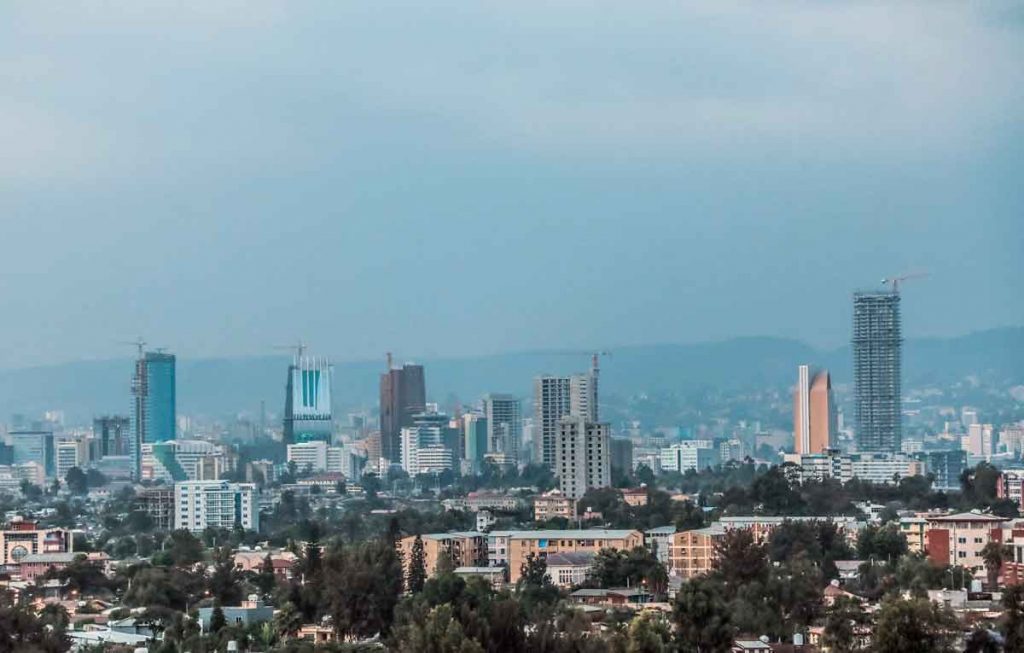
Ethiopia city addis ababa panorama -
Addis Ababa in Ethiopia

There is no differentiation in primary, elementary, middle school, and high school facilities. All are mostly given one school facility in almost all districts of Addis Ababa in Ethiopia. There are two types of education sectors in Addis, governmental owned or public schools and privately owned facilities. The education sector given to these facilities both differs economically and governmentally. Thus, from kindergarten to grade 6 or middle school, education sectors are given to students based upon their teacher’s or schools’ understandings. 

Universities in Addis Ababa are mostly privately owned; Ethiopia Addis Ababa Science and Technology University, Ethiopian Civil Service University, Hil-Co University, Admas University College, St. Mary’s University, Hayat University, Unity University, Kotebe Metropolitan University, Sante University, Micro-link University, Alkan University, Queens University, Rift Valley University and so on. 

Governmental institutes found in Addis Ababa are limited one notable example is Addis Ababa University (AAU). It was the late Emperor Haile Selassie’s residential quarters before he donated it to be the university of the capital. Addis Ababa University is a state and the national university found in the capital with almost 12 branches of campuses in the city and one found around ‘Bishoftu’, a city in Debre Zeyit.

Water and electric supply are not constant and rarely available depending on the sub-district zone. There are 10 sub-cities in Addis Ababa, Bole, Arada, Lideta, Yeka, Nifas Silke Lafto, Addis Ketema, Kolfe Keranio, Gullele, Kirkos, and Akaki – Kality. The most generic and possible things for the provision of these sectors are living conditions of and in the environment and proximity to the city centers.

Thus, highly populated districts or that show economic growth are less likely to encounter a shortage of water and electrical supplies. Whilst districts in a further range from the city, with congested spaces and slum areas, are highly likely to encounter a shortage of water and electrical supplies.

What is the Future of Addis Ababa in Ethiopia?

Addis Ababa in Ethiopia is a city embroidered by nature. It has a lot of agricultural potentials and as the capital, could be the source of growing ‘Teff’, as a vital harvest region. ‘Teff’ is the major ingredient to the output of ‘Injera’, the nation’s unique and distinctive cultural food. 

The government had a five-year plan until 2025 to achieve the goal of green Addis. Although many factors aid against it. One of which is, unplanned urbanization. The urban infrastructure and economy of the city aren’t balanced, as the rate of urbanization is increasing enormously by the day.

There are already an estimated amount of 3,384,569 million people living in Addis Ababa in Ethiopia currently. The higher rates of urbanization are causing high slum areas in the city. The city expanded horizontally which involuntary gravitated agricultural lands to trifle. Due to denser centers, the urban setup of the city is in grave danger, as it becoming non-existence.

Currently, Addis Ababa in Ethiopia is the 84th largest city in the world with a population of its inhabitants. By 2100 it’s expected to be the 20th largest city with over 30 million people living in the city of Addis Ababa. That is 3.5 million within the next six months and ten times what it was in the future. We are currently at an estimated 3 million people with a fast-increasing amount of growth rate.

The infrastructure, settlement areas, and arrangements are not keeping up with the fast population increase in the city. The main cause being immigration from rural to urban areas. At this rate, Ethiopia Addis Ababa is in grave danger to attain its name of becoming a green city or preserving the environment as its economic growth will also decrease.

The more the high-rise buildings, the more space required, the more the settlers or population increase, the city gravitates towards a polluted raggedy city. Nowadays people are taking awareness of the pollution around them and are taking action. Some act in groups, others individually but all are initiated to create a sustainable environment, through perseverance or care. 

A Concise Guide to The Ethiopian History

1
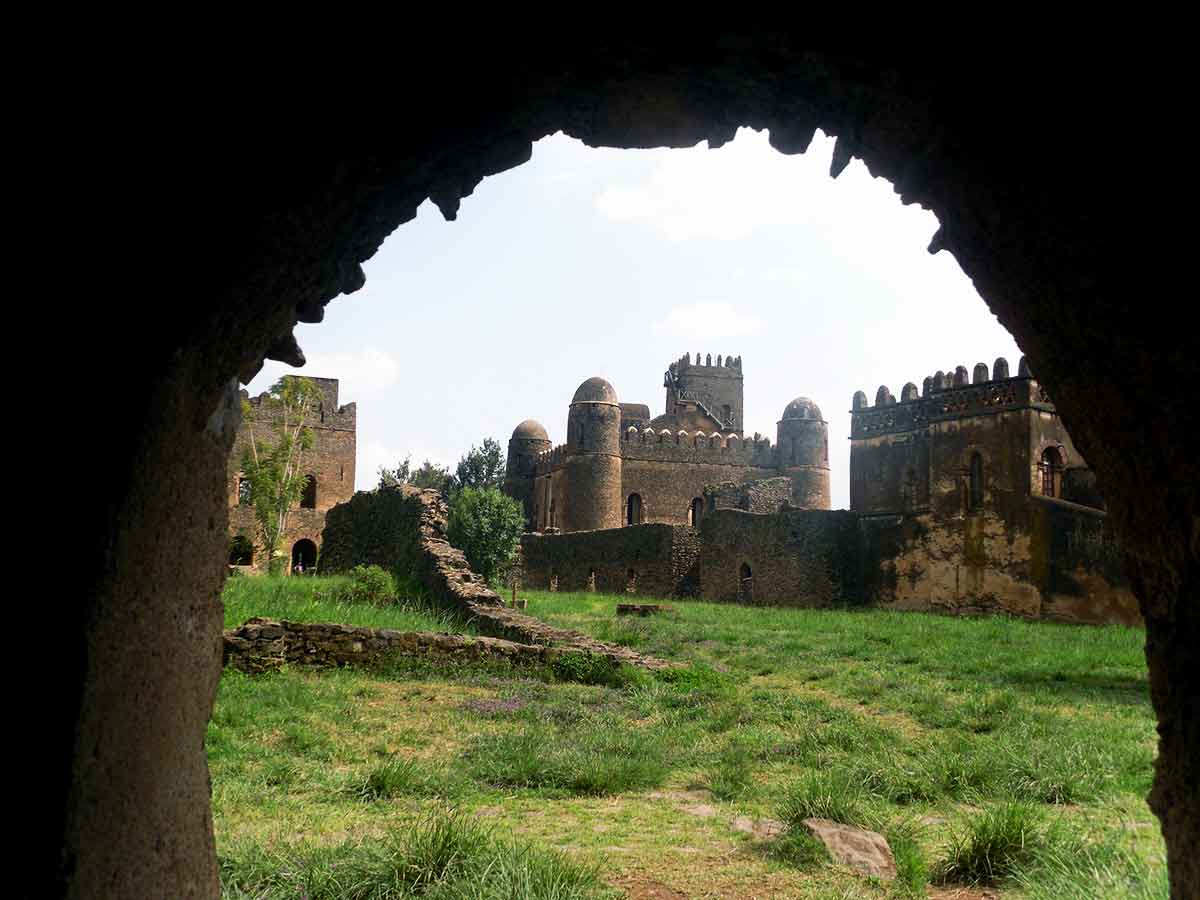
gondar castle

Ethiopian history has immense stories and myths that made it colorful and meaningful. Ethiopia is a more than 3000 years country, and its first history is predicted to be 3500-2000 BC where the ancient Egyptians traded with the people in the land of punt, the place near Eritrea and somalin coast. Soon Geez, a base for Amharic and Arabic was created in the present land of Ethiopia. The history went from the Axumite empire to the present day.

Here is a short Ethiopian history.

The Beginning…3.2 Million Years Before Ethiopian History

Ethiopia is known to be the origin of humans according to the evolution theory that suggests that we humans evolved to be humans from apes and because the fossil called Chororapithecus Abyssinicus with its estimated time of existence to be from 12.7 million years ago being the oldest fossil ever found in human history was found in Ethiopia and because there were findings of other fossils like Lucy that were found in Ethiopia this name seems to be more or less fitting.

1000 BC Ethiopian History

Ethiopian history dates back to the ancient times starting from the Afro-Asiatic speaking people that later created their first civilization known as punt letter becoming Damat which had its capital at Yeha in Tigray at 1000BC and then comes Axum which reigned from 400BC to 10thcentury AD, and at 365BC the emperor was converted to Christianity than at the time of king Kaleb made it empire’s religion.

The vast territory of this empire included Far East Yemen beyond the red sea which can say a lot about how powerful of an empire they were. As any civilization known to man, their trade was active with other civilizations like Egypt, the Roman Empire, and India. Their decline started as the Rashidun Caliphate took over the Red Sea which pushed Aksum into economic isolation. Which then forced them to go farther inland to them for protection.

By moving the capital to a new location, currently unknown but believed to be known as Ku’bar. And started to regain the territory lost in the north by the south. But it is Sayed that they were defeated by a queen named Yodit who also burned churches, even though her existence is questionable or unacceptable to some historians.

gondar castle

1137-1270 Ethiopian History – Zagwe Dynasty

Although they believe their downfall comes from inside, from the people of Agaw starting the Zagwe dynasty which started its era from king Mara Takla Haymanot in 1137 who married the daughter and killed the last king of Aksum who was a Solomonic dynasty made Zagwae dynasty a Solomonic one.

The famous king of this era was King Gebre Mesqel Lalibela, who is believed to be the one to take credit for the 11 rock-hewn monolithic churches in Lalibela. the Zagwe kings are believed to embrace Eritrea and Tigray to the north, southwards to Waag , Lasta and Wollo also westwards to the Lake Tana unlike the coming kings of Ethiopia, from the Agaw laws for the order of succession was that of brother succeeding brother asking, then its decline came with King Yekuno Amlak of the Abyssinian ending the zagwe era by defeating King Za-Ilmaknun of zagwae.

1270 Ethiopian History- Solomonic Dynasty

Yekuno Amlak claiming to descent from Solomon he reinitiated the Solomonic dynasty to Ethiopia. Lasting until 1974, until it was ended by a coup d’état and deposition of the emperor Haile Selassie.

During this time most of Tigray’s rock churches were founded and Christianity spread throughout much of the country, creating gloriously illuminated manuscripts. The empire confronted a series of powerful Muslim sultanates or Sheikhdoms in the South and East with its major centers in the northern Shewa and Wollo regions of Amhara, where a range of peoples had adopted Islam.

1529-42 Ethiopian History- Ahmed Gragn

The Christian empire and the Adal Sultanate existed in a precarious state of equilibrium for most of the 15thcentury, Yet successful military commander Ahmed Ibn Ibrahim Al Ghazi (“left-handed” Ahmed Gran) took power in Harar during the latter decade of the sixteenth century.

Which became the Capital of the Sultanate in 1520AD. Acquiring a religious leader’s position, he called for an effective jihad to break the power of Christians.

After a major victory in 1529 AD, his forces devastated the kingdom for more than a decade, destroying much of the historical, architectural, cultural, and material resources of medieval Ethiopia.

In 1541, the introduction of a Portuguese army to help Emperor Galawdewos prompted Emir Ahmed to ask for the protection of the Ottoman empire after a partial setback, the Portuguese enabled Galawdewos to gain a victory near Lake Tana in February 1543, when Emir Ahmed was slaughtered.

The jihad fell with his passing, as did the influence of Adal. Subsequently, they made every effort to try to persuade Ethiopia to reject its monophysical version of Christianity and to convert it to Roma Catholicism.

1629 Ethiopian history – Catholicism

The consequent disputes, which reached the level of civil war, lasted until the Jesuits as well as all the Roman Catholics were removed in 1632. It has also led to the weakness of the Solomonic empire to the inability to stem the advances of the peoples of Oromo from the south.

Conflicts between both the successes of the jihad and the crash of just the Sultanates and the Sidama kingdoms opened the way for the Oromo pastoral confederations in the Ganale area to extend north to Bali and Fatajar.

Originally, the strikes seemed to have been mostly plundering raids, but when the vulnerability of the opposition became clear.

The Oromo then started to settle in the regions they had invaded, their initial alliance fractured, and, as they settled, the confederations started to disintegrate. 

To the East, In the latter sixteenth century they defeated Adal’s power while Harar’s walls held the city inviolate. Oromo advances continued north, the west, and southwest.

Faced with the growing threat of Oromo, the weakening empire reestablished its base farther north, in Gondar, north of Lake Tana. It has become a new city and the hub of another robust flourishing of Christian art and culture Oromos involvement to the Gondor politics was high in this time(the end of the 17th century), Their rise was symbolized by the marriage of the Emperor Bakaffa to an Oromo, This medieval period was called Zemene Mesafint, then imperial power collapsed, the princes of Amhara, Tigrean and Oromo fought to control Gondar and the emperors.

culture of ethiopia -

1800 and later Ethiopian History

The 6 princesses in 1800 were a good example of the need for control. Tewodros II of Qwara temporarily ended this time of madness, who briefly restored some imperial power with victories over regional nobles, but he was later defeated by the British invasion, because of internal affairs not being good for him he had to take their own lives rather than giving up.

Yohannis IV was crowned emperor 1872 and his success story mostly lies on defending Ethiopia of the foreign attacks like that of Egypt and Italy even though he was winning the war against Mohammed Ahmed of Mahdis dervish army at the battle of Metema in 1889 he was killed by one lucky shot that changed the course of the war to them.

The king of Shewa Menilik II succeeded Yohannis IV, who in turn tried to expand the territory of his empire to every direction from Shewa, This expansion came to be with the arrival of the colonial powers to the region, then comes the big win for black peoples and for us Ethiopians the 1896 AD Battle of adwa but its historical significance isn’t only because of the win over white peoples but rather because Menilik couldn’t go through with it till Eretria.

He also founded Addis Ababa as the capital city of Ethiopia the starting point of modernization. Then he was succeeded by his grandson Lij Yasu whose father was Negus Michael, who converted his religion to Christianity from Muslim by Yohannis IV.

His reign came to an end in three years of time because of his link to Germany and the ottoman empire at the time of FWW which was concerned with the English which made them help with the coup made by the shoan Amhara nobles in 1916. He was later replaced by Empress Zewditu with Ras Tafari as Crown Prince and Regent.

1930 Ethiopian History

In 1930 by taking the name of Haile Selassie after the death of empress zewditu he came to power with a centralized autocracy, but from 1935 to 1941 the 5-year colonization of Ethiopia interrupted his process, this second-time war of the Italians were with much more advanced war machines and war strategies but because the people of Ethiopia never really give up their freedom and country for no foreigner making the 5 years not to last long also the emperor’s diplomatic work English came to the aid and helped us get rid of the Italians once and for all.

Italian Invasion of Ethiopia -

Britain tried to control and occupy Ethiopia in 1941 and for that Haile Selassie tried to look for another ally to the aid a powerful one like America, in 1962 Ethiopia took control over Eretria once again but this ignited the Eritrean struggle for independence led by the Eritrean Liberation Front (ELF).

1955 Ethiopian History

The 1955 constitution is one of the frameworks the modern state he imagined but because he didn’t work on the effort to change the land policy or to rearrange the power hierarchy, rather he was working on international affairs like provided Organization of African Unity (OAU), and the UN

1975 Ethiopian History – Famine

The weakness of this era started to create a crisis throughout the country from the student revolution to the famine of wollo and Tigray with fatality of 200,000 (1972-74) which led to its abolishment in 1975. Which introduced the social politics to Ethiopia with its harsh, unjust and brutal government with the help of USSR until its downfall in a soviet union which led to the Derg regime to stand alone which helped the opposing parties a chance to win the war, some of this parties are Tigrai Peoples Liberation Front (TPLF) and the Oromo Liberation Front (OLF).

1989 Ethiopian History – Change of Government

After a series of defeats at the hands of the TPLF and the Ethiopian People’s Revolutionary Democratic Front (EPRDF), an organization it had set up in 1989, he fled in May 1991 to Zimbabwe where he still resides. In 2006, after a long trial, Mengistu was found guilty of genocide in absentia, and he and a number of other leading members of the Derg were given death sentences. None have been carried out. The surviving members of the Derg were released in 2011, having been held in jail for 20 years.

A week after Mengistu’s flight, the EPRDF took over Addis Ababa and brought an end to 17 years of communist authoritarianism and military dictatorship.

In our existence Ethopian history plays the role of telling the past that created the path for our presence and gives you the tools to predict what the future might come with and it gives you a clear image of your ancestors story and how you’re present become to be like this

But even though this is what history really stands for this tool is not pure but rather intervened by personal, political, social, cultural and religious factors and that makes it harder for anyone to know what really happened but seeing the writer’s point of view from his personal, political, social, cultural and religion gain and loss we try to see the story from every angle to find out the reality of it.

When we come to Ethiopian history this problems will be encountered the most and because there aren’t too many historians that tell the story of the opposing teams to the crown at the time some people take this stories to their personal, political, social, cultural and religion advantage and tell what is good for them.

In order to get a good picture of Ethiopian history its best to consider the facts and their truth of every actor that played a role on every part of the Ethiopian history and that takes a lot of resources which isn’t given to it yet and as time goes by this resources might be even more costly which again will be a challenge to be faced so before things get even messier we need to solve this problem and get a clearer image of Ethiopian history.

cover: “Ethiopian Orthodox Church” by Rod Waddington is licensed under CC BY-SA 2.0 

The Ethiopia Capital

0

What is the Ethiopia capital?

Addis Ababa.

Addis Ababa is not only the capital of Ethiopia but also the largest city in Ethiopia.

How Did Addis Ababa Became Ethiopia Capital?

Before it became the current Ethiopia capital, Addis Ababa went through the different historical background. According to the history, Emperor Menelik founded the Current Ethiopia capital, although he didn’t come directly to Addis Ababa. Founding the current location was rather a process, a journey to a good climatic zone, and enough wood for energy, and higher attitude for security.

In 1886 the Ruler of Shoa –who soon became Sovereign Menelik II of Ethiopia- chose to move with his court from Ankober to Entoto Mountains.

His grandfather Sahle Selassie had prophesized that his grandson would build a big house at the bottom of the Entoto mountain that will grow into a city.

Menelik’s Spouse Taitu was said to be delighted with the current place of Addis, the hot springs at Fil woha, inquired her husband to build their royal residence near Entoto ( north of the current city). However, the constant shortage of wood for fuel and the rigged landscape became an issue.

King Menelik“King Menelik” by MassMu Collections & Archives is licensed under CC BY-NC-ND 2.0

Then in 1900, Menelik chose to move his court to Addis Alem, a place within the forest and the mountains before he moved back to Addis Ababa again.

The emperor ordered Eucalyptus seed from Australia after he saw these grow rapidly, and are good for an energy source.

These days the capital of Ethiopia with its more than 3 million tenants was for most immigrants the primary assembly with the Ethiopian culture.

Today, the Ethiopia capital Addis Ababa is a country in a nutshell. It is a place where you’ll be able to see all the diverse tribes of Ethiopia. It is the capital of Africa hosting the African Union.

Addis Ababa is also a crossroad between the conventional and advanced, riches and destitution, a city full of contrasts.

Is Addis Ababa a Good Place to Live? ( as Ethiopia capital)

Yes. Addis Ababa, Ethiopia capital, is a city of contrasts. Its roads are swarmed with conventional clothed ladies, some of the time with overwhelming loads of fuelwood, well-dressed commerce men with portable phones, crowds with their cattle (indeed on the ring street!), hobos and present-day pants youth, most recent show cars, and Lada or minibus taxi’s, towering glass buildings with workplaces and ghettos, advanced shopping centers and conventional markets.

Ethiopia capital is alluring as well as heartbreaking attractive since of its distinctive multicultural air and action, invitingness of the individuals, security, curiously sights, amusement and excellent green mountains on the foundation.

But heartbreaking since of the contamination and destitution which you see all over around within the informal settlements, and street children.

On the contrary, the services are growing every day. World-class standard hotels and homes are being built especially for the high-income groups. If you are an expat or a visitor from the west, you surely will have a good time living in Addis Ababa. There are options in every service industry and living space. You still can choose based on price and quality.

addis ababa -

What Is the Weather in Ethiopia Capital Addis Ababa?

The capital of Ethiopia is the third most noteworthy capital of the world, arranged on an elevation of 2300 m. on the foot of the with eucalyptus timberland secured Entoto mountains which rise up more than 3000 m.

The city grows increasingly within the heading of the mountains so much woodland has been cut as of now, too for rural use. The temperature at daytime is between 16 and 23 degrees Celsius. Amid daytime, the sun can be rather solid but within the shadow, it can be chilly and within the night temperatures can drop down between and 10 degrees Celsius.

What Should I Do in Ethiopia Capital Addis Ababa?

Within the capital of Ethiopia, there are numerous (coffee)bars, restaurants, and night clubs. You’ll be able to appreciate dinners from all parts of the world such as Italian, Asian, Middle Eastern, and Mediterranean nourishment. Or attempt a genuine conventional Ethiopian dinner with life conventional music and move in one of the numerous social eateries. There are moreover a few cinemas and theatres to see universal or nearby movies and shows.

The National Exhibition hall is the most excellent exhibition hall of East Africa with an expansive collection of archaeological unearthing, historical objects, and Ethiopian art. The Ethnographic Gallery encompasses a superb show of the culture, houses, cloth, objects, and conventions of the numerous Ethiopian ethnical bunches. On the moment floor, you’ll see an amazing show of conventional melodic rebellious and devout craftsmanship from the 13th – 20th centuries.

In the Asni display, you’ll see works of the craftsmanship of advanced Ethiopian artists The Churches of Kiddist Maryam (1911), Kidane Mehret, and Kiddist Selassie (Sacred Trinity, 1alt933) are built on strolling separate and they have lovely divider canvases and Church treasures. They are moreover of chronicled esteem with the sepulcher of head Menelik II and Haile Selassie and their wives. The Giorgis cathedral (1905) is celebrated for its divider works of art from the popular Ethiopian craftsman Afewerk Tekle. It has moreover a museum.

Within the Entoto mountains, you’ll appreciate the all-encompassing see over Ethiopia capital, appreciate nature and visit the Entoto Maryam Church which is the most seasoned Church of Addis Ababa, established by Head Menelik II.

Another to the Church is the Sovereign Menelik and Sovereign Taitu Commemoration Museum. Piazza is one of the most seasoned parts of the city with numerous little shops and Merkato is the biggest open discussion advertisement of Africa where you’ll purchase about everything.

Is the Ethiopia Capital Rich or Poor?

Addis Ababa’s engaging quality to businesses, companies, individuals, and outside coordinate venture has enhanced its significance within the residential economy. Based on the urban work and unemployment overview, the general power file of Ethiopia capital is 24.8.

The city is simultaneously encountering tall rates of financial development and urbanization, recommending a likely advance rising dominance of the Ethiopia capital Addis Ababa in Ethiopia’s economy as well as developing agglomeration of economic exercises in and around the city.

World Bank’s Ethiopia Urbanization Review (2015) appears that 20% of the country’s urban labor force is utilized in Ethiopia capital and the city is domestic to 68% of the country’s urban occupations, especially in a genuine domain, information and communication, and in budgetary services.

The usage of freely financed mega urban projects, such as condominium housing, the Light Rail Transit, the worldwide air terminal and mechanical zone development, have altogether contributed to the city’s in general economic performance.

Most of the worldwide expansive and medium-size enterprises are found in and around Addis Ababa, making huge opportunity for business creation and innovation transfer. Furthermore, the Ethiopia capital is, other than numerous international safe havens, too home to inter-governmental associations just like the African Union, the Joined together Countries Financial Commission for Africa, which collectively make solid request for products and services.

Be that as it may, Addis Ababa’s gigantic urban supremacy and the geographically uneven household advancement suggested is being challenged. A current surge within the development of Ethiopia’s secondary cities, like in so numerous other African countries, is unfurling with higher populace development rates in these cities than in Ethiopia capital.

Rustic populace weights, progressed foundation and modern communication innovations all encourage migration from provincial zones to adjacent urban centers. The allure of such auxiliary cities as Adama, Bahir Dar, Hawassa and Mekelle, particularly to rural-urban vagrants, is critical and expanding.

Owing to its central geographic area, Ethiopia capital is on the crossroad connecting all the corners of Ethiopia. Most merchandise and administrations delivered within the nation end up showcased in Addis Ababa, the Ethiopia capital. The city appreciates predominant get to ICT administrations, streets, utilities and other framework compared to the territorial capitals.

national bank of ethiopia in addis ababa

Consequently, the financial agglomeration impact is significant as compared to other Ethiopian cities. Agglomeration economies happen where transport foundation “clusters” economic exercises and interfaces firms at lower fetched. This typically leads to higher efficiency. Agglomeration benefits are moreover determined from the concentration of populace through common foundations, expanding the accessibility and diversity of labor and advertising measures.

Ethiopia capital has appeared an amazing macroeconomic performance essentially surpassing the national normal or those of person territorial capitals. Based on information from the city administration’s Bureau of Fund and Financial Improvement (2016), the GDP 5(Growth and Development Plan of Ethiopia) of Addis Ababa has developed, on normal, by more than 15% over the final five a long time; much speedier than the national GDP over the same period.

For occasion, the city enrolled a GDP of approximately ETB90.9 billion at current costs in 2015. Typically, about 8% of the national GDP. The State of Ethiopian Cities 2015 report estimates that Ethiopian cities produced around ETB 227.3 billion.

In expansion, other information from the city’s Bureau of Back and Economic Improvement (2016), appears that Addis Ababa’s per capita wage has developed from 788.48 dollars in 2010 to 1,359 dollars in 2015 at current costs- higher than the national average.

Besides a tall rate of financial development, the city has moreover achieved a decay within the destitution list from a tall of 29.6 in 2012 to 22.0 in 2014. As of now, the destitution headcount list for Ethiopia capital is evaluated at 18.9 whereas the destitution hole and poverty severity account for 5 and 1.8 list focuses, separately.

The poverty headcount list measures the extent of a populace living below the destitution line whereas the destitution crevice list measures the degree to which people drop underneath the destitution gaps. Poverty seriousness record measures disparity among the destitute and it is the squared destitution whole list. Although the destitution status of Addis Ababa is an advancement over the past a long time, there’s still much work to be done to check both the rate and severity of poverty.

Analysis of the financial structure of the Ethiopia capital reveals that the administration’s segment rules with industry in the moment place. Together, the administrations (63%) and industry (36%) sectors account for nearly all of the Addis Ababa’s GDP.

Over the final five, a long time the administration’s segment has diligently dominated the urban economy and there’s no sign of a changing trend. Within the administration’s division, transport, communications, trade, the neighborliness industry (lodgings and eateries), and financial intermediation constitute the biggest offers, in slipping order. The booming development movement too essentially contributed to Addis Ababa’s industry division, taken after by manufacturing.

What Are Current Changes in Ethiopia Capital?

Currently, the city organization is giving major emphasis on treating the financial mastery of the administration’s sector in support of fabricating. In the event that the city can invert the current shares with fabricating getting to be the overwhelming economic sector, it is accepted that this would upgrade efficiency and competitiveness, fortify innovation and aptitudes exchange and create economical employments and progressed incomes/livelihoods, exchange contributes 31% of the urban occupations, though the fabricating division accounts for 23%, community administrations 14%, and the development segment 12%.

Of the 23% employments within the fabricating division, most are in small scale businesses. Clearly, expansive and medium-scale manufacturing firms with tall value-addition potential are either insufficiently present or making deficiently work. Furthermore, discount and retail exchange are major losses in the administration’s segment. In spite of its commitment, the administration’s sector is unsustainable

And its commitment to the expertise and technology transfer is exceptionally frail. Most benefit division exercises in Addis Ababa do not require abilities or innovation and are inclined to competition from the exterior world. Retailers and wholesalers in Merkato are helpless to the costs of imported products and administrations and subsequently making work in the segment unsustainable.

The per capita salary (PCI) of Addis Ababa inhabitants not only exceeds the national normal but is additionally developing by 10% annually on normal. This outlines the financial dominance of Addis Ababa and the lob sided advancement of the Ethiopian domestic economy. The normal of USD 1,364 per capita wage for Ethiopia capital residents was twofold the national normal of USD680 in 2015.

If it helps the current speed of financial development, Addis Ababa can achieve its middle-income status objective by 2025 since the pace of development of the PCI is positive and essentially expanding. Clearly, accomplishing middle-class status for fair Addis Ababa isn’t and cannot be the extreme objective for Ethiopia. Far more topographically adjusted household dissemination of income opportunities and the related national riches dissemination is required to guarantee broad-based get to by all Ethiopians to job opportunities, salary, and riches.

skating road in addis

Ethiopia Capital and the labor markets

This area talks about the nature and structure of employment within the city and its patterns, disaggregated by sector, gender, work drive cooperation and activity rate, as well as the measure of the casual division in Ethiopia capital. Specific challenges like youth unemployment and gender-biased employment patterns will moreover be discussed.

Healthy financial development is ordinarily going with by decent broad-based business era for the citizens and increasing the efficiency so that the workforce relentlessly receives better compensation and gets get to more differing employment opportunities. On the other hand, legitimate administration and efficient utilization of the existing labor constrain may be a key parameter in the financial execution of a city.

In numerous cases, the strength and execution of a city are measured by the number of sustainable jobs which, in turn, supports livelihoods and contributes to destitution diminishment within the medium and long term. The level of business inside a city, in any case, maybe a reflection of not just financial execution but moreover of the asset escalated of output, pay dissemination, and riches redistribution.

The “activity status” reflects the degree to which the labor force is locked in profitable exercises. Based on the 2015 urban business study, the action rate is computed as the percentage of the financially dynamic populace over the overall active additionally not dynamic populace matured 10 a long time and over.

The same report appears that 63.7% of the populace matured 10 years and over were financially dynamic at the national level. Looking at gender contrasts, the action level of guys is 71.1% and 57.2 % for females at the national level, inferring an unmistakable nation-wide gender inclination with ladies not benefitting at standard with men.

Is It Safe in Ethiopia Capital Addis Ababa?

Addis Ababa is safe to place to live. Addis Ababa may not have a coordinated surveillance system but the streets are usually safe for a walk, even late at night. In some cases, street robbery and scams are obvious, especially in high-density areas such as Merkato and bus station areas.

Is Addis Ababa Expensive?

Addis Ababa is rather a fair city for two reasons. One, Addis Ababa offers a variety of services with widely different prices. These places could be located in the same block or district. Second, rent in Addis Ababa, for example, is more than 80 percent lower than rent in big cities like New York. The cost of living index in Addis Ababa is around 40 percent lower than these cities.

Then, the price depends on what you need. Most ex-pats want to live near their workplace or next to one another. Therefore, rent in these places could go up to 2000 or more dollars per month in some places. In contrast, you will find condominiums for 200 or 300 dollars per month.

Aksum Empire-cradle to grave, Dazzling story of 1 century

2
Aksum -

Aksum Empire was an indigenous African civilization which was located in northern highlands of current day Ethiopian and Eritrea between the periods of 100 to 940 AD. Advancement in agriculture and control over trade routes in the red sea area led the Aksum Empire to flourish in the era. After the control of the trade route, Aksum Empire became a strong agent on international trade, some of the trade partners were the Roman Empire and India – exporting ivory, gold, and minerals.

Aksum was regarded as a superpower along with China, Rome, and Persia, the power of Aksum was far greater than any African civilization even from Egyptian civilization. Its navy power played a role in protecting its national interest on red seas routes. Aksum

Aksum Empire was also known for its advancement in the cultural aspect. It created its own language Ge’ez which survived in the Ethiopian Orthodox church until today.

Who founded the kingdom of Aksum?

Many researchers believed Aksum Empire was founded by immigrants from the Arab world namely south Arabia and Yemen, but it was later proved that the Aksum empire was, in fact, an indigenous civilization. The existence of Da’mat civilization prior to the Aksum Empire laid the foundation for the beginning of the Aksum Empire. The name Aksum came from a Ge’ze word for water, which refers to a large presence of ancient rock reservoirs in the capital city of Aksum

Where does the Aksum Empire begin?

In the beginning, the Aksumite state was dominated by landowners who derived much of their income from agriculture. Later on, the Aksumite economy became highly dependent on the income from the Red sea trade, which it dared to monopolize. On the Red Sea coast, on the ancient port of Adulis, through which several foreign merchants came to Aksum. This port rendered shipping services for which the merchants have to pay. From this port, a very important trade route also stretched into the interior of Aksum Empire. So, the Aksumite controlled both the internal and external trade and became very much prosperous. Particularly, when Aksum took over the control of the port of Adulis, its prosperity became complete.

How Did Aksum Empire Become Powerful ?

The local and internal trade contributed very much to the development of important towns including Aksum itself. Aksumite kings further promoted the trade by issuing coins of gold, silver, and bronze, which bear their images. It seems that they were using these coins for international trade. This trade brought immense wealth and prosperity to Aksum.

With this income, the Aksumite kings build magnificent stales, palaces, and churches, which are indications of advancements of the building technology of Aksumite civilization. In order to protect these lucrative trade and trade routes from rivals, the Aksumite rulers built a strong military force using the income from the Red sea trade.

Moreover, they began to expand their territories in different directions by the use of this army. In its heydays Aksum’s territorial extents came to include the whole region between the Red Sea coast in the east, the highland region overlooking the Blue Nile (Abbay) river in the west, the northern tip of Eritrea in the north, and northern Shawa in the south. Even some sources indicate that the Aksumite influences extended beyond these areas. A book entitled The Christian Topography, written by Greek traveler called Cosmas Indicopleustes, stated that the Aksumite merchants visited lands to the south of Abbay to buy gold for the ruling class.

There were, however, intense rivalry and clashes between Aksum and the kingdom of Meroe in Sudan. Some historical pieces of evidence indicate that Aksum had controlled territories in parts of South Arabia Probably in a desire for controlling the Red sea trade on both sides. This was between the third and sixth centuries of the Christian era when Aksumite rulers had strong military power.

Aksum established closer diplomatic and commercial relations with the Eastern Roman Empire and other states in the Middle East, Near East, and other counties on the Indian Ocean coast. So, Aksum was already exposed to the Greco-Roman world even during its pre-Christian days.

In the middle of the four-century, during the reign of King Ezana, Christianity was introduced to Aksum. This further reinforced the exposure of Aksum to the outside world. This event was a far-reaching development in the history of Aksum. The introduction of Christianity to Aksum was not a well-planned missionary activity. Rather it was an incident, affected because of the diplomatic and commercial relations between the two countries.

Aksum -

What was the Aksum empire known for?

The Aksum Empire was a powerful trading Empire which its kingdom extended across present-day Ethiopia, Eritrea, Djibouti, Yemen, and Saudi Arabia. Its capital city was Aksum. Two streams lie on the east and west part of the city, perhaps it was these streams that catalyst the beginning of the empire on that specific location. Other notable cities include Yeha, Hawulti, Matara, Aulis, and Qohaito

The Aksumite adopted Christianity through king Ezana and it was the first empire that coined cross on its coins. King Ezana led his Army to Yemen against Jewish powerhouse who was persecuting the Christian community there. Ethiopian Culture is highly influenced by Aksum Orthodox Christian Religion. Aksum is also the alleged resting place of the Ark of Covenant.

Technology and material culture including-

• Pottery

• Metalwork was common mainly in the making of weapons, coins, and tools. Sometimes for construction as well

• Stone was used mainly for construction

• Glass and ivory art were also common

What Was the Economy and Foreign Relations of The Aksum Empire?

Aksum Controls International Trade Aksum’s location and expansion made it a hub for caravan routes to Egypt and Meroë. Access to sea trade on the Mediterranean Sea and the Indian Ocean helped Aksum become an international trading power. Traders from Egypt, Arabia, Persia, India, and the Roman Empire crowded Aksum’s chief seaport, Adulis, near present-day Massawa.

Aksumite merchants traded necessities such as salt and luxuries such as rhinoceros’ horns, tortoise shells, ivory, emeralds, and gold. In return, they chose items such as imported cloth, glass, olive oil, wine, brass, iron, and copper. Around A.D. 550, an Egyptian merchant named Cosmas described how Aksumite agents bargained for gold from the people in southern Ethiopia:

Aksum Empire benefited from a transformation of the maritime trading system that linked the Roman Empire and India. The change took place around the Common Era. Around 100 BC a route from Egypt to India established, making use of the Red sea and Adulis port which at the time was the main port of the Aksum Empire. By the time 100 Ad the volume of traffic being shipped on the route dramatically increased as Roman goods demand increased from India, resulting in a greater number of ships docking at Aksum ports.

Adulis soon became the main port of African goods, Such as incense, gold, exotic animals, and ivory. But this trading opportunity didn’t come without a fight, A rival and much older civilization existed namely Kush existed, it had a wide trading network with other kingdoms. However, Aksum had gained control over the Kush Empire and changed it’s exporting locating to Adulis than Meroe, the capital of the Kushite Empire.

Another major Expansion happened during king Kaleb time, the kingdom keen to occupancy a territory of 300 km by 150 km Dimensions which is not large physically but it was key to control trade routes. Kings also keen to control over the trading vessels that sailed down the straits of Bab-al-Mandeb, on the busiest sea routes in the ancient world

What Was the Religion of The Aksum Empire?

king of Aksum empire, Ezana I, officially adopted Christianity. Prior to that, the people of Aksum Empire had practiced an indigenous polytheistic which was prevalent on both sides of the Red Sea with some local additions such as Mahram, the god of war, upheaval, and monarchy, who was the most important Axumite god. Other notable gods included the moon deity Hawbas, Astar, the representation of the planet Venus and the chthonic gods Beher and Meder. Such gods, as well as ancestors, had sacrifices made in their honor, especially cattle – either living animals or votive representations of them.

There were many trades and diplomatic connections directly between Constantinople and Aksum empire, and it is probable that this passage of individuals to and from also introduced Christianity into Ethiopia. It is important to note, though, that the more ancient indigenous religious beliefs likely carried on for some time, as indicated by the careful wording of rulers’ inscriptions so as not to alienate that part of the population which did not accept Christianity.

tigray people

It was Frumentius, a 4th-century CE shipwrecked traveler from Tyre, who introduced Christianity to the kingdom. Frumentius gained employment as a teacher to the royal children, and then he became treasurer and advisor to the king, probably Ella Amida. When Ella Amida was succeeded by his son Ezana I, whom Frumentius had even greater sway over given that he had been his childhood tutor, the king was persuaded to adopt Christianity.

Frumentius next traveled to Alexandria to receive an official title from the Patriarch there in order to aid his missionary work, then he returned to Axum and became the first bishop of the kingdom. The dates of exactly when all this happened are wildly different depending on one’s ancient source and range from 315 to 360 CE, with the latter end of that range being the more likely according to modern scholars. Frumentius was later made a saint for his efforts in spreading the Gospel in East Africa.

The form of Christianity at Aksum was similar to that adopted in Coptic Egypt; indeed, the Patriarch of Alexandria remained a strong figurehead in the Ethiopian Church even when Islam arrived in the region from the 7th century CE. Churches were built, monasteries founded, and translations made of the Bible, the most important church was at Axum, the Church of Maryam Tsion, which, according to later Ethiopian medieval texts, housed the Ark of the Covenant. The Ark is supposed to be still there, but as nobody is ever allowed to see it, confirmation of its existence is difficult to achieve.

The most important monastery in the Aksum empire was at Debre Damo, founded by the 5th-century CE Byzantine ascetic Saint Aregawi, one of the celebrated Nine Saints who worked to spread Christianity in the region by establishing monasteries. From the 5th century CE, the rural population was converted, although, even in cities, some temples to the old pagan gods would remain open well into the 6th century CE. The success of these endeavors meant that Christianity would continue to be practiced in Ethiopia right into the 21st century CE.

Even if Christianity was the state religion Judaism also exists. A group of people called ‘’Bete Isreal also known as Black Jews have a substantial impact on the kingdom. Between 1985 and 1991 almost the whole ‘’Bete Israel’’ population moved to Israel.

Aksum is also the alleged resting place of the Ark of Covenant. The Ark is housed in the church of Mary of Zion, and heavily guarded by the priests there; The Ark is believed to be brought by queen of Sheba and King Solomon’s son. Controversy surrounds this situation as no one can verify its existence as the only priest is allowed to enter the church.

lalibela cross

What Were the Early Ethiopian Crosses?

All four parts of equal length.

• Similar to the ‘Greek cross’ rather than the ‘Latin cross’.

• These crosses were used on Aksumite Coins

• They are also depicted in drawings/paintings, artifacts, or as architectural motifs in windows and reliefs.

What Was the Aksum Empire Culture?

The Aksum Empire is noble for a number of its achievements, like its own language and alphabet, Furthermore, in the early times of the empire, around 1700 years ago; giant Obelisks to mark emperor’s tombstones were constructed. Under Emperor Ezana, Aksum adopted Christianity in place of its former polytheistic and Judaic religions around 325. This gave rise to the present-day Ethiopian Orthodox Tewahedo church.

Aksum was a cosmopolitan and culturally important state. It was a meeting place for a variety of cultures, the major Aksumite cities had Sabean, Jewish, Nubian, Christian, and even Buddhist minorities.

What Was the Exchange Currency of the Aksum Empire?

The Empire of Aksum was also the first African state to issue its own coin. Issuing coinage in ancient times was an act of great importance in itself, for it proclaimed that the Aksum Empire considered itself equal to its powerful allies like Byzantine Empire. The inscription on Ezana’s stele was written in Ge’ez, the language brought to Aksum by its early Arab inhabitants. Aside from Egypt and Meroë, Aksum was the only ancient African kingdom known to have developed a written language. It was also the first state south of the Sahara to mint its own coins.

Made of bronze, silver, and gold, these coins were imprinted with the words, “May the country be satisfied.” Ezana apparently hoped that this inscription would make him popular with the people. Every time they used a coin, it would remind them that he had their interests at heart. In addition to these cultural achievements, the Aksumites adapted creatively to their rugged, hilly environment. They created a new method of agriculture, terrace farming. This enabled them to greatly increase the productivity of their land. Terraces or step-like ridges constructed on mountain slopes, helped the soil retain water and prevented it’s being washed downhill in heavy rains.

What Was the Aksum Empire Art?

The Aksum Empire had a unique architectural an everyday object that depicts the creativity of the nation. From these, the top is the Aksum stelae, the architecture of the town, and the everyday objects.

The Aksum Empire Stelae

The Stelae are perhaps the most identifiable part of the Aksum Empire, these stone towers served to mark the grave location. The largest of these Stelae measures 33 meters high. The stone was often engraved with a pattern depicting the king’s symbol.

Art in Aksum Empire

Axum potters produced simple red and black terracotta wares but without using a wheel. Wares are usually matt in finish, and some are coated with a red slip. Forms are simple cups, bowls, and spouted jugs. Large-scale statues have been discovered from the kingdom but there are stone bases. One example has indentations for feet carved into it with each foot space measuring 90 cm (35 inches) which would make the standing figure three-times life-size. An inscription on the base indicates that there once stood a large metal figure on it, probably of a divinity. The same inscription mentions other statues of gold and bronze.

The stone thrones found near stelae may also have had seated metal statues on them. Small scale figurines abound and these depict nude females and animals. Unfortunately, the impressive stone chamber tombs of the kingdom were all looted in antiquity and only broken fragments of precious materials and pieces of storage chests and boxes indicate what has been lost to posterity.

axum church
“Ethiopian Orthodox Church” by Rod Waddington is licensed under CC BY-SA 2.0 

Aksum Empire and Architecture

• Monumental Architecture (a high level of artistic ability, advanced engineering, and mathematical skills)

• Expression of the desire to build a multi-story building

• Their ambition to build a high-rise building is clearly stated in their stele, 8 – 10 stories

• Well dressed and decorated steles

• Decorations on the steles were main elements and construction techniques of buildings at that time

Aksumite Architecture

Aksum Kingdom Palaces

• Grand entrance stairs mainly at palace buildings, Courtyards, Strong and well-dressed corner walls, Strong stone buttresses, Multistory

Construction technique: The ‘Monkey-head’

Typical structural method of the Axumite period and in the later Tigray vernacular architecture

  • • The walls are made of small stone –and-clay masonry
  • • The walls had to be strengthened at narrow intervals with long squared timbers.
  • • These were then held by short round cross-pieces the ends of which became visible as rows of protruding and smoothly rounded “Monkey heads”.
  • •Axumite window and door frames were made of timbers cut into each other, with no nails but with shallow recesses and projections.

Axumite Dry Stone Masonry Construction

Large and squarely dressed stones at the corners, Small broken stones for the main bulk of walls, Slabs of slates or similar flat stones to cover the many narrow “shelves” which are formed because the walls are stepped inwards at regular intervals, the walls are much wider at the bottom higher up

Design principle: The ‘equal-equal’

The principle of ‘equal-equal’ generates the square, the cube, and the 450 angles and the octagonal shape. ‘Equi-dimensional’ of the Aksumite principle is different from the ‘Central symmetrical’ of the European/ Byzantine tradition. The proportion in Aksumite architecture was not by “the golden section” or any similar complicated geometrical procedure but by straight forward arithmetical counting of numbers and units. Like 2:3 or 3:4, The Square was the main dominant geometry being used as a basic design module.

Ship Building in Aksum Empire

Shipbuilding technology was also well known in the port town of Adulis. The construction of obelisks and temples and the use of writing in Greek, Sabean, and Ge’ez languages indicated the development of craft and literature. Those ruins have become among the known centers of tourism in Ethiopia today.

yeha axum aksum

How Did the Aksum Empire Fall?

Aksum begins its decline in the 7th century and finally defeated around 950 AD. Local history holds the Jewish queen Judith also known ‘’Yodit Gudit’’ in Ethiopia, responsible for the fall of the Aksum Empire and the burning of its many historic churches. The Aksum Empire was later succeeded by the Zagwe dynasty in the 12 century, and after King Yekuno Amlak, killed the last Zagwe king and the Solomon dynasty followed.

Another less dramatic reason for the fall of the Aksum Empire is climate change and trade isolation.

Aksum empire started to decline in the mid-6th AD. Few reasons are raised for the fall of the Aksum empire, some of which are the Persian influence in the gulf and the spread of a very dangerous disease called bubonic plague and the major one the rise of the Rashidun Caliphate which is a sunny Muslim caliphate the caliphate controlled most of middle east which led them to control most of the trade influence that was formerly held by the Axumite kingdom thus leading to the shrinking of the kingdom of Axum.

After a second golden age in the early 6th century, the empire began to decline in the mid-6th century eventually stopping its production of coins in the early 7th century. Around this same time, the Aksumite population was forced to go farther inland to the highlands for protection the Axumite kingdom keeps on loosing most of its money tributary which in turn leading to the abundance of their city in northern Ethiopia though Ethiopia was no longer an economic power it has started to hold ground in the south, it still attracted Arab merchants and The capital was moved unknown new location. The Aksumite power was ended by a southern queen named Bani al-Hamwiyah,

possibly of the tribe al-Damutah or Damoti (Sidama). Although it is not a clear source a female queen form south of the country indeed has ruled the country for a short period of time then Aksumite Empire was succeeded by the Agaw Zagwe dynasty in the 11th or 12th century most likely around 1137.

Why Should Aksum Be Preserved?

Unlike many other centers of civilization like Yeha, Mattara, and Adulis, Aksum continued to exist as the biggest center of a highly developed civilization for several centuries. Some of the legacies are: –

  • Aksumite temples
  • Iron tools
  • Obelisks
  • Ornaments
  • Bricks construction
  • Pottery
  • Coins and tombs

Why Do I need to Visit Axum City in Ethiopia?

Axum is rich in its real and potential attractions. Some are spectacular in their own right – others can support interesting stories or embody potentially memorable experiences that can, with appropriate development, enrich a visit lasting several days. Axum is a small town with areas of major interest concentrated in a compact zone around the main Stele Park and the Cathedral. Stelae, tombs, thrones, and palaces are the distinctiveness of Axumite Civilization at the height of the Empire. Many visitors are drawn to Axum because of the spectacular Stelae.

Religious traditions in Axum are part of a living culture that has its roots at a time when much of Europe was in a state of barbarism during and after the collapse of the Roman Empire. Traditional religious paintings are used as the major element conveying narrative and atmosphere.

Finally,

Aksum empire established in the ­1rst century to the 7th century AD at the north of Abyssinia the now Ethiopia, Axum served as a major trade route between roman and Indian empire in the past the kingdom of Axum has controlled over the northeast of Africa and south of Arabiya like HImyar, Raydan, saba, salhen, tsiyamo, Beja and kush.

The Axumite kingdom becomes a major trading route after traders learned that they can use the autumn wind to sell through the Arabian sea this created a good trading opportunity for the countries alongside the trade route between the Arabian sea and Indian ocean taking this as an advantage the Aksumite rulers facilitated trade by creating and minting their own currency they majorly trade ivory, tortious shell incense, gold, slaves and rhino horns the kingdom grow to become one of the major trade outlets for Africa when the kingdom become an empire they take the name Nuguse Negest which means king of kings.

By the mid-4th century, the empire reached its peak and started using the name Ethiopia.

Cover: “File:Obelisken in Aksum (6821531495).jpg” by Martijn.Munneke from Netherlands is licensed under CC BY 2.0 

Ethiopia Orthodox Church

1
ethiopian-celebration

Ethiopia Orthodox Church has survived long in the history of Ethiopia. Ethiopia is one of the ancient Christian countries in the world. It is said that Ethiopia is the second country to accept the old testament next to Israel and the first to accept the new testament. The old testament tells the journey of Queen of Sheba (Queen Makda) to Jerusalem to visit King Solomon.

This paved the way for the introduction of the old testament to Ethiopia. Minilik I, the son of King Solomon and Queen of Sheba brought the Ark of the Covenant to Ethiopia. Since then Judaic beliefs and practices like animal sacrifice become the norm of the people following the religion. As a witness, altars are found in some monasteries of the country.

When Does Ethiopia Orthodox Church Gain Popularity?

In the fourth century, Christianity became the official religion in the Aksumite empire. It was at the reign of the two emperors, Ezana and Syzana (also called Abraha and Atsbaha) through St. Fremnatos (also known Abba Selama), who was consecrated by St. Athanasius of Alexandria. King Ezana replaced the sign of the moon on coins with a cross sign and became the first sovereign to engrave the sign of the cross on coins. The Ethiopia Orthodox church was further strengthened by the arrival of the nine saints, who came from Syria, Constantinople, and Rome.

Their names were Abba Gerima, Abba Aregawi, Abba Aftse, Abba Pantelewon, Abba Guba, Abba Alef, Abba Liqanos, Abba Yem’ata, Abba Aregawi, and Abba Sehma They translated several books including the Holy Bible from Greek to Ge’ez, they also founded a lot of monasteries such as the monastery of Debre Damo by Abba Aregawi, Abba Garima monastery by abba Garima, Pentalewon monastery in Axum by Abba Liqanos and Abba pentalewon. The rise of St. Yared in the 6th century, who founded the Ethiopic hymnody was a new era for the Ethiopian Orthodox church.

What is the History of Ethiopia Orthodox church?

From the start, the Ethiopia Orthodox Church was integrated with the St. Mark of Alexandria, for a long period. After Abba Selama (in which selam means peace), also known as Frumentius, who was the first bishop of Ethiopia died, Ethiopian Bishops were appointed to lead the Ethiopia Orthodox Church. This continued until the end of the ninety century. (it should be noted that through the history of the Ethiopia Orthodox Church there was always an Administrator of the Church who was an Ethiopian, and who would not try to replace his Egyptian Peer).

ethiopian-celebration

This was because of many reasons: (1) The fathers of the Ethiopian Orthodox Church do not pursue after their own glory, but that they had rather seen the glory of others. (2) The word, “A Prophet is without honor in his own country” (John 4:44) is a very respected phrase by the Ethiopians. (3) If a native person is declared Bishop, there was a worry that he, might be enticed and become partial in his authority to those who had blood relation to him. (4) Since the dogma of the late fathers discriminated against Ethiopians from holding such positions.

In 1926, after the death of Abuna Mathewos, Emperor Haile Selassie I, then Ras Tafari, began to negotiate for the appointment of an Ethiopian native Bishop to be head of the Ethiopian Orthodox Church. It was agreed by His Holiness Patriarch Cyril V and by the Holy Synod of the Coptic Church, and in May 1929, five Ethiopian Bishops were bishoped for the first time in the history of the Ethiopian Orthodox Church. Unfortunately, all five Bishops were killed by the Italian forces during the five-year war (1935-1940) by Mussolini.

April 6, 1971, as the Church reached the highest peak of the Patriarchal seat when Abuna Theophilus was elected Patriarch, next to Abuna Basilos the first Ethiopian native Patriarch who became bishop in Alexandria and died in 1970.

What Are the Teachings of Ethiopia Orthodox Church?

As in all Oriental Orthodox Churches, the Ethiopia Orthodox Church grounded on the Apostle’s experience of Jesus Christ who is Creator and Saviour of the World.

The three councils the council of Nicaea on 325A.D, the council of Constantinople 381A.D, and Epheus 431A.D which confessed the Son of God and condemned Arius’ formula are all been accepted by the Ethiopia Orthodox Church, but the Ethiopia Orthodox Church refuses the Council of Chalcedon at 451A.D conducted by Pope Leo I which preaches the formula of the “two natures” against that of “one nature”.

The Ethiopia Orthodox Church intensifies that all regarding Jesus Christ should be related to his entire person as one God. Not to single out the “Human nature” as subjected to hunger, passion, suffering, etc., Properties strange to the human are referred to his Divine powers as God shed blood, God was crucified, God died, and God was risen up for the saving of all men.

The seven sacraments Penance, baptism, unction of the sick, confirmation, holy orders, holy communion and matrimony are valuable in the teaching of the Ethiopia Orthodox Church.

Also, the Ethiopian Church preaches the five pillars of Mysteries in which the church is firmly grounded. These are the Mystery of the Trinity, Incarnation, Baptism, Holy Communion, and the Mystery of the Resurrection. These Mysteries are considered by the Church as basic knowledge for all and every Christian must understand these. Fasting is strictly obeyed by all baptized members of the church who are seven and above. During lent; any meat and products animals are forbidden.

Besides, all Christians must keep the Ten Commandments that were given to Moses from God and the six parables of the new testament in Matt. 25:35-36, to inherit eternal life in heaven. In the glorious second coming of Jesus Christ, the dead will be raised and sinners will receive punishment according to their sin. So, everyone is responsible for his/her own committed misdeed.

lalibela cross

What Is the Holy Scripture of Ethiopia Orthodox Church?

The Ethiopia Orthodox Church accepts both the old testament and the new testament. The church comprises 46 books of the old testament including the book of Maccabees, a book of Ezra, books of Enoch and Jubilee and twenty-seven books of the old testament i

Doctrinal Teachings

The Ethiopia Orthodox Church is grounded on five pillars of mystery

1- Mystery of the holy trinity

It is a belief in one God eternally exists three consubstantial persons (the father, the son, and the holy spirit). The doctrine of the trinity is regarded as one of the central Christian assertions about God.

2- Mystery of Incarnation

The mystery of Incarnation explains one of the three consubstantial persons ‘the son’ or Jesus Christ “was made flesh” from the womb of the holy woman, the virgin Mary. It entails Jesus is fully God and full man.

3- Mystery of Baptism

The mystery of Baptism is the main entrance to the Ethiopian Orthodox church and participation of its sacramental grace. Since we receive the invisible grace of adoption through visible performance it used to be called a mystery. “He that believes and baptized shall be saved, but he that believeth not shall be damned.” (John 19:34)

4- Mystery of Holy Communion

On the Maundy Thursday Jesus instituted the mystery of the holy communion at the Last Supper. “For as often as you eat this bread, and drink the cup, you do shoe the lord’s death till he comes” (1 Corinthian 11:26). The Eucharist a sacrament to attain union with God and far off from our sin.

5- Mystery of Resurrection

The mystery of Resurrection is all about the eternal life of humans. We will resurrect after we die as Christ did which will happen at the second coming of Christ. “But Christ has been raised from the dead, the first fruits of those who have fallen asleep. For since death came through a man, the resurrection of the dead comes also through a man. For as in Adam all die, so in Christ, all will be made alive again.” (1st Corinthians 15:20)

What Is the Fasting Culture in The Ethiopia Orthodox Church?

1. Abiy Tsome or Tsome Hudade (55 days of fasting and has three sections

  • Tsome Hirkal; the first week
  • Tsome Arba 40 days in which Jesus’s fasting in the wilderness
  • Tsome himamat; the last week of the fasting, by thinking about Christ’s torture

2. The fasting of the apostles, 10 to 40 days the apostles kept after receiving the holy spirit

3. Tsome dihnet; Wednesday in memorization of the plot to kill Jesus and Friday in commemoration of the crucifixion

4. Fast of dormition; which the apostles fast to see the resurrection of virgin Mary and it is 16 days.

5. Gena tsome 40 days of fasting Starting from Hedar 15(November) and ends on the eve of the with the feast of Gena and the Tahisas 29

6. Tsome nenewe (fast of Nineveh) three days of fasting commemorating the preaching of Jonah. It is the shortest of all fasts

7. The Gehad, the fasting eve of epiphany

5 Years Italian Invasion of Ethiopia – Concise History and Unexpected Twist

0

The Italian invasion of Ethiopia? Victory seemed unlikely. It was in 1935, where the war between Italy and Ethiopia revived again. The victory of Adwa did not hold back Italy, from revising to colonize Ethiopia. Adwa, a place where Italy lost the first war, was a place of shame for the proud Italians. How could a powerful European power lose for some African nation? It was an easy job for the other colonial powers to enslave Africa. 

No matter how long the Italian power waited for a reason to provoke a fight with Ethiopia, the stacks were against them. League of Nations, which was formed to prevent wars and to solve problems between countries through negotiation. The organization has power and influence to stop fascist Italy from provoking Ethiopia.

Ethiopia, therefore, trusted the League of Nations and the international community and hoped for fair justice. Even though, the League of Nation created a relatively peaceful situation for some countries after world war I, it didn’t give much attention to the constant call for action from Ethiopia. League of Nation was not a fair organization. Conflict emerged between Ethiopia and Italian Somaliland.   

Beginning of the Italian invasion of Ethiopia

Italian attack came from two bearings, within the north from Eritrea and within the south from Italian Somaliland. Italian military operation in the north was driven by Marshal Emilio de Bono, who after the starting of the war was replaced by Pietro Bergoglio. Badoglio led the highly ruthless phase of the war on the northern front. His troops progressed quickly into Tigris, went with by air attacks.

About three hundred airplanes were ordered to shower the internationally outlawed poison gas upon the Ethiopians. In the south, the Italian army was under the command of General Rudolf Grazziani. Italians also used about 100 airplanes for air attacks on this front.

On the Ethiopian side, there was a massive reaction to the mobilization order of the state. However, Ethiopia’s counter-offensive came very late. There were two reasons for the delay. First, Ethiopia trusted the League of Nations and the international community to intervene. Second, Ethiopia desired to stretch out Italy’s line of supplies by allowing them to proceed deep into the interior.

Eventually, Ethiopian forces set out to confront the Italians on both northern and southern fronts. Within the north, the Ethiopian armed force was put under the overall command of Ras Kasa, the most reliable strategist appointed by Emperor Haile Selassie who was also the emperor’s closest advisor.

Ethiopian forces brawled the Italians in three different directions.  The forces under the minister of war, Ras Mulugeta, went on the eastern direction at the battle place of Amba Ardom. At the center were the forces of Ras Kasa and Ras Seyoum. Ras Imiru Haile led a force that fought against Italians in Shire in the western direction. 

After a treacherous match, the Ethiopians finally won the battles in the western front. However, they were unable to stop the overall Italian advance, Ethiopians could not withstand Italian aerial bombardment and poison gas. Italian won a victory at the battle of Tembien and Amba Ardom. Ras Mulugeta Yigezu lost his life in the war. The Ethiopian army scored minor victory only at the battle of the shire in the western front.

Beginning of the Italian invasion of Ethiopia

Italian Invasion of Ethiopia and Haile Sellasie

Emperor Haile Selassie took command of the Ethiopian powers which offered the remaining organized resistance. The better-trained army, the imperial Bodyguard was at his disposal led by the emperor, Ethiopians fought the battle of Maichew on 31 March 1936. Nonetheless, they lost this battle as well.  After Maichew, Ethiopian troops retreated in a disorderly manner.

Muddled, the emperor came back to his capital, late in April 1936. The council of ministers, under the chairmanship of the emperor, decided to continue the diplomatic campaign at the League of Nations. On 2 may, 1936 emperor Haile Selassie, his royal family, and some notable officials left Addis Ababa for Europe via Djibouti. On 5 May 1936, Addis Ababa came under the control of the Italian army led by marshal Badoglio.

In the south, the Italian army under General Rodolfo Grazziani attacked Ethiopians using its superior weapons. The Ethiopian forces under the command of Gejazmach Mekonnen Endalkachew resisted the Italians with determination.  In the south, the Ethiopian resistance had successful and United authority However, they could not stop Italian advance. Harare was occupied by Italian, some days after Addis Ababa was under the troops.

Finally, the summation of different factors; the poison gas caused great frustration among Ethiopian troops. Even the neighborhood Europeans colonial powers blocked the import of arms into Ethiopia, accusing Ethiopians of using arms in slave raids on the other hand; the Ethiopian army was still predominantly traditional. The Italo-Ethiopian War of 1935-36 was then concluded by the victory of the fascist forces.

  • Italian Invasion of Ethiopia and Haile Sellasie

Fascist Rule and Patriotic Resistance 1936-41

The Italian invasion of Ethiopia and Italian control over Addis Ababa on 5 may, 1936 marked the beginning of the fascist Italian invasion of Ethiopia in Ethiopia. Ethiopia was then merged with the other Italian colonies, Eritrea and Somaliland. In 1936, Italy declared the establishment of Italian East Africa, by putting the three territories together and began to administrator them as one colonial unit. The Italian victory was selected to be in charge of the administration of the Italian East Africa.

The prime fascist governor was Badoglio, but he was soon replaced by the commander of the southern front, Grazziani in May 1936. The latter ruled up until the unsuccessful attempt of his life in Addis Ababa in February 1937. The last Italian victory was Amadeo Umberto, whose administration is said to be relatively liberal. The Italian east African empire had six administrative divisions. These administrative divisions ruled from the towns of different parts of urbanized areas, which were made capitals of their respective administrative divisions.

The fascist Italian Invasion of Ethiopia was a military rule, racist and violent. Its officials were highly corrupt, most of them inefficient and irresponsible.  Italian effective control, in most cases, was limited to towns due to a nationwide patriotic confrontation.  Italian rule caused great human and material destruction of Ethiopia; hundreds of thousands of Ethiopians lost their lives during the invasion, as well as in subsequent patriotic movements against the Italians.

Italian Invasion of Ethiopia and the Aftermath

These included both soldiers and civilians. Young educated Ethiopians were executed.  Thousands of Ethiopians have deported to prisons the Italian set up in different parts of their empire as well as in Italy. Many Ethiopians were exiled to neighboring countries.  Families were broken up and children orphaned.

Yet, Italian conquer also witnessed the establishment of a few factories, producing items for colonial consumption like food, textile, cement, and construction materials. The want for effective control of colonies engaged them to invest a huge sum of money on road construction. 

Italians expelled other foreign companies engaged in trade and replaced them on their own. The time of the fascist Italian Invasion of Ethiopia saw the expansion of hotels and prostitution.  In major towns, they left modern buildings, garages, and different technical services. The linguistic influence is still to be seen in Italian loan-words in many Ethiopian languages.

Italian Invasion of Ethiopia and urban Goals

Immediately after the capture of Ethiopia and the establishing of the Empire, it was only with the conception of this general territorial plan, which was projected to coordinate and guide all of the urban planning measures in the colonies, which a public discussion began in Italy concerning colonial urban planning. The debate was gradually dominated by Political events, and it turned into an explicit medium for conveying ideology.

Major points in the discussion over an Italian form of colonial urban planning concerning ways of controlling the flow of traffic as well as the residents themselves ordered subordination of the architecture to a systematic planning model and detailed subdivision and specialization of land areas. On the first national urban-planning conference, held in Rome in 1937, plans for Addis Ababa, Gondar, and Dessié were presented in the Sector devoted to colonial urban planning.

Among the foremost imperative comes about of the conference were the choice to set up coordination arrange for urban-planning measures in Italian East Africa and the foundation of a Colonial Office for Urban Arranging. At the beginning of the Italian Invasion of Ethiopia, a colonization program for Ethiopia was built up and was to be actualized inside six a long time. It basically included plans for infrastructural measures: road development, water supply, hydroelectric offices, advancement works, and the establishment of farming villages.

Formative plans for the bigger centers, especially for Addis Ababa, were given exceptional significance within the colonization program. The press gave much consideration to the ambitious urban arranging ventures for the unused abroad region, indeed in spite of the fact that these basically included common plans that were afterward decreased in scale or not implemented at all.

Italian Invasion of Ethiopia and urban Goals

Italian Invasion of Ethiopia And the Patriotic Resistance Movements

The Italians faced nation-wide opposition from the very beginning of their Italian Invasion of Ethiopia. It has already been stated that few notables who had grudges with the emperor became collaborators.  There were also some ordinary individuals that served the Italian for small pay. Aside from this fascist rule had triggered protests and large-scale opposition virtually in all parts of the country all the way through the five years of Italian Invasion of Ethiopia. The peoples of Ethiopia were not willing to surrender the independence of their country and thus paid immense sacrifices to defend it.

There were 2 stages of the patriotic resistance against Italian rule. The first was a continuity of the major war that lasted up to early 1937. It was led by members of the upper mobility in command of their respective troops.  One of them was Ras Imiru Haile Sillase, designated viceroy of the emperor, in exile after 1936. Imiru was in the gore town of Illubabor when members of the black lion organization invited him to become their leader. 

This organization was formed in 1936 and it consisted of graduates of Holeta military academy and some other civilians. The black lion team engaged in fighting the Italians around Naqamte, in Wollega. Ras Imiru accepted the invitation and became the head of the black lion organization. He led the Patriots on the first planned attempt to liberate Addis Ababa in 1936. However, the forces under the Ras were defeated near river Gojeb in Kaffa by an Italian army before they reached Addis Ababa, Ras Imiru was caught and deported to Italy. Some other participants were detained.

Italian Invasion of Ethiopia, Second Libration Attempt

The second attempt to liberate Addis Ababa was carried out in the summer of 1936. A group of notable commanders planned to attack the Italians in the capital, from different directions, at a time. The operation was organized by the two sons of Ras Kasa, Dejazmachs Abrera, and Asfawossen Dejazmach Balcha safe and Dejazmach Fikremariam. However, the plan lacked proper coordination, and Italians easily crushed it. One of the unifying figures of the attack, Abuse Petros was caught and executed in the capital. The Kasa brothers were later on persuaded to surrender, but executed in the end. Dejazmach Balcha continued his active involvement in the resistance in the south, until his death in 1937.

On February 19, 1937, two young Ethiopians named Moges Asgedom and Abraha Deboch made an attempt to assassinate the Italian viceroy, Grazziani, Grazziani was seriously wounded while some other officials were killed. As revenge, Italian soldiers carried out a wholesale massacre of Ethiopians in the city. The incident is referred to as the February or Grazziani Massacre.  Within three days about 30,000 Ethiopians were killed.  Most of them were shot on the street’s others burnt alive in their homes, and others were beheaded. The Italians targeted chiefly educated Ethiopians.  Mass atrocities exposed the true face of fascism and provoked a new wave of nation-wide opposition to Italian rule.

This event marked the beginning of the second phase of resistance that was led by the nobility and local notables. It assumed the character of guerrilla warfare and largely centered in rural areas. It was mainly strong regions of Shoa, Gojjam, Begemidir. Many renowned guerilla leaders fought the enemy at different battles. Haile Mariam, Abebe Aregay, Geresu Duki, and Bekele Woya in Showa were some of the renowned patriotic leaders.

As guerilla fighters, the Patriots made a serious of surprise attacks on enemy forces camps, vehicles and broke enemy lines of communications. Knowledge of the terrain and the ability to rapidly disperse and regroup enabled the Patriots to harass the Italians throughout their struggle. There were also instances of direct foundation with enemy forces

Ethiopian resistance fighters had no organized system of supplies and provisions.  They depended largely on individual contributions and the looting of enemy properties. They also looted those whom they considered collaborators.  At times, Patriots used to assign soldiers to peasant homesteads for shelter and food.  In addition to these, some patriotic groups were engaged in farming to feed the combatants.  In this way, the Ethiopian peasantry and ordinary people contributed by supplying food and sheltering fighters.  At times peasants fought with Patriots against the Italians on several occasions.  They also supplied the Patriots with value Information.

Another significant contribution to patriotic resistance came from yewust Arebegnoch’ inner Patriots ‘. These were Patriots who lived and often worked with the Italians in towns but passed on useful information to the Patriots.  Some members of this group used to give underground service to the Patriots fighting in the bushes.  Their major service was in the collection of arms, medicine, food, and intelligence reports to be secretly sent to fighters.

Italian Invasion of Ethiopia, Second Libration Attempt

The Italian invasion of Ethiopia and Ethiopian Women Resistance

Ethiopian women played significant roles as Yewst arbegnoch women used to spy on the Italian soldiers and the high-ranking officials.  They collected arms from corrupt officials and deserters.  Some were even able to exert influence on Italian officials so that they would be moderate towards prisoners.  Some went to the extent of arranging secret killings of Italian authorities. In addition to underground activities some of the women-led their own troops in the battle of resistance. 

Others served as rallying points to soldiers as a widow. The patriotic struggle persisted often under difficult circumstances. Shortages of arms, food, clothing, and medicine had always been daunting challenges to the Patriots throughout the period of struggle.  There were also personal conflicts among patriotic leaders which even some times led to the extent of armed clashes.  The Patriots also lacked proper coordination.  They had no strong uniting political organization. Their slogan was ‘fighting for the Ethiopian flag and monarchy’.

The Italian invasion of Ethiopia and Ethiopian Women Resistance

Italian Invasion of Ethiopia And Public and International Reaction

Italy’s victory dominated concerns about the economy. Mussolini was at the tip of popularity in May 1936 with the proclamation of the Italian empire. He was able to make something going after a national agreement both in favor of himself and his new set administration. A sign of Mussolini’s extended control and popularity after the war was, he made a cutting-edge military rank.

To start with Marshal of the Italian Domain, which he progressed both himself and Lord Victor Emmanuel III, to hence putting the prime serve on a hypothetical level of balance with the ruler. Haile Selassie cruised from Djibouti within the British cruiser HMS Endeavor. Whereas still in Jerusalem, Haile Selassie sent a telegram to the Alliance of Countries.

The Ethiopian Emperor’s telegram caused several countries to give high attention to Italian conquest. On 30 June, Selassie talked at the League of Nations and was presented by the President of the Gathering as “His Royal Magnificence, the Head of Ethiopia” (“Sa Majesté Imperiale, l’Empereur d’Ethiopie”). Some groups of Italian journalists began yelling insults and were deported before he could speak. The Romanian chairman, Nicolae Titulescu, bounced and yelled: “Show the savages the door!” (“A la porte les sauvages!”). Selassie criticizes Italian hostility and criticized the world community for standing by.

At the end of his speech, which showed up on newsreels throughout the world, he said “It is us nowadays. It’ll be you tomorrow”.

France conciliated Italy since it could not manage to chance a union between Italy and Germany; Britain selected its military weakness meant that it had to take after France’s lead. Selassie’s firmness to the League to reject recognition of the Italian conquest was defeated and he was deprived of a loan to finance a resistance movement.

On 4 July 1936, the Alliance voted to end the endorsements imposed against Italy in November 1935 and by 15 July, the approvals were at a conclusion. The treaty signed in Paris by the Italian Republic (Repubblica Italiana) and the victorious forces of World War II on 10 February 1947, included formal Italian recognition of Ethiopian independence and an agreement to pay $25,000,000 in compensations.

Since the Association of Countries and most of its individuals had never formally recognized Italian sway over Ethiopia, Haile Selassie had been recognized as the reestablished head of Ethiopia following his formal section into Addis Ababa in May 1941.

Ethiopia presented a bill to the Economic Commission for Italy many million birrs, for damages inflicted during the course of the Italian Invasion of Ethiopia. Even though Haile Selassie was seeking of fair justice from league of nation and had spoken in public meetings, but the case that makes the external to give fast reaction was, Italy’s conflict with British, that gave the opportunity for Ethiopia to get help from British.

Despite the fact that mentioned in the above weaknesses, patriotic resistance continued throughout the five years of Italian Invasion of Ethiopia. This played a great role in the gradual weakening of the fascist forces and enhanced the liberation of Ethiopia.  Yet, the final liberation of Ethiopia was achieved by combined efforts of internal and external forces which were partly associated with the Second World War.

Cover: “Detail, ‘Battle of Adwa'” by A.Davey is licensed under CC BY 2.0  (color and size modified)

Ethiopia city: Ancient to Modern, Essential 11 points

0
tigray debre damo

Addis Ababa is the most known Ethiopia city. There are, however, several Ethiopian cities in the country that have their own cultural and economic character. Ethiopia is in east-central Africa, is one of a landlocked country in the Horn of Africa, on the west by Sudan, the east by Somalia and Djibouti, the south by Kenya, and the northeast by Eritrea. Ethiopia becomes landlocked after the separation of Eritrea 1993.

Ethiopia is the largest and most populated country in the Horn of Africa. The country lies completely within the tropical latitudes and is relatively compact, with similar north-south and east-west dimensions. The capital city of Ethiopia is Addis Ababa, which located almost at the center of the country. In the country, there are around more than 80 nations and nationalities.

After the Eritrea referendum, these two countries were enemies of one another. Even there is no communication between the two country peoples but recently these two countries make peace and people can move Eritrea to Ethiopia and Vis versa.

  1. A Rough Guide to Lalibella Ethiopia and Churches
  2. Rough Guide for Bahir Dar City Ethiopia
  3. A Rough Guide to Tigray Ethiopia
  4. Rough Guide for Gondar Ethiopia

It has several high mountains, the highest of which is Ras Dashan at 15,158 ft (4,620 m). The Blue Nile, or Abbai, rises in the northwest and flows in a great semicircle before entering Sudan. Its chief reservoir, Lake Tana, lies in the northwest.

History of Ethiopia city

Ethiopia is one of the oldest cites which said to be the origin of human beings. As evidence the remaining of   Ardipithecus ramidus kadabba (c. 5.8–5.2 million years old) and Australopithecus anamensis (c. 4.2 million years old).

Ethiopian is the oldest and most colorful history of any African kingdom. In prehistory, it absolutely was the home of the earliest hominids on this earth. Its traditional history stretches back to the time of King Solomon. Few know much of the mighty Aksum Empire that grew up within the north of the country after the birth of Christ and which was a significant trading center for a few seven hundred years. Neither have many of us heard of the awe-inspiring rock-hewn churches that were constructed during the Middle Ages in Lalibela high on the Ethiopian plateau.

Since that point, the country has had very varied fortunes all told forms of ways.

With frequent incursions from neighboring lands and particularly from the influences of Islam, social and political development was somewhat piecemeal for an extended time, with notable periods of relative peace and stability like that provided by the rule of the king Fasiledes within the 17th c. in Gondar.

It was the Emperor Tewodros who was to create real progress along with his vision of a united Ethiopia within the 19th century until his unfortunate demise following the arrival of British troops under Robert Napier in 1868.

Ethiopia’s history within the 20th c. is de facto fascinating, with great leaders like Emperor Menilik and Emperor Haile Selassie, with dramatic events like Italian occupation before the second world war, and political turmoil provided by seventeen years of communist government and also the following decade of uneasy movement towards democracy.

tigray debre damo

Prehistory Ethiopia and Ethiopia city

Ethiopia is located in the north end of the great African Rift valley and has been the site of some amazing archaeological finds in recent years.

In 1974, the archaeologist Donald Johansen was working near Hadar in the north-east of Ethiopia and discovered the human skeleton of a female dating back 3.2 million years, member of the group Australopithecus afarensis. This female was named ‘Lucy’ by the digging team as the Beatles hit “Lucy in the sky with diamonds “was playing in the camp at the time. To the Ethiopians, however, she is known as “dinkenesh’ or ‘birkenesh’ meaning ‘wonderful’. The skeleton is now on the view on the National Museum just above Arat kilo in Addis Ababa.

Other more recent findings near Hadar have served to confirm this part of the Rift valley as the major site of the early man’s development.

We know that the Ancient Egyptians traded in the Land of Punt for such commodities like gold, myrrh, and ivory, and this is thought to have been situated in the Horn of Africa of which Ethiopia is part.

Local tradition has the Queen of Sheba as an Ethiopian queen who traveled to King Solomon in Jerusalem. Their child, Menelik was to be the first in the Solomonic line of the Ethiopian emperor. Eventually culminating with Emperor Haile Selassie in the 20th c. Tradition also says that Menelik brought the Ark of the Covenant from Jerusalem to Ethiopia and that it still exists under close guard in the St Mary Zion chapel in Aksum.

Before the birth of the Christ was developed the language of Geez, a kind of Latin and forerunner of today’s lingua franca Amharic. Ge’ez is still spoken by priests today.

Prehistory Ethiopia and Ethiopia city

Axumite Empire Ethiopia and Ethiopia city

The north of Ethiopia was to be of world importance as an influential trading center during the first seven centuries after the birth of Christ.

Centering on the Ethiopia city of Axum, today a crucial Ethiopia city on the Historic Route, and strategically situated near to the bottom of the Red Sea, it absolutely was a significant commercial crossroads between Egypt and also the Mediterranean and also the eastern countries of India and Ceylon. Exotic trade flourished during this richly fertile and agricultural area.

Exports from Axum included ivory, animal skins, rhino horn, and frankincense. Imports came from India, Arabia, and Egypt and included wine, olive oil, iron, and glassware. During the great years of the Axumite Empire, coinage in bronze, silver, and gold was produced, immense stone monuments were erected and Christianity was too introduced to Ethiopia.

-Axumite Empire Ethiopia and Ethiopia city

gondar ethiopia outside

Middle ages Ethiopia and Ethiopia City

By the early 12th c, the importance of the Aksum had declined and the capital of Ethiopia had shifted to near present-day Lalibela, high up on the central plateau. Of this period we know comparatively little, and yet it is from this time that dates one of the most extraordinary archaeological sites in the world, the rock-hewn church of the Lalibela.

Legend has it that the king Lalibela himself traveled to Jerusalem and so wondered at the building he saw there that determined to create an Ethiopian Jerusalem high in the Lasta Mountain.

These amazing churches attest to an epoch in Ethiopian history which must have known immense technical skill and competence and yet of which we have almost no written record. Tradition tells us that the world’s greatest craftsmen toiled during the day to create these monuments while bands of angels took over to continue the work by night.

It was also during this middle age in Europe that the name Prister John came to be associated with Ethiopia at the royal courts. This legendary priest apparently ruled over a land full of riches and luxury where precious gems and all manner of exotic items were plentiful. It is thought that the first Portuguese expeditions to Ethiopia in the 16th c and the even earlier travels of the Knights Templar might well have been inspired by the ideas of the discovering Prister John’s Kingdom.

Middle ages Ethiopia and Ethiopia City

17th century Ethiopia and Ethiopia City

The year leading up to the 17th c were to see all manner of the religious challenges from outside the country, notable from the Muslims under Mohammed Geragn the left-handed in the 1530s and, more peaceable, from the Jesuits in the early 1600s. At the same time, the Oromo’s from Kenya and the south of the country were making a strong incursion into the Ethiopian empire.

Ethiopia was true of the strong emperor and found one in Emperor Fasiledes who took over from his father Susenyos in 1632 and, in 1636, founded his new capital in Gondar near Lake Tana. The Ethiopia city of Gondar was the first permanent capital and was to flourish until the early 19th c.

Emperor Fasiledes was to bring a period of stability to Ethiopia and Gondar was to become a sophisticated and artistic city its Royal Enclosure of magnificent castles started by fasiledes and continued by ensuing monarchs.

-17th century Ethiopia and Ethiopia City

19th century Ethiopia and Ethiopia city

In 1855 emperor Tewodros, an unusual character who had once lived as a bandit had himself crowned. And try to set out to unify the cities in the country. He showed himself to be a very capable and creative monarch and he chose the mountain of Maqdala as his royal base.

He planes a system of roads across the country, encouraged landform, established a national army and promoted Amharic as his country’s Lingus Franca. He was a reforming who took great pride in his country, his people, and himself.

bahir dar city

-19th century Ethiopia and Ethiopia city

20th century Ethiopia and Ethiopia city

The 20thc was to be a period of great positive development as well as great trauma and anguish for Ethiopia city.

In the late 1800s, there were to be threats and incursions from Italians and the dervishes from Sudan with both ended with the victory of Ethiopia.

It was to be Emperor Menelik II who was to take Ethiopia into the modern world of the 20th c. He chose the site for his new capital of Addis Ababa- his ’new flower’- and set to creating a modern country with electricity, telephones, school, hospitals, and railway. 

-20th century Ethiopia and Ethiopia city

Demographic Trends of Ethiopia City

The population growth of Ethiopia is highly increasing. And Ethiopia is among the highest growth rate in Africa. And also the birth, death rate for the country are above those for the word. Life expectancy is about 50 years of age which is less than of other countries. Different scholars give different reasons for the low life expectancy in the country one of the reasons is the low quality of health and welfare systems.

Addis Ababa is first in the population next are Mekelle, Gondar, Adama, and Hawassa consequently according to the last census in 2007.

Ethiopian is one of the countries that host refugees from several neighboring countries. The majority of the refugees are from Somalia, Eritrea, Sudan, and South Sudan. Most of the refugees left the home county because of conflicts and civil war in the country.

Is There a Clash Between Ethiopia City?

There has been a conflict in the different Ethiopia cities because of ethnicity and other different factors like blocking the roads, protests in many cities. These led the county to not be stable and different organization works were disturbed schools were closed. And these also affect the economy of the country. Due to these and other, inflation and unemployment increased in the country.

Ethiopia is building the Abay dam which is the symbol of the unity of the country. Which makes it different from the other project is it is that the only finical support of the project is the county itself. And it is a mega project which was first estimated to cost 8 billion birr but due to different reason like delay in the project and others the project is still and finished and the first estimated cost of the project is not enough to complete the project.

Not only the insufficient cost but also the Egypt and Somalia disagreement with Ethiopian on the volume of the water to be accumulated in the reservoir. And the USA interference in handling the disagreement between the countries and taking the side of Egypt.   

In this year Ethiopia will hold an election on which parties will govern the country and it is announced that the day of the election if push back.

facts about Ethiopia -

Plant and Animal Life in Ethiopia

Like other countries, the plant and animal life in the country is affected by the location of the country and the weather condition of the country. Ethiopia is the home of different plants and animal. Ethiopia has had a rich variety of wildlife that in some cases has been reduced to a few endangered remnants. Lions, leopards, elephants, giraffes, rhinoceroses, and wild buffalo are rarities, especially in northern Ethiopia.

The Rift Valley, the Omo River valley, and the Western Lowlands contain remnants of big-game varieties. Smaller game varieties such as foxes, jackals, wild dogs, and hyenas are found abundantly throughout the country. Uniquely Ethiopian and among the most endangered species are the walia ibex of the Simien Mountains, the mountain nyala (a kind of antelope), the Simien jackal, and the gelada monkey.

They are found in the Western and Eastern highlands in numbers ranging from a few hundred for the walia ibex to a few thousand for the others. More-abundant varieties found in the lowlands include such antelopes as the oryx, the greater kudu, and the waterbuck, various types of monkeys including the black-and-white colobus (known as guereza in Ethiopia and hunted for its beautiful long-haired pelt), and varieties of wild pig.

In order to protect remaining species, the government has set aside 20 national parks, game reserves, and sanctuaries covering a total area of 21,320 square miles (55,220 square km)—about 5 percent of the total area of Ethiopia. 

Ethnic Groups and Languages and Ethiopia City

Ethiopia city is ethnically diverse, with the most important differences on the basis of linguistic categorization and cultural differences. Ethiopia has around 100 languages that can be classified into four groups. The vast majority of languages belong to the Semitic, Cushitic, or Omotic groups, all part of the Afro-Asiatic language family. A small number of languages belong to a fourth group, Nilotic, which is part of the Nilo-Saharan language family.

Under the constitution, all Ethiopian languages enjoy official state recognition. However, Amharic is the “working language” of the federal government; together with Oromo, it is one of the two most widely spoken languages in the country. In the 1990s ethnolinguistic differences were used as the basis for restructuring Ethiopia’s administrative divisions.  These are some of the many reasons that there is conflict in the country.

Finance of Ethiopian Cities

The National Bank of Ethiopia is the country’s central bank. It issues the national currency, the birr, and is also responsible for regulatory functions. There are many commercial banks all in Ethiopia but of which are located in Addis Ababa. The Commercial Bank of Ethiopia is the largest commercial bank, with branches throughout the country.  Most of the employee payment, condominium payments are done through the Commercial Bank of Ethiopia.

Addis Ababa Ethiopia City, The Capital of Ethiopia

Addis Ababa also known as Finfinnee, is the capital and largest Ethiopia city. According to the 2007 census, this Ethiopia city has a population of 2,739,551 inhabitants. Addis Ababa lies at an elevation of 2,355 meters and is a grassland biome, located at 9°1′48″N 38°44′24″E. The Ethiopia city lies at the foot of Mount Entoto and forms part of the watershed for the Awash. From its lowest point, around Bole International Airport, at 2,326 meters above sea level in the southern periphery, Addis Ababa rises to over 3,000 meters in the Entoto Mountains to the north.

As a chartered city, Addis Ababa also serves as the capital city of Oromia. It is where the African Union is headquartered and where its predecessor the Organization of African Unity (OAU) was based. It also hosts the headquarters of the United Nations Economic Commission for Africa (ECA), as well as various other continental and international organizations. Addis Ababa is therefore often referred to as “the political capital of Africa” for its historical, diplomatic, and political significance for the continent. The Ethiopia city lies a few miles west of the East African Rift which splits Ethiopia into two, through the Nubian Plate and the Somali Plate.

Ethiopia city is populated by people from different regions of Ethiopia. It is home to Addis Ababa University.

Ethiopian Airlines – Growing through the odds

1
ethiopian crash -

Ethiopian Airlines is the largest African airline group and Ethiopia’s flag carrier airline. EAL (Ethiopian Air Lines: Former name of Ethiopian airlines) was founded in 1945 and commenced operation in 1946 and started international flights in 1951. In 1965 the airlines’ name changed from Ethiopian Air Lines to Ethiopian Airline and became a share company. The airline has been a member of the International Air Transport Association since 1959, a member of the African Airlines Association (AFRAA) since 1968, and a Stars Alliance member since 2011.

The headquarters and main hub of the airline are located at Addis Ababa Bole International Airport from where he serves 105 international destinations, 20 domestic destinations, and 44 cargo destinations. The airline has also a secondary hub in Togo and Malawi in Lomé–Tokoin International Airport. As of December 2017, the airlines have about 14,000 employees.

The airlines have managed to become one of the top airline groups in Africa. It has been lauded by many international institutions, economists, and aviation professionals for its rapid growth that doesn’t seem to slow down. The airlines managed to grow through several famines, economic crises, and political crises, upheavals, and revolutions. Despite all this, the airline is one of the most successful business ventures to come out of the country.

History of Ethiopia Airlines

After the liberation of Ethiopia and with the help of the US and UK Emperor Haile Selassie I established the then called Ethiopian Air Lines (EAL) in 1945 as part of his modernization effort. The creation of the airline Carrier was also part of an effort to remove the idea of Ethiopian poverty from the international mindset.

After negotiation between the Imperial Government and the Trans World Airlines (TWA) on September 8, 1945, an agreement was signed between the TWA and the then US foreign affairs advisor to Ethiopia, John H. Spencer, on establishing a commercial aviation company in Ethiopia. Hence; with an investment of 2.5 million ETB, Ethiopian Air Lines (EAL) was founded on December 21, 1945.

The company was financed and owned by the Ethiopian government which held all the 25,000 divided shares of the initial 2.5 million ETB investment. However, management was undertaken by TWA and during its formative years, the airline was operated by an American general manager, H. H. Holloway, and staffed by American pilots, technicians, accountants, and administrators. With the Ethiopian Minister of Works and Communications Fitawrari Tafasse Habte Mikael as EAL’s first president and chairman of the board, the company held its first meeting on 26 December 1945.

Early years of Ethiopian Airlines

Shortly after the first board meeting the airline bought five Douglas C- 47 planes and acquired landing rights with Aden (now Yemen), Saudi Arabia, Sudan, Egypt, and French Somaliland (now Somalia). The first revenue flight of the carrier was on April 8, 1946, from Addis Ababa – Asmara – Cairo, and this route would later operate weekly. Soon the carrier set up destinations in Aden, Djibouti, and Khartoum as well as domestically to Jimma.

In June 1946 Henry Bruce Obermiller replaced Holloway as the general manager and four more Skytrains joined the airline’s fleet. Nairobi was also added as a destination in 1947. Another significant addition to the service the airline provided was operating a charter flight to Jeddah during Hajj beginning in 1947. By the start of the ’50s, the aircraft carrier had more than 13 Skytrains, several destinations including Port Sudan, Lydda, Oman, and Bombay. By 1949 the carrier recorded a profit of £40,000.

During the 50s the airline started operating on long-haul routes such as a destination in Athens via Khartoum that was launched on April 3, 1954. During this age the airline managed to add Three Convair CV-240 planes named “Eagle of Ethiopia”, “Haile Selassie I” and “The Spiritual Power” into its fleet. The Planes were acquired through a 1,000,000$ loan from the Ex-Im Bank. By the end of the era, the carrier had a fleet of 18 planes and an order for two Boeing 720Bs to be delivered in 1961.

ethiopian crash -

The Fast Growing age of Ethiopian Airlines

On March 1, 1960, Port Sudan was removed from as a destination. On July 15 the first fatal accident happened when a plane en route from Bulchi to Jimma crashed and killing the pilot. An order for two Boeing 720B aircraft was placed based on the then EAL’s general manager’s suggestion of buying two jet planes for long -haul operations. Ethiopian Air Lines was the first African airline to make an East-West Africa by launching an Addis Ababa – Accra – Lagos – Monrovia route on November 8, 1960.

On September 5, 1961, the second fatal accident for the airline happened when a DC-3 plane crashed after it took off from Sendafar taking the lives of four passengers and a flight attendant. This would not be the only cause of accidents involving DC-3 planes. On January 13, 1962, another DC-3 plane crash took the lives of the crew and four passengers prompting the Civil Aviation Department to investigate the accidents. The lack of infrastructure at many airfields was identified as a major contributor to the accidents leading the airfields in Mizan Teferi and Tippi to close down.

By December 1962, the two Boeing 720 jets named “Blue Nile” and “White Nile” marked the airline’s entry into the jet age. The addition of the two crafts opened up a network to Madrid, Frankfurt, and Rome. The addition of the Boeing crafts prompted the construction of a new airport to replace the Lideta Airfield in order to accommodate the Boeing Jets. This airport was to become The Bole Airport where the Company sets its headquarter.

The firm changed from a corporation to a share company in 1965 and changed its name from Ethiopian Air Lines to Ethiopian Airlines. In 1966 the airline started to transfer management from the TWA to itself with the appointment of an Ethiopian deputy general manager. In 1970, the role of the TWA changed its role from manager to an advisor. Finally, in 1971, on its 25th anniversary, the company broke professional assistance ties with the TWA and appointed Colonel Semret Medhane as the first Ethiopian Manager. Ever since then the company has been managed and staffed by Ethiopian Personnel.

The 1980s and onward of Ethiopian Airlines

After expanding the airline’s workforce resulting in the decline of quality and revenues, Derg allowed the company to run independently of the government and on a “strictly commercial basis”. In 1980 Captain Mohammed Ahmed became the CEO of the company and managed to slash the workforce by 10%. The airline made business ties with the west despite the links between the country’s communist government and the USSR.

During the 1980s and ‘90s, Ethiopian Airlines focused on expanding its fleet and destinations. The company especially had strong business ties with Boeing co, with many of the fleets’ planes bought from Boeing. In 1984 a Boeing 767 twin jet made a new distance record of flying 12,100 km nonstop from Washington D.C. to Addis Ababa. Despite famine and general economic downturn, the airline managed to maintain its reputation and growth during this time.

In the late 1990s the carrier grew its fleet number and the number of destinations it served with international destinations such as Copenhagen and Maputo being incorporated. New York City and Washington also became one of the key transatlantic destinations. The frequent flyer program is known as “Sheba Miles” was also launched during this time. In 1998 the airline discontinued their flights to Asmara following the war between the two countries.

The 2000s saw a fleet renewal with the airline becoming the launch customer of the Boeing 787 Dreamliner planes. September 2010 saw Ethiopian Airlines officially invited to join Star Alliance under Lufthansa Air. The airlines became the third African airline following EgyptAir and South African Airways to join the Star Alliance and became a member in December 2011.

As of 2020, the CEO of Ethiopian Airlines is Tewolde Gebremariam after replacing Girma Wake in 2011. Under his leadership, the company has seen an unparalleled growth in revenue, profit, and size becoming the largest carrier in Africa and exceeding the company’s own 2025 vision. Currently, the company’s headquarters is located at Bole international airport but is intending to build a new 300million ETB complex on a 50,000m2 plot at Bole International Airport. The design of the headquarters was awarded to BET architects in September 2011 after a competition.

ethiopian airlines closer

From Brith to Now Ethiopian Airlines

Since its birth 74 years ago Ethiopian Airlines has been on an upward growth trajectory. As of 2016, the company has crossed the 100 marks in two major ways. Fleet number and destinations in total. The airline has 125 planes and 127, 105 international, and 20 local destinations now.

As of 2018, the company made a revenue of $3.1billion and a profit of $245million. It is the world’s 4th largest airline by the number of countries it serves and the largest African airline. In 2010 it became the 3rd African airline and 28th International member of the Star Alliance group. The average age of an Ethiopian Airlines aircraft is 5.4 years, compared to United Airlines (15 years), American Airlines (10.7 years) and British Airways (15 years).

Africa’s Biggest Airline: Ethiopian Airlines

In 2018 the airline was voted the Best Airline in Africa. The state-owned carrier has overtaken its regional competitors Kenya Airways and South African Airways to become the biggest airline in Africa. It is the biggest airline in terms of revenue, profit, fleet number, passengers served and destinations included. It is widely regarded as one of the most profitable airlines business in Ethiopia as well as in Africa.

Beyond its own operations, the airline has stakes in several African airliners. With a 49% and 45% stake in Zambia Airways and Malawi Airlines respectively, regional bases planned to be established in Djibouti and Chad, Hubs in Malawi and Togo and a plan to help re-launch a new airline in Mozambique the airline has been lauded as having “a very smart model” by Max Kingsley-Jones, of aviation publisher Flight Global. It recently overtook Dubai as the biggest international transit hub for long-haul travel to Africa.

The undergoing expansion of the main Bole International airport is expected to further enhance the company’s presence and influence in the aviation industry of Africa. Once the expansion is complete the airport will be able to accommodate up to 22 million passengers a year outpacing South Africa’s OR Tambo International airport in Johannesburg. However, Ethiopia’s Prime Minister Abiy Ahmed has a bigger ambition than 22 million passengers a year and want to expand to be able to accommodate at least 100 million passengers a year.

A new expansion of the Ethiopian Airlines

In order to achieve the 100 million passengers a year mark, Ethiopian Airlines is planning on constructing a new $5 billion airport later this year. The airport will cover an area of 35 square km and will be built 39 km south-east of Addis Ababa in Bishoftu town. The airport is projected to have the capacity to handle 100 million passengers a year, a passenger number topping those at Dubai international airport.

Vision 2025 of the Ethiopian Airlines

In 2010 the airline launched a 15-year plan called “Vision 2025”. The 2025 plan objective is to make Ethiopian Airlines the leading airline group in Africa in seven strategic areas: aviation academy, Maintenance, and Repair Operations (MRO), international service, regional service, cargo, in-flight catering service, and ground service.

The airlines have been spending up to 120 million$ on expanding its MRO services. It has built three new maintenance hangars, spent around a 100 million$ for pilot and flight attendee training, and expanded its catering service by spending 2.5milion$ to increase food production from 23,000 in-flight meals to 80,000 daily. It also trains students from other African countries.

The airlines have managed to achieve its Vision 2025 seven years ahead of schedule. In 2018 the airlines became the largest airline group in terms of revenue, profit, fleet number, passengers served and destinations included. The airlines are now working toward its new Vision 2035. The vision aims to increase its total revenue to 25 billion$, the number of its fleet to exceed 200, and 100 million passengers per year capacity airport.

Ethiopian crash airlines

Accidents and Criticisms

Flight 302 was the deadliest accident involving Ethiopian Airlines to date. The flight was an international flight scheduled from Addis Ababa to Nairobi. The aircraft took off from Addis Ababa at 08:38 Local time and had 149 passengers, 35 different nationalities, and 3 crew on board. Many of the passengers were traveling to Nairobi to attend A UN Environment Assembly. The plane was captained by Yared Getachew, 29, who had an almost 9-year experience of flying and logged a total of 8,122 flight hours. The first officer, a recent graduate from airline’s academy Ahmed Nur Mohammed Nur, 25, had 361 flight hours logged with 207 hours being on the Boeing 737 Max.

The accident happened after a “flight control” problem was reported to the control tower. A malfunction in the plane’s MCAS system led the plane’s nose to continually dive toward the ground. The pilots struggled to control it and managed to prevent the nose from diving downwards, but the plane continued to lose altitude. After the pilots shut off the electrical trim system which disabled the MCAS system, they attempted to stabilize the plane by cranking the wheel manually.

However; this proved difficult as the stabilizer was located opposite to the elevator and strong aerodynamics forces were acting upon it. The engines were inadvertently left on full take-off power causing the plane to accelerate at high speed and adding further pressure on the stabilizer.

With the pilots’ attempts at manually cranking the stabilizer back into position failing and the plane accelerating beyond its safety limits, the first officer requested traffic control to return to the airport. After struggling to keep the plane’s nose from diving down further manually the pilots’ turned on the electrical trim to put the stabilizer back into neutral trim. However, the electrical trim also activates the MCAS system back on which pushed the nose further down.

At 8:44 local time, six minutes after takeoff, Flight 302 crashed in a farm field in Gimbichu district, Oromia region near Bishoftu town 62 km away from Bole Airport. Shortly after the crash, police and firefighter crew arrived at the nearest Ethiopian Air Force base to extinguish the fires. Ethiopian Red Cross personnel and air crash investigators together with local villagers, sifted through the wreckage to recover artifacts, personnel effects, and human remains.

Several international teams aided in the emergency response and subsequent investigation of the crash. Personnel from Interpol gathered human tissue for DNA testing. The black boxes were given to Ethiopian Airlines and sent to Paris for inspection by the French aviation accident investigation agency, BEA.

Following the accident and the Lion Air Flight 610 crash, most airlines around the world chose to ground the Boeing 737 MAX for safety concerns. Ethiopian Airlines also grounded their remaining four MAX 8 aircraft after the crash.

An investigation by the Ethiopian Civil Aviation Authority (ECAA) seems to suggest that MCAS was “to the best of our knowledge” active when the aircraft crashed. According to the then transport minister Dagmawit Moges, the crew “performed all the procedures repeatedly provided by the manufacturer but was not able to control the aircraft”.

However, Boeing’s CEO Dennis Muilenburg argues that if “you go through the checklist…it calls out actions that would be taken around power management and pitch management of the airplane … And, in some cases, those procedures were not completely followed”. There is also a speculation based on A data spike in the flight data, that a debris hitting the plane as it was taking off, cutting off away the airflow sensor.

Although the safety record of the airline is outstanding as compared to other African airliners, the Flight 302 accident had led many to doubt the airline and question its reputation even if the airlines had nothing to do with it.

Ethiopian crash

Criticism for Corona

Since the outbreak of the Corona Virus in January 2020 and a declaration of a public health emergency by the WHO, almost all African countries with the exception of Ethiopian Airlines have canceled all flights to China. The decision by Ethiopian Airlines has garnered massive criticism toward the carrier both internationally.

Amidst the criticism, Ethiopian Airlines continued flight to and from China only reducing its number of flights. But many fears that this reduction in a number of Ethiopian flights and flight capacity might not be enough to avoid a health crisis. And many cynics believe it is more in response to the economic benefit of the Chinese flights rather than safety precautions the airlines decided it won’t cancel flights.

Others like Kenyan president Uhuru Kenyatta take the position that in a continent where the health system is weak a decision like this can be very compromising to the health of the whole continent, Urging Ethiopia to cancel all flights.

However Ethiopian Airlines CEO Tewolde Gebremariam has defended the airline’s decision to maintain flights to China, arguing that suspending flights to the country would not stop the spread of the corona virus outbreak. Instead he urged that strengthening screening according to WHO guidelines is a better alternative and that it would be “immoral” to marginalize and cut ties with china.

Many critics also believe that the Ethiopian Government’s reluctance to curtail the airline stems from fear of falling out with China over Its economic dependence and political ties.

Conclusion, Ethiopian Airlines

Ethiopian Airlines has been in the business for over 70 years. In those 70 years, the airlines have managed to grow exponentially. This is due to the fact that unlike other African nations airlines, which are controlled by the government, Ethiopian Airlines, although owned by the state, operates as an individual, independent company. This model enables airlines to grow free of government nepotism, bureaucracy, and political pressure. Part of the company’s growth also comes from brand management and the reputation it garnered through the many years of aviation work.

Ethiopian Airlines is considered to be one of the most respectable business ventures and almost national heritage to the country. The 70 years history of aviation is a testimony to the above fact.

A Rough Guide to Lalibella Ethiopia and Churches

2
lalibela bete
DSCF0549-by-Giustino-is-licensed-under-CC-BY-2.0

Lalibella is marked as the New Jerusalem because it was constructed on the vision of the real city. Historically, the first name of the town was Roha which later changed to Lalibella by the Orthodox Church. During the rule of Lalibella, it was a time in which Christianity took over as the main religion. Today, the town Lalibella is one of the most religious centers and pilgrimage destinations in northern Ethiopia.

Lalibella became the main tourist attraction due to its fascinating architectural work with its underground construction. It is mainly characterized by its eleven monolithic churches each constructed with different methods and techniques.

Surrounding the church’s living areas are settling in a circular arrangement creating church-based and showing the historical arrangement and linkage within the surrounding. The special characters of the town are one of the greatest tourist attractions for Ethiopia, as stated under UNESCO world heritage. These massive structures built are designed with a connection through tunnels and bridges.

  1. Ethiopia Lalibela: 15 Top and Basic Questions Answered
  2. Lalibela And My Experience In The Holy City On A Budget
  3. 11 amazing Lalibela Churches you should visit, and their mystery
  4. How far is from Gondar to Bahir Dar, to Debre Tabor, From Addis Ababa, from Lalibela?
  5. Where to Stay in Lalibela: 50 Best Options

Lalibella is also a town of legends as well. The eleven churches were built with the help of angels is a myth. Each church is carved from a single rock and chiseled from top to bottom. It is said, the Emperor had a specific spot to pray for him and his families within the churches, having the view of the town and the church.

Origin and History of Lalibella

The history of Lalibella begins with the birth of emperor Lalibella. It is said that a swarm of bees covered him at his cradle, thus he was called Lalibella which means “the bees have recognized has recognized his greatness” in the local language. Lalibella reigned after the fall of the Zagwe dynasty in the 12th century. Roha was the name of the capital city during Zagwe.

Later on, this historical name was changed to Lalibella by the Ethiopian church. Another legend by the people of Lalibella is by the prediction that Lalibella would come to greatness he was poisoned so that the throne won’t be his.

Instead of killing him, the poison had Lalibella in a three days sleep, through which it is said an angel took his soul to heaven to show him the Jerusalem. As soon as he woke Lalibella started on the construction of the churches. As per legend, when King Lalibella had nearly finished the gathering of holy places which God had shown him, Saint George showed up and pointedly rebuked the ruler for not having built a house for him. Lalibella vowed to assemble a congregation more excellent than all the others for the holy person.

lalibela bete

The main character of Lalibella is its churches, built by carving volcanic rocks. The churches are said to be completed with labels quarter-century rule which is from 1185 to 1225, it is said that the day shift was all built by humans while the angels work twice the humans in the night. The architecture of the rock-hewn church is so diverse and yet keep its sequence of chronology. The churches are designed in a cluster while connected and only one isolated from others which is Bete Giorgis.

The northern group is Bete Maryam, Bete Medhane Alem, Bete Golgotha, Bete Danagel, and Bete Meskel. The western side church is Saint Giorgis. The Eastern side is Bete Amanuel, Bete Abba Libanos, Bete Qeddus, Bete Leham, and Bete Gabriel Rafael.

The Lalibella Churches – tourist attractions and UNESCO attractions

The churches of Lalibella are an imitation of Jerusalem. And they are classified into the northern, western and eastern sides, each having their design type and names based on the previous Jerusalem. The north of the river Jordan has five churches that are more interactive and connected and have their courtyard with the outer trench. On the eastern side, five churches are more defined as not symmetrical. These two groups of churches also help to define and bound the Lalibella town.

The main reasons why there were built up cave churches built by rocks are for protection against war, for an environmental factor, the need for seclusion from the outside environment, and the need to achieve permanency. The northern group of churches is also named earthly Jerusalem, the eastern side of churches are name heavenly Jerusalem and the western side is a representative of Noah’s ark. The main character that is seen in all churches located in Lalibella is the holiest part of space that will be directed to the east.

The initial function of Bete Mekoriyos and Bete Gabriel was used for defense function. The shapes of the churches are all either in rectangle or square form, with cruciform or basilica plans each carefully excavated from all the sides.

The church types can be classified based on the building technique and what they represent.

  • Built-up cave churches – by burrowing
  • Rock hewn church – not open on all side
  • Rock hewn monolithic church – from one stone

Bete Medhane Alem is the largest monolithic church that has five aisles. Decorated with carvings on the roof of crosses. Characterized by massive pillars on all four sides, 36 pillars on the inside, and another 36 on the outside. The entrance is not emphasized, has an arcade, and is about 11 meters tall. Characterized by symmetry in its design and interior space classification. Due to its similarity, Bete Medhanealem is said to portray Axum Tsion. The main structural support of the roof on the exterior is three columns located on each edge.

The rest are massive pillars which most are reconstructed after the destruction by the war. Interior space also takes the Axumite style, is said to contain a column that has all the past and the future written on it. Legend has it during the vision Lalibella had when God showed him Jerusalem Christ touched that column revealing all of the truth. The interior space division having pillars with an extended roof somewhat has a similar character to the Greek architecture.

lalibela prist
  1. Bete Mariam has three entrances and is emphasized. Their design uses two methods to emphasize entrance. One is using the monkey head as a framing for the door, the other one is by using the arched design on the doorway. The interior space of Bete Mariam is a normal grid shape. On the entrance, a pillar of stone stands by which is said to represent the 10 commandments of Moses.
  2. Bete Maskel also is known as the house of crosses is built on the northern side of Bete Mariam. Similar to Bete Mariam the doorway is characterized by the monkey head, the interior is also characterized by a row of four pillars that define and divide the aisle and nave.
  3. Bete Danaghel is a small space also located south of Bete Mariam, mistaken for scholar’s residence than a church. It is a small chapel that dimension around 8.6 m length and 3.6 m height.
  4. Bete Debre Sina and Bete Golgota are said to be the most mysterious out of all the others. Location for the tomb of Adam. Debre Sina is similar to Bete Mariam its interior space is divided into aisle and nave by pillars with round arches.
  5. Bete Amanuel differs from the other heavenly Jerusalem churches by its highly decorated interior and monolithic structure. Have scaled and proportional plans. The only access to Bete Amanuel is through a tunnel. Sam decorative methods and material is used throughout the exterior and interior space.
  6. Bete Mekoriyos connected to a courtyard through the eastern end. Characterized by low decoration. Had to be reconstructed due to a natural disaster it collapsed.
  7. Bete Abba Libanos this church is used by the purest saint people of the church. Semi monolithic church and accessed in all directions.
  8. Bete Gabriel characterized by disorientation, its façade is considered as monumental.
  9. Bete Giorgis Is a monolithic church, crossed shape when viewed from the top. One detail that is hidden due to perspective views is that the wall thickness at the bottom is greater than at the top and this difference is hidden by the molding on the exterior. Height is around 15 meters. The construction of Bete Giorgis is dedicated to the death of Lalibella.

The location and path of each church are planned the northern group is located across the main road from Bete Giorgis. Bete Medhanealem is linked To Bete Mariam through a small pathway than to Bete Golgotha which known to be home for the tomb of King Lalibella. The congregation of Bet Giorgis is an almost perfect cube shape, slashed looking like a cross, and is situated with the goal that the fundamental passageway is in the west and the sacred of holies in the east. The nine windows of the baseline are visually impaired; the twelve windows above are practical.

The development procedure has been lost in the fogs of time, however, 13 holy places were to be sure worked between the late twelfth and thirteenth century. These were no basic structures — the stone cut places of worship had angled windows, moldings with strict images, and paintings covering the inside dividers. Based on either side of a channel — which was named the River Jordan in acknowledgment of the new heavenly city — they associated with each other through a progression of tunnel passages.

The Town of Lalibella

The small village is still categorized as one of the towns that are still keeping the main culture going. Isolated from the modern world it’s a rural town. Christianity is their center of life. From data collected from 8-10,000 people, 1,000 of them are priests. This added to the history and culture of the town gives the small city its character.

Most villagers live by selling goods for tourists. The church is developing a cottage industry that can provide goods for both tourists and residents. ‘Main thing that needs to happen at Lalibella to protect the churches is to ensure there are trained craftspeople with the correct skills to carry out conservation, not just in short term but on an ongoing basis, this is why we invested so much time and effort in training a core group of priest mansion at Lalibella,’ Battle says.’ with correct supervision, all the churches can be conserved and afterward the shelters can be removed.’ James Jeffery/AL JAZEERA

Currently, the residents of Lalibella town are being more and more encouraged to produce crafts and create other markets, having tourists as their main buyers. The most significant salary source in the town, which is situated at a height of about 2,600 meters, is the travel industry.

The individuals who visit the town likewise go to see is the bazaar, which is overflowed by a huge number of individuals weekly. Individuals who live in the close by towns that associated with agribusiness goes to the town each Saturday to sell their items and go out on the town to shop. The townspeople, who come downhill from the mountains with their items in gatherings, make immense groups in the bazaar region of the town

Since the town is built on the Christian base, data collected shows only 200 Muslims are located in the town. There are churches or mosques for other religion therefore people with different beliefs are located on the border of the town.

lalibela chruches
Image-by-RogueAngel-is-licensed-under-CC-BY-NC-2.0

Material and Technique of Ancient Lalibella churches

The material of the site was decided by the existing nature of the site. The churches, for example, are built on massive rocks that were available nearby, technique, however, depended on the design type and the plan they wanted to achieve. The new Jerusalem inherits designs from previous civilizations from the example of the Axumite civilization and the basilica plan design.

Lalibella was a highly Christian based town resulting in the church built areas highly wanted due to the easy access to the church. This intention resulted in the circulating settlement of the residences around the church. Two types of residents in that area.  One is the tukuls characterized by two-story, made with stones, and access to the first level is through an external staircase. The second one is called Chika characterized by a single story and constructed with wattle and earth.

The church’s opening was carved in specifically shaped intentionally.

Lalibella was constantly inclined to the age of residue, which would gather normally in the outdoors cuttings and yards. Besides, cutting ever-more profound solid dividers normally expanded the way toward enduring, some of the time strengthening them to the point of collapse. There are a few cases on the site where one can watch leftovers of now-vanished stone cut structures. This is the situation in the yard of present-day Libanos, which was freed from its stores of residue after around 1970 uncovering various highlights having a place with previous buildings.

Creating courtyards next to the churches to be able to excavate another one created an accumulation of water. This circumstance would once in a while lead to unforeseen and conceivably disastrous occasions.

This can be found in the front yard of Gabriel-Rufael, where the first ground level was brought down by 9m. All things considered, the developments at Lalibella constantly modified the geomorphological and hydrological frameworks, which could both quicken the procedure of sedimentation and incite its expulsion. One can propose that these two procedures didn’t generally work simultaneously.

For the Churches, the drainage system is a critical design since they are built underground water system could affect the whole structure. The drainage system of the church was clogged for several centuries since these were not cleaned on time. This factor has affected the monuments and the structure with the risk of collapse.

Currently, providing a shelter to block rain is the only solution. This intervention was supposed to be a lightweight shelter but the negative impact has prevailed much greater. The shelter has ruined the visual, space quality, and its unique building technique. Based on some researches made it is stated that the shelter is not a promising structure that will last long.

For the wrecked churches, the material intervention has been made. For Bete Mikael and Bete Golgotha church, the new stone and mortar will blend in with the original material. This is promised by Stephen battle program director for world monument fund.

As the priests assume the reason for the destruction of some churches while others are still intact is due to the different timeline in which each church was constructed and due to the different characters of the stones.

Conserving the Deteriorating Lalibella Churches  

There is no legal framework provided to protect the rock-hewn churches except the general law, proclamation no. 209/2000, which has also established the institution in charge, the authority for research and conservation of cultural heritage (ARCCH). With the Ethiopian church as a partner, the ARCCH has a representative in Lalibella. One difficulty is the harmonization of the different projects and effective coordination between the partners

The property is administered under regional and Lasta district culture and tourism office. To prevent the property from the impact of development, a draft proclamation has been prepared but is not yet ratified. A management plan has not yet been established. A four-year conservation plan was established in 2006 but has yet to be fully implemented

Constructing Lalibella

The troglodytic phase which is characterized by dome-shaped chambers and galleries running below the rock. This phase is in the time before the site became a Christian based

Hypogean phase creating hanging chambers and chambers built based on the Aksumite style. Characterized by heightened ceilings, the connection of cubic chambers. The occupants of the site kept on involving, or reoccupied, the exhibitions of the past stage yet changed some of them into a system of cubic chambers, increasing roofs, and ornamenting passages with Aksumite-like columns and entryways.

Lalibela -
Igrejas-de-Lalibela-Etiópia-by-Samuel-Santos-is-licensed-under-CC-BY-NC-SA-2.0

At that point, these entryways (today hanging over the void) associated with outside patios, recently uncovered entries more profound in the massif, and with fringe passageways or channels that were connected to the inside spaces. Related with this stage are landmarks, for example, Masqal, and Denagel, separately north and south of Maryam, and parts of others, for example, the focal office of Gabriel-Rufael

Monumental 1 stage, as is additionally the situation with a currently vanished great access to this arrangement of chapels. Incorporates the first appropriately solid landmarks uncovered. This occasionally involved extending and developing an already existing outside courtyard, as on account of Maryam. Over the span of these changes, some previous Hypogean landmarks were safeguarded in light of the fact that the augmentation of the unearthing would somehow have broken into underground spaces.

Different structures had a veneer cut and planned on the outside while being inside changed into houses of worship. The holy places of Maryam and Medhane Alem unmistakably have a place with this Monumental 1 stage, as is additionally the situation with a currently vanished great access to this arrangement of chapels. Most of the eastern side churches are assumed to be under this phase of construction.

Monumental phase 2 is by opening a new facade and deepening the trenches. It is mostly portrayed by an extensive bringing down of the outside levels. The point was clearly to make veneers, gets to and windows to recently exhumed places of worship beneath the ground level of the past ones. Accordingly, the amazing access to Maryam wound up shortened and unusable as such.

During this stage, not exclusively were new holy places likely made (Golgota-Selassie), yet in addition, other non-strict landmarks were changed into houses of worship (for example Marqorewos), the entire site turning into a Christian strict complex that lost a portion of its nonmilitary personnel or cautious highlights. Hence, it appears that the Monumental 2 stage is set apart by an ideological split from the past stage.

Conclusion

Lalibella is the main source location for many study areas, for tourism attraction, for religious activities. Maintaining its structural strength should always be the number one priority in heritage preservation. If the right authority takes over the supervision of the sites through time the shelter that’s worsening the current problem can be removed. The church is a critical function in people’s life religion-wise or market-wise all the activities are interrelated and dependent on each other.

Lalibella through time has changed. Some of the churches that were built for the royalties are now changed into a church and holy spaces dedicated to priests. A church belonging to certain priests. The link between the Lalibella church and Jerusalem is thought to be the Solomonic dynasty and fall of Jerusalem.

Despite being the main area for tourist attraction, Lalibella still remains to be the same by keeping the culture.

The Ethiopian Calendar – the origin and the principle

0
Ethiopian calendar

Modern Year in Ethiopia starts on September 11. This upbeat day falls on the 12th each fourth year. The Ethiopian calendar comprises of 13 months. Twelve months of 30 days each also one of five days. This final month includes a day more to stay six each fourth year. Thus, the leap year, clarifying why an Ethiopian Unused Year day substitute between two days within the Gregorian calendar, this appearing inconsistency is but a result of interpretation. The title of the Ethiopian to begin with the month is Meskerm. That of final shows up in transliteration as Pagumen.

Uniquely Ethiopian, this time figuring framework has been given down over the era in composed shape. Like the Ethiopian Calendar, Ethiopia also has its old letter set and numeral. The Ethiopian calendar much originates before Julian, which loaned itself to Gregorian through the preparation or modification. It is said to have based its development on Alexandria or Hellenistic Judeo-Christian time figuring framework.

But this special calendar has been utilitarian to this day and will stay so distant generational to come. For over a year presently Ethiopians have, hence, been celebrating their thousand years. And as one of the numerous occasions, a scholastic conference paid tribute to the Ethiopian calendar, which perseveres the test of time for centuries.

Where does the Ethiopian Calendar Come From?

Ethiopia has an ancient calendar. Concurring to the convictions of the Ethiopian Orthodox Church, God made the world 5500 years before the coming of (birth of Christ) and it is 2012 years since Jesus was born. Based on this timeline, we are within the year 7512 of eight thousand years. These are alluded to as Amete Alem “አም” in Amharic or “the time of the world”. Period of the world dates from 5493 B.C.

Ethiopic isn’t the only found Ethiopian calendar. As our diversity in our culture, there were a lot of differences in beliefs as well as a result that there are different types of people that don’t have the same structure of calendar as the Ethiopic one. The Oromo people, for example, have a different type of calendar. And when we come to how we manifested this kind of calendar type we get into the works of Enoch. The works of Enoch had been in Ethiopia and Egypt before the times of Moses.

The Ethiopian Calendar – Hebrew and Ethiopia

And also, on the times of Ruler Solomon and Ruler of Sheba. As has been the case for Israel, Egypt and Ethiopia have had critical parts in Scriptural History an Enochian year is completed in 364 days, Enoch 82:4-7 and Celebrations 6:23-28. More absolutely, a 365-day-solar-year and the 365 year-solar-cycle show up as a 365-days-and-years single term. From the three books of Enoch, an inquisitive 364-day length of calendar year loans modern knowledge by saving the final day of the sun oriented year. Ethiopians obeyed the Old Testament when even before the coming of Christianity (1 Kings 10:1-9). The Arc of the Covenant was brought here In Ethiopian long acter the acceptance of Christianity.

Ethiopian calendar

Enoch’s book known as “The book of Enoch” Ethiopic version of it was the oldest author and book in any human language. And the book has been featured in the bible of the orthodox religion. And in that holy book, it was stated that the days contained in one year are 364 days and it has its way of counting days. And that book was taken from Ethiopians by the European named James Bruce and got published around 1790 A.D. the book was a unique one only to be found in Ethiopia at that time and in that book, it has been stated on Enoch 28:11 that the years concludes at the day of 364.

The most punctual known date is 4236 B.C.E., the establishing of the Egyptian calendar. The old Egyptian calendar was lunar. The sun-powered Coptic (ግብጽ) calendar, most seasoned in history, started three centuries sometime recently the birth of Christ. The precise date of its Egyptian beginning is obscure. It is accepted that Imhotep, the preeminent official of Ruler Djoser C.2670 B.C. had an extraordinary effect on the development of the calendar Verifiably, old Egyptians at first utilized a respectful calendar based on a sun oriented year that comprised of 365 days as it were, without making any alteration for the extra quarter of a day each year. Each year had 12 months.

The heliacal rising of Sirius coincides with the entry of the most elevated point of waterway Nile flood at Memphis checking the primary day of the year. The unused year of the antiquated Egyptians begun on Meskerem 1 (መስከረም ፩). This date is in Ethiopian Calendar unused year signaling the conclusion of Noah’s surge.

(The Hebrew unused years to begin in Meskerem The Egyptian sun-powered calendar comprised of 12 30-day months with five additional celebration days after the year. It ought to be famous that the chronology of 3,000 years of Antiquated Egyptian history, by advanced Egyptologists, was made conceivable as it were since the Old Egyptians took after the Sothic Year of marginally over 365¼ days, i.e. 365.25636 days.)

Ethiopian Calendar- the beginning

The Ethiopian Calendar – Egypt and Ethiopia

The association between Egypt and Ethiopia from at slightest as early as the Twenty-second Line was exceptionally insinuated and every so often the two nations were beneath the same ruler so that the expressions and civilization of the one normally found their way into the other.

The Ethiopian calendar has very similar features to the Coptic Egyptian calendar. Having the same number of days in a month and 30 days. And also the same amount of months in a year. The last month at the end of the year date is going to vary from 5 – 6 on the type of year that we are on if it leaps year then the outcome would be 6 and if it’s not leap year it becomes 5. The beginning of the year is on 11 September in the Gregorian Calendar (G.C.)  on the celebration of new year’s (እንቁጣጣሽ) or the 12th in (Gregorian) Leap Years.

Taking after his success in Egypt, Julius Caesar counseled the Alexandrian cosmologist Sosigenes almost calendar change. The calendar that Julius Caesar embraced within the Roman year 709 A.U.C. (Ab Urbe Condita, i.e. since the establishing of Rome or 46 B.C.) was indistinguishable to the Alexandrian Aristarchus’ calendar of 239 B.C. and comprised of a sun based year of twelve months and of 365 days with an additional day each fourth year.

This calendar that supplanted the Roman calendar got to be the Julian calendar. The lunar Roman calendar had as it were ten months with December (the Latin “decem” for ten) as the tenth month until January and February were embedded. Quintilis, the fifth month, was changed to July in honor of Julius Caesar and Sextilis was renamed Admirable for Augustus Caesar.

Ethiopian Calendar- the up to Egypt

The Ethiopian Calendar – Rome

When the Roman ecclesiastical chancellor, Bonifacius, inquired a minister by the title of Dionysius Exiguus to execute the rules from the Nicaean Board for common utilize and to get ready calculations of the dates of Easter, Dionysius settled Jesus’ birth in such a way that it falls on 25 December 753 A.U.C., in this way making the current period beginning with A.D. 1 on 1 January 754 A.U.C. It was approximately 525 A.D. that Dionysius Exiguus, begun his tally (rather than the Diocletian of 284 A.D.) with the year 1 A.D., considered to be the year of the birth of Christ. Jesus was likely born around 7 B.C. or some time recently Ruler Herod’s passing in 750 A.U.C.

Ethiopian Calendar- the Hebrew and Rome

Ethiopian calendar- Julian Calendar

The Julian Calendar was adjusted to the Gregorian calendar in 1582 A.D. Pope Gregory authorized that ten days be extracted from October 5 through October 14 in the year 1582. Christians celebrated Easter on the same date, utilizing the calculation from A.D. 325 until 1582. In 1583 G.C. Joseph Scaliger presented Julian day and started tallying time from 4713 B.C. to taking it day by day. In 1740 G.C. Jacques Cassini utilized +1 to assign A.D. 1 so that +1 is gone before by year 0, which is gone before by year -1.

In the Gregorian Calendar, the tropical year is approximated as 365+97/400 days = 365.2425 days. In this way, it takes around 3300 years for the tropical year to move one day concerning the Gregorian calendar. The guess 365+97/400 is accomplished by having 97 leap years every 400 years. Few people claim that the Gregorian calendar took care of the additional 11 minutes and 14 seconds of the tropical sun-powered year with 365.242199 days rather than 365.25 days.

However, within the Eastern Conventional framework, a century year could be a leap year as it was on the off chance that division of the century number by 900 clears out a leftover portion of 200 or 600 with 365+218/900 days = 365.242222 days, which is certainly more exact than the official Gregorian number of 365.2425 days. Moreover, due to the gravitational dynamics of the Sun-Earth-Moon framework, the length of the tropical year isn’t steady.

Within the Ethiopian calendar leap, years come every four years. The Julian year is rise to in length to the Coptic or Ethiopic year. Within the Gregorian calendar each year that’s precisely separable by 4 maybe a leap year, but for years that is precisely separable by 100; this centurial year leap years as it were on the off chance that they are precisely separable by 400. In other words, Ethiopic has 100 Leaps years every 400 years whereas Gregorian has 97.

The Ethiopic calendar varies from both the Coptic and the Julian calendars. The current 2012 Ethiopian Calendar (E.C.) year is at almost equal proportion to the 1718 Coptic Calendar (C.C.), the 2020 Julian Calendar (J.C.), and the 2020 Gregorian Calendar (G.C.) years. After the gigantic slaughtering by the Romans that was so extreme and traumatic, the Egyptians started an unused calendar called “The Martyr’s Calendar” in A.D. 284.

ethiopia calendar

Ethiopian calendar and Coptic Calendar

The contrast between the Ethiopic and Coptic is 276 years. Ethiopic Calendar is closely relatable with the rules and the diverse calculations affected by the Coptic Church and the Ethiopian Tewahido Church.

Agreeing to Ethiopian calendar researchers such as Aleqa Kidane Wold Kiflie (ኣለቃ ኪዳነ ወልድ ክፍሌ), the Ethiopic Calendar A.D. contrasts from other Christian calendars sense of the progression to these years after completion of the 5500 years and the previous is devout whereas the last mentioned is based on history. The Ethiopic years are seven years behind the Western and Eastern Church calendars. The seven years contrast by Meskerem 1 gets to be eight on January 1. Ethiopic employments the 5500 E.B.C. years in proleptic as well as present-day calendrical calculations.

Concurring to Asrat Gebre Mariam and Gebre Hiwot Mehari, the Romans supported a wrong figure by the time they began from tallying the birth year of Jesus Christ. Exiguus proposed that the Romans (drop the A.U.C. calendar and) begin with the Christian Calendar at 532 A.M. (and 19 lunar cycles times 28 sun based cycles rises to 532). Numerous churches acknowledged the A.D. 1 (or 753 A.U.C.) calculation of Exiguus, which was off by four years, as it were since of the trouble related to changing calendar rules and directions set up on it.

The creators point out to prove displayed by Flavius Josephus and others which incorporate Matthew 2:1. To Tiberius Caesar got to be the lord of Rome within the Roman 765 year and Jesus began educating fifteen years into his rule, at the age of thirty, in 780 A.U.C.- see Luke 3:1-23.

Calendar raises the issue of the sorts of tallying glyphs utilized for documentation. The antiquated individuals might have utilized the “Aebegede” (ABGD) digits. The numerals of the Heleheme (HL” M) Ethiopic are not alphabetic to Ethiopic. A few Ethiopians claim that the likeness of most Ethiopic numbers to the Greek or Coptic numerals don’t fundamentally cruel they were replicated from them. The later investigation appears that the Greek alphabetic numerals were borrowed from the Egyptian Demotic framework.

The cutting-edge Ethiopian calendar is organized with Ethiopic and Latin alphanumeric characters to form it bi-alphabetic and incorporates the G.C. dates. Numerous join national, Christian, and Muslim occasions. (The week tables begin with Sundays.) It has kept on play imperative parts in farming, family history, space science, history, crystal gazing, commerce, science, etc. and in calculating mobile occasions such as Ethiopian Easter. Numerous other mobile Christian occasions alter with the Easter (that moreover employments the Hebrew calendar)

Ethiopian calendar tables are as a rule yearly, even though one ranges from 532 years. The calendar cycles rehash and hence the charts are re-usable. Dr. Getatchew has distributed illustrations and portrays how the 532-year cycle table with the mobile occasions (B]lt) and quick (aiwmt) days was made for the primary time by Annianus (anyns), an Egyptian friar, who lived around 400 A.M. The table was for the 12th cycle or years 5853 to 6384 A.A.

Bunches of years like those related to lunar and sun based cycles have Amharic names (qemer /awde chereka / terefe tsehay / etc.). The Ethiopic years have four-year cycles. The years are named after the evangelists Matthew, Luke, Stamp, and John. Each year has four seasons, comparable to harvest time (drop or? Dy), winter (kRmt), spring (MIw), and summer (Bg).

An Ethiopian week has seven days. Each day features numeric esteem for utilizing in calendrical calculations. For occasion, Pope Demetrios (ptryrk dmurs) of the Church of Alexandria (situate of St. Check see) utilized Mitonic cycles, the calculations of Ptolemy and the Egyptian calendar to set up the rules for calculating Easter and the day of a specific modern year. Asrat and Gebre Hiwot have distributed the math of comparable Ethiopic ancient strategies.

One of the reasons behind the discussion between the Ethiopian calendar and the Gregorian calendar is since Pope Gregory surrendered the rules for calculating Easter and presented unused rules in 1582 without counseling the Alexandrian Church. Gregorian too changed the starting of Julian modern years from Mgbt (Walk) to Tr (January) and diminished Leap years. It too includes the minutes that include up to one day (approximately every 128 years) and the relative positions of these days inside the year numbers, whereas the days have continually remained the same. 

Finally, Ethiopian Calendar

The Ethiopian calendar needs the authentic numerical irregularity and swelling of the other Christian calendars and maybe one of the most seasoned, indeed on the off chance that it is another wrong calendar. As a result, it isn’t influenced by the nonattendance of the zero digits and it is reasonable to conclude that the unused thousand years will start on Meskerem 1, 2001 E.C.

Considering that all calendars are not truly exact and we proceed to stress approximately leap seconds to make strides on them whereas overlooking years, the hesitance of Ethiopians in tolerating the Gregorian calendar is reasonable. In any case, the four years hole presented by Exiguus does not account for the seven years contrast between the Ethiopic and the Christian calendars. If Jesus was born in 7 B.C. and no one made the exertion to rectify the mistake, the A.D. years ought to have remained the same.

The Ethiopians suggest that Exiguus utilized 532 within the off-base year without saying the A.D. year, although he was working on his Easter calculations within (the proleptic) A.D. 525. Assist inquire about is defended for verifiable, chronological, computational, and other reasons and to discover out how the Ethiopians remained more youthful in show disdain toward of hanging onto the calendar for centuries. The Ethiopian calendar is not one or the other Julian nor Gregorian. (The contrast between the Ethiopian calendar and Julian calendars most likely showed up as it were after Exiguus came up with Anno Domini.)

For occasion, Ethiopic days can be references. In a modern book in Amharic, Bahra Hassab, Getatchew Haile utilized 365.25 days per year beginning with Tuesday, Meskerem 1, 5500 years sometime recently the birth of Jesus. By the by, in case the birth of Christ could be a modern time for Christians we might as well get prepared to celebrate the unused thousand years with Ethiopians within the year 2001 E.C. on September 11, 2008, G.C.

Today Ethiopian Calendar

Current Local Date and Time in Ethiopia

The Unforgettable 2019 Ethiopian crash and It’s Messy consequence

0
ethiopian airlines -

The Ethiopian crash 2019 was an unexpected incident that created an uproar in the flight industry. Boing, the plane manufacturer, was among the bodies that were deemed responsible.   

Established in 1945 by Ethiopia’s last ruler Haile Selassie, with the expectation of modernizing and shaking off the nation’s picture, Ethiopian airlines becomes a symbol for Ethiopia on the sky of the earth since then. It is the biggest aircraft in Africa and one of the only airlines that are rarely known for an Ethiopian crash of an airplane.

The Airlines joined Star Alliance Network, a universal carrier organization giving it access to more courses with accomplice aircraft, in 2011. Since then it has extended its number of planes to 111 so as to take the title of the biggest airlines on the continent of Africa, traveling to 106 international flights and 23 local ones.

Besides its operation, Ethiopian airlines have additionally been helping other African national airways. It owns a 49% stake in Malawi Airlines and a 45% stake in Zambia Airways and has reported designs to enable revive another airway in Mozambique.

It is also undertaking a negotiation to establish its base in its neighboring country, Djibouti, and another one on the central African country, chad. Accomplishing all this achievement the airlines have also bestowed with international awards and recognitions. It has won “Best Airline Staff Service in Africa” for its services given to its customers. It has also taken the title for “’ Africa’s Best Business Class Airline”.  

ethiopia-airport-waiting

Ethiopia is one of the countries that experiences a low tragedy in the aviation industry.it is both a surprise and a great tragedy when someone hears Ethiopian airlines have hosted a crash. Throughout history, only four Ethiopian crash happened and the recent one takes place a year ago within Ethiopian territory. This is only when the number of crashes that Ethiopian airlines experienced counted rejecting all the three crashes that the Ethiopian airforce has encountered.

First Military Ethiopian crash

The first historically recorded crash was a crash in 1982 near Addis Ababa, burning 73 Ethiopian and Cuban soldiers to the ground. Though it is not public aircraft, the “Antonov An-26” military aircraft crash has left a scar on the heart of Ethiopian citizens during the reign of the Derg regime. The model is a double-engine non-militarian and military aircraft, produced by an ally of the Ethiopian government at the time, the Soviet Union, up to 1986 for about 17 years since then.

It was the first military air Ethiopian crash before the crash of another Antonov model back in 2013. It was a crash when the military craft tries to land in Aden Abdulle International Airport in the capital city of Somalia state, Mogadishu.

The flight took off from an International Airport of Dire Dawa in Ethiopia at 12:00 pm local time that morning, by the command of Colonel Berhanu Geremew, a high expertise pilot in Ethiopian airforce. it was with a bunch of weapons when it crashes. Because of the area of the accident on the air terminal property, the Rescue Fire Fighting Service drove by AMISOM firemen and SKA air terminal representatives had the option to react quickly to the effect site within a range of only 90 seconds.

Two of the individuals in the were protected from the airplane accident and moved immediately to a health center. But the rest of four including the pilot has died upon the incident. At the time the air terminal stayed shut for about 7 hours because the incident happened and re-opened to business traffic again. The Somalian government ordered a team member of seven to investigate the cause of the crash. After the team found the black boxes after the incident the crash was found to be caused by a foul play. The last and the least well known military crash happened two years ago in 2018.

2018 Military Ethiopian Crash

It was a helicopter crash in the Oromia region on its way to Bishoftu military airbase taking Dire Dawa airport as an initial point. The state reported to media agencies that 15 military members and three civilians’ passenger, a total of 18 people were dead because of the aircraft crash incident happens.

Is Addis Ababa airport safe?

As mentioned earlier Ethiopian airlines are one of a few airways that encountered an Ethiopian crash. Within a range of 14 years from the first military aircraft crash in 1982, another Ethiopian crash happened in 1996. On November 23, 1996, Ethiopian Airlines Flight 961 was a planned flight serving the course Addis Ababa through Nairobi towards Lagos–Abidjan. But an unexpected tragedy happened after a short while.

The plane accident arrived in the Indian Ocean close Grande Comore, Comoros Islands, because of fuel depletion. 125 passengers of the 175 travelers and all the team crews, including the three hijackers died. The accident was caught on record by a tourist from South Africa. The airplane serving the flight, a Boeing 767-200ER, was hijacked on the way from Addis Ababa to Nairobi by three Ethiopians who were looking for a haven in Australia.

But their interest led to the loss of more than a hundred lives. The captain on position, captain Leul Abate was in charge of this long flight.he was one of the high expertise that the Ethiopian airlines have. Before this hijacking happened the pilot has experienced another two hijackings. One was in 1992 on the way to Nairobi after two hijackers get on board with a hand grenade.

And the second on the way to Sweden, when the hijackers took advantage of the hostess by terrifying the passengers to make her dead. But in either case, the flight landed safely with no injury occurred. Back onto our point, the hijacking of the plane happened in a complete theatrical way. The flight at first was in await for its connecting flight. After it took off three passengers standby from the civilians and starts their treat by taking an ax and a fire extinguisher while showing their handmade grenade to all the passengers on board.

The men took steps to explode the plane in flight if the pilots didn’t comply with their demands. The thieves said that there were eleven of them when in reality there were just three. After attacking and compelling first official Yonas Mekuria into the lodge, they made the accompanying declaration that Everyone ought to be situated since I have a bomb.

Over the radio, they pronounced in three languages in Amharic, French, and English that on the off chance that anybody attempted to meddle, they had a bomb and they would go through it to blow the whole plane. Authorities later disclose that the implied bomb was a secured jug of liquor. But The thieves requested with its plane be traveled to Australia.

But the captain Leul attempted to clarify they had just taken on the fuel required for the booked flight and along these lines couldn’t make a fourth of the excursion, yet the criminals didn’t want to accept him. One of them called attention to an announcement in the carrier’s in-flight magazine that the greatest flying time of the 767 was 11 hours. Rather than flying towards Australia, the skipper followed the African coastline southward. The ruffians saw that land was as yet noticeable and constrained the pilot to guide east.

Leul covertly set out toward the Comoro Islands, which lie halfway among Madagascar and the African territory. During this time two of the robbers went into the lodge, with the lead thief (as expressed in the report) remaining in the cockpit. The plane was almost out of fuel as it moved toward the island gathering, yet the robbers kept on overlooking the chief’s admonitions. Out of alternatives, Leul started to circle the region, wanting to set down the plane at Comoros’ principle air terminal. But the passengers do not let him do that which led to the crash of the airplane. A great tragedy to all Ethiopian, who was then and still now sensitive to humanity.

Ethiopian crash airlines

2019 Ethiopian Crash

The second public aircraft crash happens near the Mediterranean Sea immediately after taking off from traffic Hariri international airport in Beirut. This horrific accident that gets all Ethiopian in shock, took the lives of more than 80 people from eight different countries outside Ethiopia. The boing 737 is said to be a takeoff from the airport in stormy weather with 82 passengers and 8 flying members on board. It was flying 2700 meters high above from the ground.

This high storm climate makes the aircraft to crash on the Mediterranian sea. Witnesses around the place of the accident have reported that they have seen an aircraft in ablaze getting down to crash ablaze. Before that, the pilots have lost a connection with operators five and six times while battling with the stormy climate. From the last trial of contact, only five and a half-hour was left to arrive in its home city Addis Ababa.

The morning after the crash happens Lebanese authorities were busy finding any survivor left around the coastal regions where the crash happened. More passengers died found to be Lebanese citizens and Ethiopia was the next in a number of passengers who died from the accident. After hearing all this tragedy, the whole world was waiting for the investigation report on the way the plane met an accident.

The Lebanese governors announce the following as a reason for the crash “the probable causes of the accident were the flight crew’s mismanagement of the aircraft’s speed, altitude, headings and attitude through inconsistent flight control inputs resulting in a loss of control and their failure to abide by CRM principles of mutual support and calling deviations”.

But the Ethiopian airlines totally do not agree with it. It responds to media as the report is biased with a lack of any evident reasons. The report clashes between the fact that the aircraft was in a blaze after a light struck. In either way, the catastrophe has left a scar on the heart of Ethiopians, Lebanese, and the left of the world.

The last which can also be called the third Ethiopian crash that the Ethiopian airline has encountered was the recent catastrophe that took place in the year 2017. The craft intends to arrive in Kenya Jomo Kenyatta airport taking off from Addis Ababa.but it only lasts six-minute on the air leaving all the 157 passengers on board burring to the ground. Two minutes into the flight, the plane’s MCAS framework enacted, pitching the plane into a jump toward the ground.

The pilots battled to control it and figured out how to keep the nose from plunging further, yet the plane kept on losing elevation. The MCAS at that point enacted once more, dropping the nose much further down. The pilots at that point flipped a couple of changes to incapacitate the electrical trim tab framework, which likewise impaired the MCAS programming. Three minutes after the flight, with the airplane proceeding to lose elevation and quickening past its wellbeing limits, the skipper educated the primary official to demand consent from aviation authority to come back to the air terminal. But on the way back to the air terminal they lose control over the craft.

The chief and first official endeavored to raise the nose by physically pulling their burdens, yet the airplane kept on plunging toward the ground leading to another tragic accident in Ethiopian history. Not long after the accident, police and a firefighting team from a close-by Ethiopian Air Force base showed up and doused the flames brought by the Ethiopian crash. Together with nearby townspeople, they filtered through the destruction, recouping bits of the airplane, belongings, and human remains.

Trucks and excavators were gotten to help with clearing the accident site. But all the trials to find a rescued passenger from the crash failed. And the government announces that all are dead. The year 2017 was called a disaster year both in Ethiopia and at the international level. Especially the new Boeing models blamed for all tragic happened around the world including the last Ethiopian crash recorded.

Even though the above-elaborated military and civilian aircraft crashes happen, Ethiopia remains a country with the least number of Ethiopian crashes. And our airlines will continue as a symbol of our nation on the sky of the planet. Proud for my country to have the greatest institution on the planet earth.

Ethiopia airline news