Home Blog Page 9

The Ethiopian government and 10 basic questions answered

0
Ethiopian government - Ethiopia history . dr abiy -

“The 11th Extraordinary Session of the Assembly of the African Union” by PMO Ethiopia is licensed under CC PDM 1.0

The Ethiopian government has passed through various layers of time in history. The country has seen a lot of political changes and social movements. The current government is a result of this continuous political evolutions and revolutions. The country passed through a monarch system up to the 80s and through socialism and now through federalism.

Ethiopia is not a new country on the map. In fact, it is a land with a history of more than 2000 years, since the time of the Axumite era. Even in the bible, the name Ethiopia has been mentioned more than 50 times. The Greeks knew the country as the land below Egypt.

The country got various images because of political and economic events thought out history. The wars and the recent famine, made a bad reputation for the country. At the same time the country’s strong foundation made it a strong nation since the Axumite era and even after that. For long, the country had a reputation and a sovereign position. Despite many African countries, Ethiopia stayed an independent state, with no colonial past. In fact, defeating colonial power in a war inspired many African countries and blacks throughout the world.

The country also lived peacefully with diverse political and religious backgrounds, with minor disagreements. Only recently, are seen religious and ethnical violence, that some think emancipated form the Ethiopian government bad policies.

Despite the bad reputations and the good ones, the Ethiopian government has prevailed to replace one another and making story thought history.

Today, the Ethiopian government has the federal government, 9 regional states, and 2 city administrations.

Here, I will answer the basic questions asked about the Ethiopian government.

What is the current Ethiopian Government Name?

The country name is called the ‘Federal Democratic Republic of Ethiopia’ or it is called ‘Ethiopia’ in short. The Ethiopian government has a structure of a federal system with parliament and a prime minister. Therefore, the Ethiopian government functions under a federal parliamentary republic.

What Type of Government Is Ethiopia?

Federal Republic: the country has many ethnic groups and these are represented in the parliament. Ethiopia, therefore, is ethnic federalism. And the governance is identified with the 1990’s consensus where ethnic groups were represented and deemed free from the federal rule. The states have their own administrations, and they solve their own issues and the federal government only involves a request or in a matter of countrywide issues.

Who Is the Head of Government in Ethiopia?

The prime minister is the head of the government of Ethiopia and the president is the head of state. The prime minister is also the commander in chief. Since 2018, Dr. Abiy Amhed has been in power in Ethiopia.

The Ethiopian Government Structure and Branch

Each regional and federal government has its own branches of government namely the legislative, the executive and the judicial. The legislative part of the government is held by the house of representatives and the house of the federation. The house of people representative has 547 seats and 22 seats reserved for minorities. The election to the house of representatives and the house of federations is planned to be held in 2020. The existing representative served since May 24, 2015.

The executive power is held by the prime minister and the council of ministers. President Sahalework Zewde has been ahead of state since October 2018.  And prime minister Abiy Ahmed has been the head of government since October 2018. The Prime minister leads the minister, whom he/she selects. The prime minister is designated by a party that has a majority seat in the house of representatives.

The Judicial part of the Ethiopian government is held by the federal supreme court. The federal supreme court has 11 judges, and responsible for constitutional issues.
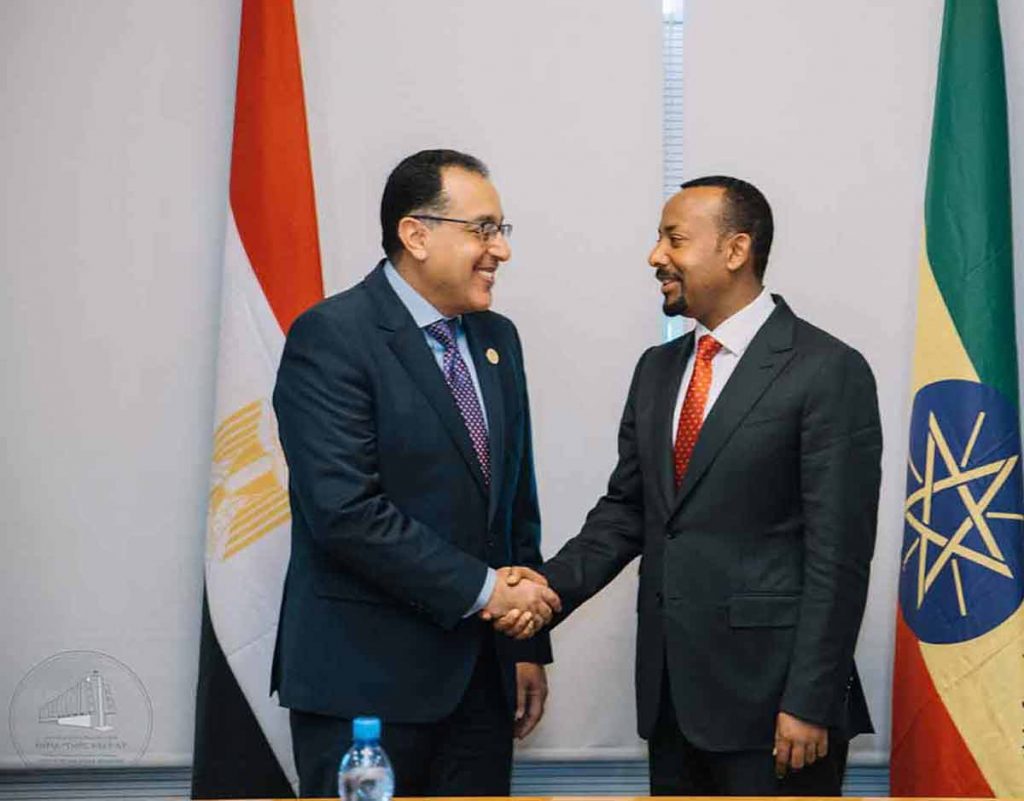
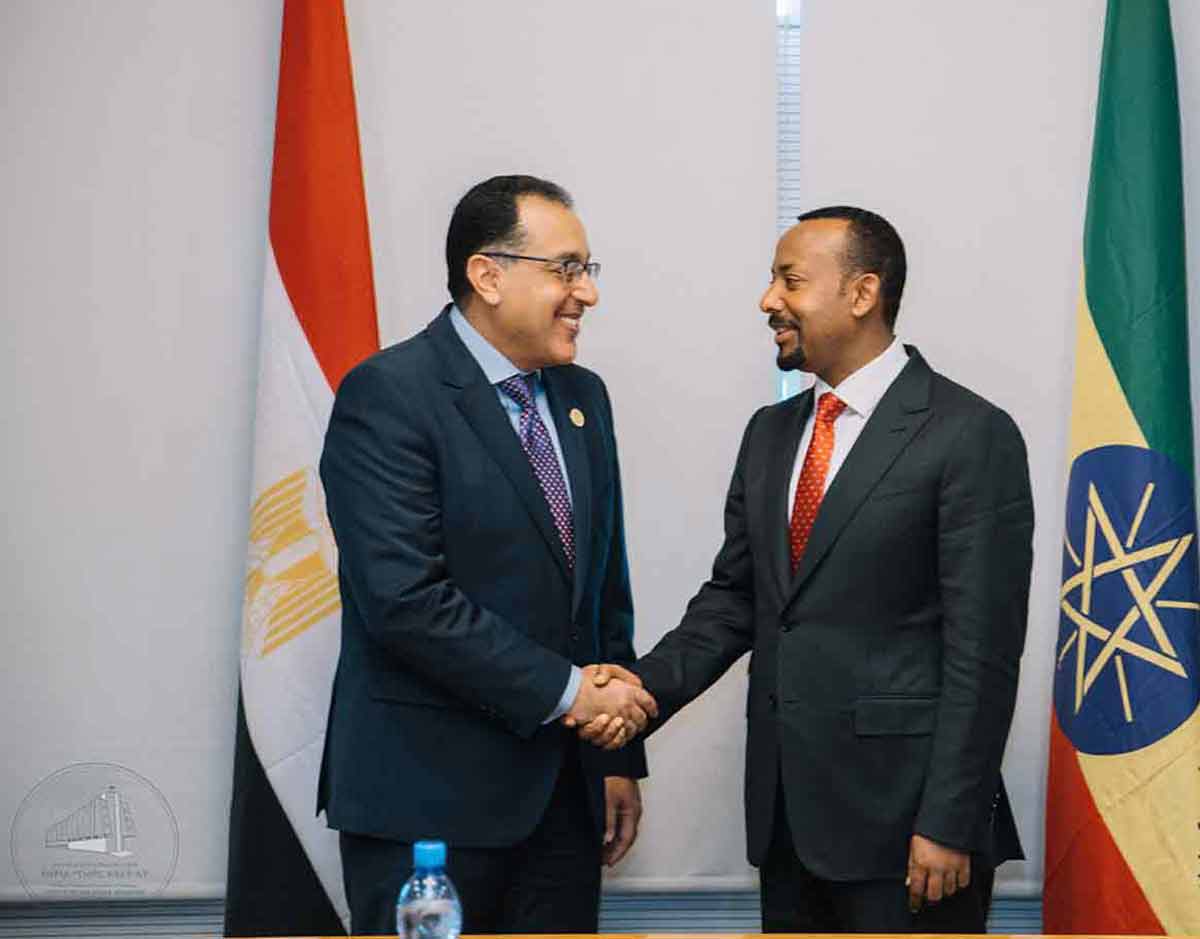
Ethiopian government dr abiy ahmed
“The 11th Extraordinary Session of the Assembly of the African Union” by PMO Ethiopia is licensed under CC PDM 1.0 

Ethiopian Government History

The Ethiopian history is traced back to the 8th c. BC, to the time of the ancient D’mt Kingdom, which reigned over present-day Eritrea and Northern Ethiopia. Then, the Axumite became part of history in the 4th century BC and ruled in the northern part of Ethiopia, and the red sea. The empire reunited the independent kingdoms in the region and controlled the sea trade.  

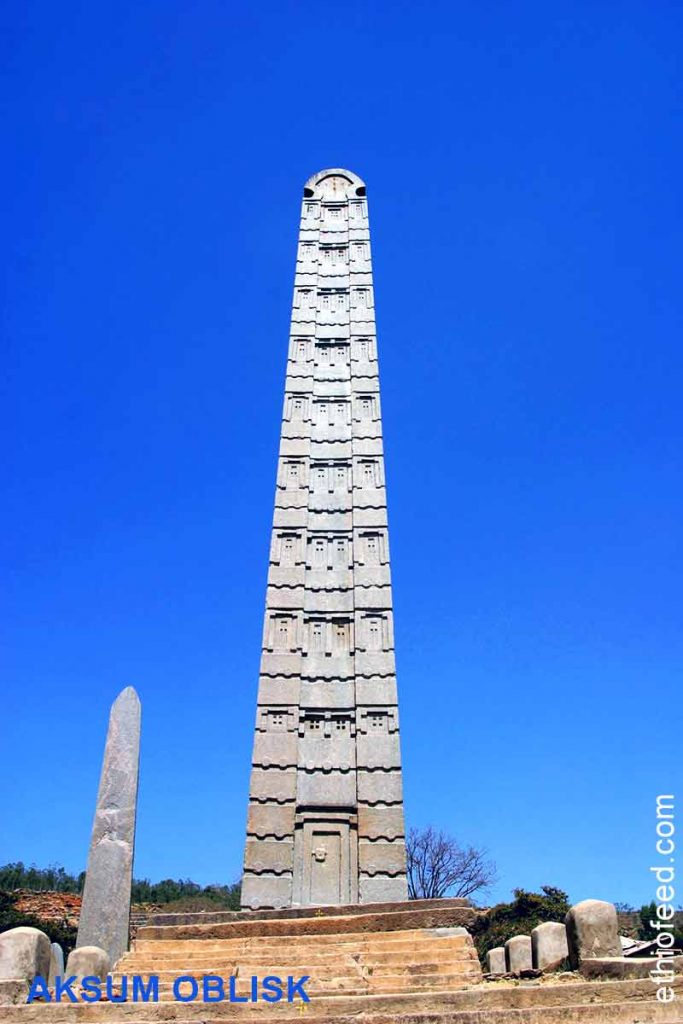
This part of the Ethiopian Government’s history is left for generations through archeological and structural artifacts. The Yeha is a town near Axum and is evidence of the time of Axum before Christianity and pre-Axumite civilizations.

For the next sixteen hundred years, Ethiopian history was tied to a monarchy with ties to the Orthodox church. King Haile Selassie was the last monarch, forcefully overthrown by a socialist government in 1974. Later the socialist Derg government was forcefully overthrown by the EPRDF, a party that is on the lead since then.  

Ethiopian government history and historians say the beginning of Modern Ethiopia is with the rise of Emperor Tewodros II in 1855. Emperor Tewodros II’s contributed to present-day Ethiopia by ending the decentralized Zemene Mesafint (Era of the Princes).

The successors Emperor Yohannes IV (1872-1889) and Emperor Menelik II (1889-1913) made Ethiopian government history with their own contributions. Following the death of Menelik in 1913, Lij Eyasu, a grandson took the throne. Lij Eyasu, a young boy at the time of the throne, inclined away from the orthodox church towards Islam. This shortens the throne of the young king.

The church hatched a plot to replace him with a relatively older young man from a royal family called Ras Tafari (Haile Selassie). After a coup against Lij Eyasu, Zewditu, the daughter of Menelik took the throne and Ras Teferi appointed as regent and became heir to the throne. Later Zewditu diet in 1930 and Ras Teferi, became the emperor.

Right from the beginning, he introduced a reformation program, the first written constitution, and he even attempted to end slavery in the country. He did much in the education sector.

The socialist era was a time of terror for many, a time of dictatorship. Opponents driven to exile and peasant families resettled in villages and farmlands were expected to supply crops to the state below market price. The drought and famine of northern Ethiopia happened this time.

Later, EPRDF took power with a coup and Mengistu, the leader of the socialist regime flew the country.

With a promise of freedom of ethnic groups and religion, EPRDF took the position. Meles Zenawi became the head, after a national conference in 1991. Meles Zenawi died on 20 August 2012 and was succeeded as Prime Minister by Hailemariam Desalegn. Meles was in power for more than 20 years. After a short turmoil and public demonstrations, a change in leadership was necessary. Later on 2 April 2018, Abiy Ahmed was declared Prime Minister.

What Are the Ethiopian Government administrative Divisions?

The Ethiopian government has 9 ethnically based regional states and 2 self-governing administrations. The regional states are further subdivided into 68 zones. The central admirations would further divide into Sub-city, then to woreda and to kebele. The kebele is the smallest subdivision that can be alternatively used as a neighborhood level.

The 9 regional states are Addis Ababa, Afar, Amara (Amhara), Binshangul Gumuz, Dire Dawa, Gambela Hizboch (Gambela Peoples), Hareri Hizb (Harari People), Oromiya (Oromia), Sumale’ (Somali), Tigray, Southern Nations, Nationalities and Peoples.

Ethiopian Government Ministers

The council of misters that are the country’s executive organs is the cabinet of the Ethiopian government organized under the constitution.

Ethiopian government AU meeting in addis ababa
“The 11th Extraordinary Session of the Assembly of the African Union” by PMO Ethiopia is licensed under CC PDM 1.0 
  • Prime Minister of Ethiopian Government Ministers……Abiy Ahmed
  • Deputy Prime Minister of Ethiopian Government Ministers……Demeke Mekonnen
  • Ministry of Innovation and Technology of Ethiopian Government Ministers……   Getahun Mekuria
  • Minister of Finance of Ethiopian Government Ministers……   Ahmed Shide
  • Minister of Transport of Ethiopian Government Ministers……               Dagmawit Moges
  • Minister of Foreign Affairs of Ethiopian Government Ministers……Gedu Andargachew
  • Minister of Peace of Ethiopian Government Ministers……Mufheriat Kamil
  • Attorney General of Ethiopian Government Ministers……Birhanu Tsegaye
  • Minister of National Defense of Ethiopian Government Ministers……Lemma Megersa
  • Minister of Health of Ethiopian Government Ministers……Amir Aman
  • Minister of Trade and Industry of Ethiopian Government Ministers……Melaku Alebel[3]
  • Minister of Agriculture of Ethiopian Government Ministers… Omer Husen
  • Minister of Education of Ethiopian Government Ministers……Tilaye Gete
  • Minister of Mines and Petroleum of Ethiopian Government Ministers… Samuel Hurka

  • Minister of Science and Higher Education of Ethiopian Government Ministers…Hirut Woldemariam
  • Minister of Water, Irrigation and Energy of Ethiopian Government Ministers…Sileshi Bekele
  • Minister of Urban Development and Construction of Ethiopian Government Ministers…Aisha Mohammed Mussa
  • Minister of Labor and Social Affairs of Ethiopian Government Ministers…Ergoge Tesfaye
  • Minister of Women, Children, and Youth of Ethiopian Government Ministers…Yalem Tsegaye
  • Minister of Culture and Tourism of Ethiopian Government Ministers… Hirut Kassaw
  • Minister of Revenues of Ethiopian Government Ministers…Adanech Abebe
  • Commissioner of National Planning of Ethiopian Government Ministers…Fitsum Assefa
  • Minister of Foreign Affairs of Ethiopian Government Ministers…Gedu Andargachew
  • Minister of Peace of Ethiopian Government Ministers……mufheriat Kamil
  • Minister of Finance of Ethiopian Government Ministers…Ahmed Shide
  • Minister of National Defense of Ethiopian Government Ministers…Lemma Megersa
  • Minister of Transport of Ethiopian Government Ministers…Dagmawit Moges
  • Minister of Education of Ethiopian Government Ministers…Tilaye Gete
  • Minister of Culture and Tourism of Ethiopia…Hirut Kassaw
  • Minister of Health of Ethiopian Government Ministers…Amir Aman
  • Ministry of Innovation and Technology of Ethiopian Government Ministers…Getahun Mekuria

  • Minister of Trade and Industry of Ethiopian Government Ministers…Melaku Alebel[3]
  • Minister of Agriculture of Ethiopian Government Ministers…Omer Husen
  • Minister of Urban Development and Construction of Ethiopia…Aisha Mohammed Mussa
  • Minister of Science and Higher Education of Ethiopia…Hirut Woldemariam
  • Attorney General of Ethiopian Government Ministers…Birhanu Tsegaye
  • Minister of Mines and Petroleum of Ethiopia…Samuel Hurka
  • Minister of Water, Irrigation and Energy of Ethiopia…Sileshi Bekele
  • Minister of Labor and Social Affairs of Ethiopia… Ergoge Tesfaye
  • Minister of Women, Children, and Youth of Ethiopia…Alem Tsegaye
  • Minister of Revenues of Ethiopia…Adanech Abebe
  • Commissioner of National Planning of Ethiopia…Fitsum Assefa

updated link

Is Ethiopia a Democracy

Ethiopia is a democratic country, with a constitution and distribution of power to states. The 1995 constitution established the federal democratic republic of Ethiopia.  This was thought to create unity and living together within the ethnic groups. The federal government assumes responsibility in matters of foreign relations, the general policy of common interest and national defense. The state council has power on state matters and on powers of legislation.

Ethiopian Government Problems

Since the 2005 election, Ethiopia has unrest and protesting against the government. Recently, even after constant leader change, the problem continues. Is there corruption in Ethiopia? The simple answer is yes. There is corruption in Ethiopia. The land administration has a higher level of corruption.

Land certificate, a construction permit, the business permit, all are vulnerable to corruption. The level of corruption extends to day to day events. These include traffic violations, tipping for faster services and even in schools. These trends are increasing and creating greater problems in the overall economic scenario of the country. According to transparency international, Ethiopia sits on 37 out of 100, on a scale where 0 is high corruption and 100 is no corruption. This puts the country on the 96th position out of 180.

Map: corruption perceptions index 2019

The Ethiopian government is also accused of controlling media and detaining journalists. Many pollical prisoners who have been detained without any evidence and without probable cause have testified to have been beaten and tortured. Recently, after the political change, many journalists have been released from prisons.

The internal displacement due to ethnic violence has been a challenge for the Ethiopian government. The scale of displacement is huge and it needed strong interventions. The current Ethiopian government repetitively says it is working to support more than 1.4 million internally displaced people.

The clash between the neighboring countries is also a problem. Policy problems were the result of the clash between these countries and Ethiopia. Recently, the prime minister is working hard to create a peaceful resolution between these countries. The peace deal between the north and the south of Sudan is a good example. Ethiopian government played a great role in the deal. The peace deal between Ethiopia and Eritrea even got Abiy Ahmed a Nobel prize.

Drought and famine are other challenges for the Ethiopian government. The long history of famine in the country comes and goes in a while. The new humanitarian says, in 201, 10 million Ethiopians needed food aid.  And this happens in the next years.

Ethiopian government contacts and addresses

Final words

Ethiopia is a land of many histories. Its past begins 2 millenniums ago, at the time of Yeha and Axum. The Ethiopian government since ten had its own good and a bad reputation. In general, each monarch or leader did something that is reputable or something bad. In all these times, the country persisted with its strengths and flaws. The recent story of the socialist government is a bad reputation. In 20 years’ time, many people lost their lives, lost heir belongings.

And others were limited to the bad policy of the country and refrained from creative and productive endeavors. The country’s famine, that many foreigners refer to the country to happened at that time. Even the EFDRE government had its flaws. Ethnic violence grew readily this time, as some stipulate was intended the act to remain on power.  Many people lost their lives and others were detained. Ethiopia’s structure is still based on federalism.

Ethiopian federalism has been on work since the 1990s. The ethnic-based federalism has 9 reigns that have various ethnic groups. These are represented in the parliament. There is still a problem in Ethiopia. Poverty is the first. Recently, ethnic violence became a story of the country. The federalism structure and the wrong policies seem to have caused a sense of competition among the ethnic groups and even among different religious groups.

The Ethiopian government has 3 structures, the legislative, the executive and the judiciary. Through this system, the power is fairly shared. One makes the rules the other implements them and the last interprets them. The Ethiopian government, despite the power-sharing, and other gestures has challenges. Corruption is the main one. The country seems to have run out of cash due to constantly losing money.

The internal displacement, the timely drought and the pollical crises as some call it are few of the Ethiopian government challenges. The country, especially under the Abiy Amhed administration seems to work to change these issues.

The best way to contact the Ethiopian government office is to directly call and get an appointment.

If you are a foreigner and if you have problems that you can’t solve, you can always contact your embassy and let the embassy help you figure it out. The US embassy emergency involving American citizens can call at 251 11 130 6000. 

If you are UK citizen living Ethiopia and needs assistance, call at +251 (0)11 617 0100

Ethiopia weather guide that will save you a lot of time.

0
Ethiopia weather -

Ethiopia weather has two major seasons: the dry season and the rainy season. However, each month in every season has its own character and setbacks. It is necessary to know what is going on in Ethiopia, before deciding to come or before deciding to wear certain clothes or for any other reason.

Ethiopia is situated in the horn of Africa, and it has enormous diversity in altitude from place to place. The highest point, for example, is 4,550m (14,930 ft), at Ras Dashin mountain, Africa’s 10th tallest mountain. The lowest point is at the Danakil Depression that reaches 125m (410ft) below sea level.

This difference in altitude has a huge impact on the weather of the country. You may have different climatic zones and huge variance in Ethiopian weather. The north part of the country has a high altitude, therefore it has early rain and colder weather. Some cities, surrounded by high latitudes and mountains, have a much higher temperature. The Ethiopia weather changes as it goes down, especially near the rift valley region. It then goes cooler as it approaches the south. The overall green cover also increases.  

The climate zones range from tropical savanna in the west to desert climate in the east. Tourist destinations such as Lalibela and Gondar are at an elevation above 2,000m (6,561ft). These places enjoy a considerably cooler climate year-round.

The best time to visit Ethiopia is between October and May.  

Here I will show you everything you need to know about Ethiopia weather, what you should wear and when to visit the country. This article will save you a lot of time.

The Ethiopia Weather and the Climate

Ethiopia weather is influenced by the three climatic zones: The Kola, Woina Dega, and the Dega. These are the tropical zone, the subtropical zone, and the cool weather zone respectively.

The Kolla or the tropical zone of Ethiopia weather is in areas 1800 above sea level. Here the average annual temperature could be above 25-degree Celsius. The temperature rises higher in areas such as the Danakil Depression up to 50 degrees Celsius.

The Woina Dega or the subtropical zone is in areas between 1800 or above to 2500 or below meters above sea level. The temperature is about 22-degree Celsius.

The Dega or the cooler part of the country is above 2500 meters above sea level. This Ethiopia weather regions could have 16 Celsius.

Traveling to Ethiopia, it’s vital to understand the country’s climate in order to make the very most of your time there. Ethiopia weather varies with altitude, from the hot and arid weather of the lowlands to the cool weather of the plateau. The country is just north of the Equator, therefore, experiences little variation in temperature throughout the year.

The country has four major seasons. The summer or the Kiremet is a rainy season, from the end of May to the end of September. The rains are usually caused by the southwest monsoon, which affects most of the country from June to September. It only affects the plateau and the mountain slopes exposed to the south-west. The area on the south-east of the country has two rainy seasons from March to May and from October to November. The rains are less tense than the southwest plateaus. In the southeast part, during some years, the rain doesn’t occur and, causes droughts.

On the Ethiopian Plateau, the weather is mild and warm. The sun shines from November to February, and the rain takes place from June to September and rain and thunderstorms once a day (mostly in the afternoon) from March to May.

Except for Mekele, located at 2,000 meters (6,500 feet) of altitude, the arid or semiarid areas surrounding the Ethiopian plateau have much lower altitude. These places have a July and august rainy season, and hot April to June.

 Afar is very hot and is a desert. The Danakil depression gets hotter as the altitude suddenly drops to 125 meters below sea level. With the low temperature around 30 °C (86 °F) and highs around 40 °C (104 °F), the area is one of the hottest in the Ethiopia weather.

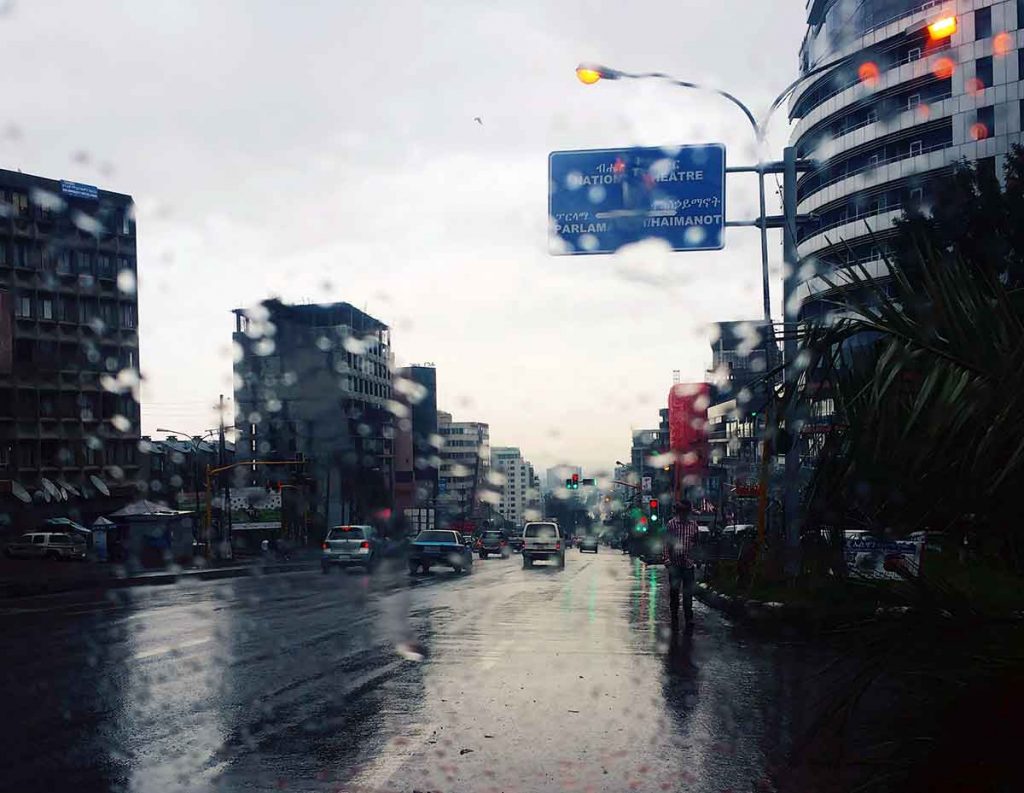
addis ababa rain

Is Ethiopia Hot or Cold?

Since Ethiopia is near the equator the sun shines almost all year round. There is no snow in Ethiopia weather, and the rain usually comes and goes in half a day in may places. The rain mostly forms due to evaporation and precipitation due to mountains near cities.

Ethiopia weather changes from city to city and from place to place depending on the altitude of the place. The higher the altitude, the colder the place becomes.

Addis Ababa, for example, is located at 2300 meters or 7500 feet above sea level. The temperature is mild and the day is pleasantly warm. And the night is cool. The average temperature at day time is 23/25 °C (73/77 °F), and at night is 1 0 °C (50 °F) or below.

Gondar is located at 2000 meters or 6500 feet above sea level, therefore the temperature is higher than Addis Ababa.

Bahir Dar, for example, is hotter than Addis Ababa, since it sits 1800 meters or 5900 feet above sea level.

Altitude is not the only criteria here. The location also matters. Places in the north that sit near the high plateau areas would have a hotter climate. Mekele, for example, sits on 2000 meters or 6500 feet but has a hot and dry climate. If the altitude goes lower than that, the heat becomes higher.

Places such as the Somali region and Dire Dawa are hot areas with 35 °C (95 °F) temperature. Like a desert the day becomes hot and night very cold.  

Does It Get Cold in Ethiopia?

In Ethiopia, in some places like Debre Brihan, few kilometers from Addis Ababa, and somewhere in the plateaus of northern Ethiopia, it could get cold. Some times the night could be windy and very cold even in Addis Ababa.  

Ethiopia Weather Map

Weather Forecast Addis Ababa 15 Days

Addis Ababa has an optimal temperature, around 24 degrees or less in the day time. This consistently goes from October to march. March might see some increase and soon declines in the rainy season. here is the weather forecast for Addis Ababa for 15 days.

Lalibela Ethiopia Weather

Lalibela has 3 months of rainfall days with 1140mm or 44.9inch of precipitation. January, the middle of the year, is dry. May and June are warm and they have an average high temperature of 24°C (75.2°F). The temperature drops between August and November by 4-degree centigrade.

Gondar Weather

The temperature of Gondar varies from 51°F to 84°F and is rarely below 48°F or above 88°F.

What to wear and pack

The average temperature is warmer between October and May and is colder between June and September. Based on when you will visit the country, you need to pack accordingly. However, you should not expect extreme weather. The Ethiopian climate has an optimal temperature throughout the year.

In the rainy seasons, you need to have Jackets and full cloths. At this time of the year, avoid short dresses or short trousers. You don’t need many fur clothes or too many clothes. In the night time, especially in Addis, you only need normal clothes. The locals wear, shirts and trousers and dresses as well.

Sometimes, the night gets cold, then you only need to have an extra sweater or coat.

If you are traveling on a bus from Addis Ababa to the north, then you definitely will have a layer of weather varying from one place to another. Especially in the northern part of the country, despite the altitude, the temperature could change. The Abay desert in the north is a very hot place. Humera is also very hot during the summertime. Some places in the north also get very cold. Mekele could become warm and humid like Bahir Dar.

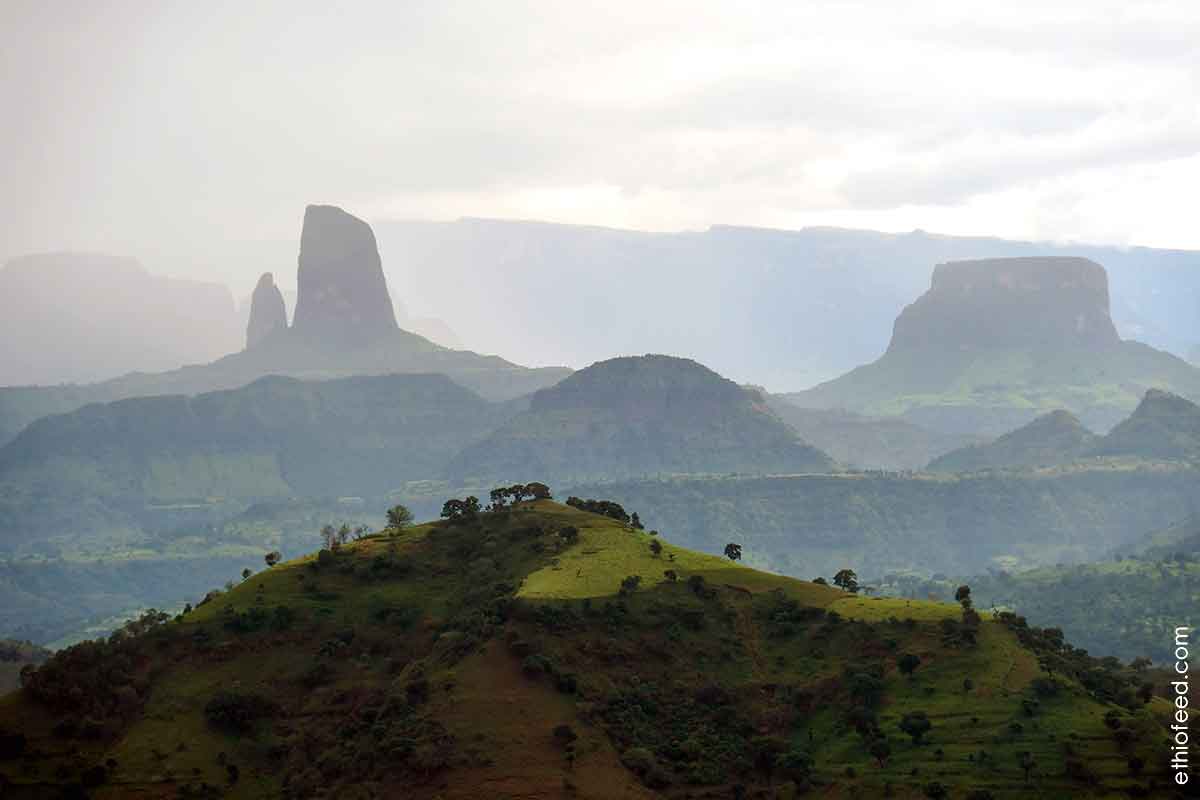
ethiopia landscape seimen mountain

Therefore, you need to pack clothes and change as you feel like it.

The day time is warmer in many places and the cold comes as soon as the sun goes down. Therefore, you need to consider the temperature change and pack accordingly. In Addis Ababa night, for example, the Ethiopian weather goes down at least in half of the day temperature.

The harshest place is in the northeast part of the country. Near the Danakil depression and near afar, and Dire Dawa, the weather becomes harsh. The day is very hot and the nights get very cold. The locals do heavy manual work such as grinding and cutting salt out of the ground, and they even have to walk for hours to arrive at the workplace. But it is not advisable to do for a foreigner. Here, wear cotton and linen cloths and have a turban and a simple scarf.  Wear white cloths, and avoid black clothes. Don’t expose skin to the sun, if you have a frail skin.

In the regions of Danakil and Afar and in the south-east, bring loose-fitting, light-colored clothing, light and long shirt and pants of natural fibers (cotton, linen), a desert turban, hiking shoes, a sweatshirt for the evening at an altitude higher than the plain.

The best time to visit Addis Ababa, Aksum, Lalibela and Gondar

The best time to visit Aksum, Lalibela and Gondar are from November to April. The sun is up and the day is warm. You won’t have a problem with rain. The cold season begins in June in many places. Timely rain and cold weather begin here. Then in July and August, the rain proceeds and it rains at least once a day. In some places, it rains for hours nonstop.

October gets warmer and the flowers bloom in many places. March and April have a higher temperature in many of these places. It is advisable to wear cotton clothes in these months.

The big plus of the weather is that in September and October, March, April, May, and June, traveling gets cheaper. With unexpected rain and colder weather, you can enjoy the country.

The best time to visit the Lower Omo Valley

The best time to visit the Omo Valley is from January to April when the Ethiopian weather is dry but hot. Since you are looking for social and cultural events, you need to avoid going there in the rainy season. The people would be sitting their chambers waiting for the cold to pass rather than going out and dance and do their things.

The roads that lead to some villages are also not paved and the mud, due to the rain, would give you a hard time.

The rain in the south is much more than in the north. It may rain all day, nonstop in some places. The days get cloudy and cover all the beautiful things you need to visit.

The wild animals also would take a shade instead of coming in the open to be seen.

The best time to visit the Danakil Depression

The Danakil depression Ethiopia weather could get up to 50 degrees and more. It is not a place for a simple walk. If it was not for the marvelous landscape and the natural features, the places would not be fun to be inside. Due to the altitude, the weather is harsh. The mountains and higher altitudes surrounding the area would trap the air and you feel a still hot air. While in a car you need to close windows or else you see the heat against your face.

denakil depression , afar ,ethiopia

Make sure you have a good ventilation system on your car before departing to Danakil depression.

Final words

Visiting new places is always a strange activity. You would see new phenomena that your body did not experience before. Therefore, it is best to understand the climate and the weather of the place beforehand.

1-The weather of a place in Ethiopia doesn’t only differ based on altitude, but also the nearby altitude and the mountains surrounding it. For example near the northern part of Addis Ababa, the air is colder and the rain stays longer than the rest of the city. The south part seems dry. This is due to the mountains in the north and the relatively higher altitude. The great depression zone in the south makes the area hotter.

2-When traveling by bus to long-distance, the Ethiopia weather changes fast. You need to be aware of this all the time.

 3-White cloths and thin clothes are preferable in the day time.

4- Time from June to October is a rainy season for many places. The sun gets harsh in march.

5-Ethiopia, even Africa is not a desert as you may have heard. It is definitely less humid and less desert and less cold than any place in the world.

10 unexpected facts about Ethiopia

0
ethiopia landscape seimen mountain

Many facts about Ethiopia seems to have been hidden away from the world for a long time due to various reasons. One of these is the history of drought and famine the country had in the 80s. This has destroyed the image of Ethiopia and facts about Ethiopia were covered with this news.

Ethiopia, in fact, is one of the oldest Africa’s oldest civilization, that has its own system and alphabet. With more than 2 millennium’s history, the country persists until now with a diverse nation and with diverse culture.

Ethiopia has been represented through the ancient Axum that was a powerful nation in the horn of Africa. The Axum’s domination on the red sea was obvious and written on many occasions and historic artifacts.

Ethiopia became world news in 1896 after defeating Italy, refusing a colonial rule. The fascist country returned in 1935, and in the battle of Adwa, it was defeated and returned home. Within the occupation four years period the Italian government ad put its influence on the country. The buildings and some roads and even Italian names still exist in the country.

The present territory of Ethiopia was consolidated during the 19th and 20th centuries as European powers invaded Ethiopia’s historical domain. Since then the country passed through various political and economic situations. King Haile Selassie’s monarchy era in the 50s was replaced by a socialist government in a coup in 1974. Recently a party system has been seen for the last 25 years.

 Here are 10 facts about Ethiopia that are interesting.

1. Thirteen Months – facts about Ethiopia

Unlike the rest of the world, Ethiopia has 13 months to a year. The country seems to have stuck to its own calendar system for a very long time. Not only the calendar but also the timing is different from the rest of the world. Only a few counties have their own calendar system. The Hebrew, the arabas, the Chinese, the Koreans. These use a mixed system with the rest of the world or they kept their calendar as a souvenir. Ethiopia, however, uses the calendar together with the Gregorian calendar.

First, The Ethiopia calendar has 8 years difference with the Gregorian calendar. Second. Every month has 30 days and the 13 months will be a five- or six-days leap year.

Since the country is located on the equator there is no much disparity between the length of the day and the night. The few minutes difference is not that noticeable. Therefore, Ethiopian time starts at 1 in the morning, not at 7, and ends at 12 and the evening begins at 1 and ends at 12 in the morning. There are not days of light saving.

The fists of facts about Ethiopia is it has 13 months and some call it 13 months of sunshine. 

Facts about Ethiopia #1- Ethiopia has 13 months.

2. Ethiopia and ancient religions

Ethiopia has been a name in many historic and religious books including the bible, the Koran, Homer’s Odyssey. The name Ethiopia has been in the bible more than 45 times and other times mentioned as a country in the south of Egypt.

It is a story that Mohamed the prophet of Islam first sent his daughter and accomplices to Ethiopia, running from persecution. The Christian country of Ethiopia accepted them and sheltered them and some have changed to Christianity while locals also changed to Islam. Mohmed is said to have ordered his followers not to attach Ethiopia if they didn’t attack them first.

 Facts about Ethiopia #2 – Ethiopia in religious books

ethiopia landscape seimen mountain

3. The contradictory Scenic Landscape

The landscape of Ethiopia seems to contradict each other on every few kilometers the altitude increases and decreases. A few kilometers from the highest altitudes in the world lays the lowest point in Afar, the Danakil Depression. The northern mountains, as high as 2600 and much more above sea level became the lowest point in Afar up to 125 meters below sea level.

Danakil Depression is a place many archeological findings in Ethiopia were found. The colorful landscape due to underground chemicals on the surface makes the place dreamy.

Besides this, the Erta Ale active volcano, on the surface is one of the most attractive landscapes in the world.

The rift valley, the Blue Nile gorge, the Seimen mountains, all make the place a land of landscapes.

Facts about Ethiopia #3- The landscapes change so fast.

how to make ethiopian coffee at home

4.  Discovery of Coffee- Facts About Ethiopia

Ethiopian coffee is a household name in the country. It has gained popularity even in the west and in the Arab world. The coffee arabica of Ethiopia has a unique position in the world of coffee. Many brands prefer it for its taste and color.

It is considered Ethiopia could be the first person to have discorded the use of coffee and have used it. The oral story begins with a farmer called Kaldi who was born in a Kaffa region. Coffee is thought to have derived from the place Kaffa. Kaldi saw one day that the goats that consumed the coffee tree became hyper and he could not handle them. Curiosity led him to discover the overexcited effect of the plant.

Related: How to Make Ethiopian coffee at home.

Since then the world shared this drink and today coffee is considered only the second valuable commodity after petroleum.  And 4 out of 5 Americans consume coffee daily.

Ethiopian coffee is a way of life in the country. Many people use it to socialize and create a social bond.  

Facts about Ethiopia #4- Ethiopia probably gave coffee to the world

facts about Ethiopia

5. Birth of Rastafarianism

Many Rastafarians think that religion begins in Jamaica and with the inspiration of the Ethiopian emperor Haile Selassie who inspired the religion. Ras- Tafari is translated as head or a leader Terferi, that is the first name of Haile Selassie.

The Rastafarian movement believes Haile Selassie as the incarnation of God. They also believe Ethiopia to be a promised land. They present the religious background and the reason why Ethiopia has not colonized a sign the country is sacred land.

The country also inspired many black Americans and black Africans to see a better future beyond colonialism. The country played a great role at the beginning of the African Union.

The flag of Ethiopia is a symbol for the Rastafarians and Africans, and it is a sign of freedom and the future.

Facts about Ethiopia #5 – Ethiopia is a reason for Rastafarianism.

6. Origin of Mankind

A land of Lucy and other archeological hominid finds, Ethiopia is considered one of the beginning places for humankind. Lucy, an almost completed skeleton found in Afar was found in 1972 and is thought to be 3.2 million years old.  

Facts about Ethiopia #6 Ethiopia is an origin of humankind.

7. A place of the True Cross

Religion has a big place in the lives of Ethiopia. Orthodox Christianity has an oral history that seems fantasy for some. The history of the church is immense and has a lot of unverified but amazing claims. The tomb of Adam is thought to be in Lalibela. The legend says that the true cross that Christ was crucified on, was found by St. Helena—the mother of Constantine the Great, the Roman Emperor who converted to Christianity—in the 4th century. The relic of that cross was later given to Ethiopia’s kings to protect Coptic Christians in their country.

Related: When to be in Ethiopia to celebrate Meskel?

Ethiopia celebrates this day once a year, on September 26. The celebration is called Meskel, and for more than 1500 years the country celebrated the arrival of the True Cross in Ethiopia.

Facts about Ethiopia # 7 – a place for the true cross

8. The Ark of Covenant

The ark of the covenant that was given to Moses is thought to be in Ethiopia somewhere hidden away from the public. The ark of the convent is a stone that has the ten commandments that God gave to Moses.

The orthodox church claims to have the ark of the covenant.

Facts about Ethiopia #8- the arc of the covenant could be in Ethiopia.

9. Never been Colonized

Ethiopia is one of the two African countries to never be colonized. This is news for many readers but this is true and the second one is Liberia and was not colonized due to a prevalent disease in the country.  

The Italian colonization power was defeated at the end of the 19th century (in the 1880s), in the war of Adwa and the country remained free for long. The country then fell under the Italian invasion for four years in the 1940s, from 1936- 1941. At the time the whole world ignored the call of the Ethiopians, and the invasion of Italy, that was against the international rule, then King Haile Selassie left the county to find assistance to defeat the power of Italy.  

British and France and other countries supported Italy. Later, the king returned and Italy was defeated. The day is celebrated once a year in the country.

Facts about Ethiopia #9 – Ethiopia has never been colonized.

10. Abebe Bikila

Ethiopian distance runner Abebe Bikila became the first black African to win the gold medal in the Olympic Marathon at the time Blacks were considered inferior. He won the first gold medal at the 1960 summer Olympics in Rome, barefoot.

He was an inspiration for many aspiring runners and other African and black people. When he said he could do another 10 kilometers after the Marathon, he was not joking. He was a very competitive person, with great charisma. His bare feet running was another amazing occasion.

Today many records are broken by Ethiopia. Some of the known runners are Haile Gebre Selassie and Fatuma Roba. These runners set a bar in their respective running category.

Facts about Ethiopia #10- Setting the bar in running

Ethiopia is one of the civilizations that contributed much to the world. The Axum civilization 2 millennia ago was a big influence in the development of the world. Today, it seems the country is in a problem, and poorness is associated with its name. However, it is always to remember the good part of a country as well.

The country’s position in religion, sports, and social and historic areas should be celebrated as well.

11 amazing Lalibela Churches you should visit, and their mystery

0
lalibela chruches, Facts About Lalibela Churches-
Image-by-RogueAngel-is-licensed-under-CC-BY-NC-2.0

Lalibela churches are one of the most marvelous pieces of architecture you would see in Africa. Lalibela churches are considered as the 8th wonders of the world, next to the seven that UNSECO identified. These churches still survive, centuries later, in a small town called Lalibela.

Lalibela is a small ancient town in the Northern part of Ethiopia and is known for its religious buildings and its history. The town contains rock-cut monolithic churches that were part of the medieval civilization that the country was in.

Lalibela is thought to be hugely influenced by Aksum (Axum). The Architecture and the religious influence are visible on the buildings. Lalibela was also influenced by Jerusalem and wanted to be the second Jerusalem, especially after the middle east Jerusalem fell under the Islamic influence at the time.

The river in the town and other buildings have biblical names.

There are 11 rock-hewn Lalibela churches and the two are monolithic sanctuaries, namely Bete Hawariat and Bete Estifanos. Lalibela is majorly a tourist city, unveiling its history and attracting the economy in return. Many people in the town live dependent on these religious and historic artifacts. The society also lives around these edifices, where these are geographic and Thousands of visitors travel to see them every year.

The churches, in the center of the city, are located on the other side of a small stream, from each other. A seasonal stream called Jordan separates the northern side churches from the east. Beite Giyorgis, saint George building stands in the sloping rock terrace in the southwest of the churches.

The Northern side of river Jordan churches:

  1. Bete Maryam, ‘House of Mary’
  2. Bete Meskel, ‘House of the Cross’
  3. Bete Denagel, ‘House of Virgins’
  4. Bete Medhane Alem, ‘House of the Saviour of the World’
  5. Bete Golgotha Mikael, ‘House of Golgotha Mikael’

The Eastern Group:

  1. Bete Amanuel, ‘House of Immanuel’
  2. Bete Gabriel-Rufael, ‘House of the angels Gabriel, and Raphael’
  3. Bete Qeddus Mercoreus, ‘House of Saint Mercurius’
  4. Bete Lehem, ‘Bethlehem’
  5. Bete Abba Libanos ‘House of Abbot Libanos’

The Western side churches:

  1. Church of Saint George

1. Bete Mariam, ‘House of Miriam/House of Mary’ Lalibela churches

Lalibela church medhane alem door

"medhane alem door" by nicholaslaughlin is licensed under CC BY-NC-SA 2.0
Edited “medhane alem door” by nicholaslaughlin is licensed under CC BY-NC-SA 2.0 

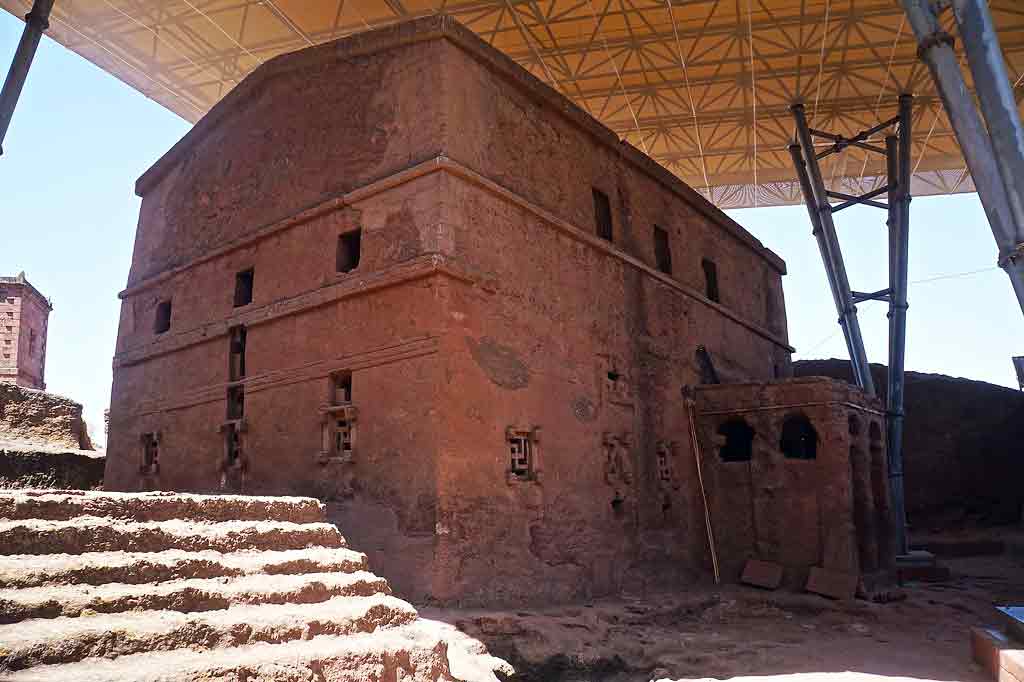
Being one of the oldest churches in the town, Beite Mariam is a UNESCO heritage. The building was built with a concept of the Tombs of Adam, the first man, and Christ, the savior, the second man. Beite Mariam Lalibela church is a one-story monolithic building with seven rooms.

The church is thought to be built during the reign of the Zagwe dynasty, at the time of Gebre Mesqel Lalibela. The churches were made between the 11th and 13th centuries.

The exterior walls have a molding decoration that runs horizontally across the walls and the three rows of windows gave the church a memorable image. The rows on the upper side of the windows are plain and are rectangular without any fillings while the rows on the lower end are carefully decorated with various cross image.

The interior of Bete Mariam is a fully developed cathedral, decorated with icon diagrams of St. Marry and St. Joseph, Star of David, Seal of Solomon, cross symbols. A semi-circular gallery is located on the first floor consisting of seven rooms.

With a trapezoidal courtyard, the church’s courtyard is used for a religious celebration space especially during the Christmas season. In between the courtyard is a deep rectangular pool that is believed to make a barren fertile with a blessing from priests. The people bath in the pool looking for a miracle. 

2. Bete Meskel, ‘House of the Cross’

Bete Meskel also means a house of the cross. It is an underground monolithic church carved out of and into a rock. The church is also part of the UNESCO heritage site. It is believed the building was built during the Axum Kingdom.

Image by RogueAngel is licensed under CC BY-NC 2.0 

3. Bete Denagel, ‘House of Virgins’ Lalibela Church

Beite Denagel has church arts and decorations that are unique to Lalibela churches.

4. Bete Medhane Alem, ‘House of the Savior of the World’ Lalibela Churches

Being one of the largest monolithic churches in the world, Bete Medahane Alem is one of the most impressive monolithic churches in Lalibela. Since it is a place for Lalibela cross, it is an important edifice.

Bete Medane Alem has resemblance with St. Mary of Zion of Axum and is thought to be an imitation of the church.

The walkways and the tunnels connect Bete Medhane Alem with one of the oldest churches of Bete Maryam. The east side of the Bete Medhane Alem wall of the Lalibela church is a display of geometric carved windows in a vertical line. Axum shaped crosses and Latin crosses are also seen on the church walls. 

5. Bete Golgotha Mikael, ‘House of Golgotha Mikael’

Bete Golgtha Mikael was renovated and reopened in 2018. The Lalibela church is a monolithic church carved out of soft volcanic tuff. It was built in the 12th century by King Lalibela. With its pilgrimage symbols, the church has been a destination for many visitors and religious people.

The deteriorating Bete Golgotha Mikael church has cracks and the outer part is eroded during rainy seasons.

lalibela church 

"DSCF0549" by Giustino is licensed under CC BY 2.0
“DSCF0549” by Giustino is licensed under CC BY 2.0 

6. Bete Amanuel, ‘House of Immanuel’

Bete Amanuel is another underground monolithic rock-cut Lalibela church. The church building shows the Axum construction prints more than any of the other Lalibela churches. The building is believed to be a royal prayer house of King Lalibela and his family.

Bete Amanuel is a three-story building in which the ground floor in cross-shaped, the first floor is arched over, and the second is square-headed.

Inside the courtyard on the ground, it is accessed by three gates, of which is from Bete Merkorious. The Bete Amanuel church is fascinating. Its wall is carved with horizontal strips that go around the walls. It has 24 external columns and 45 small windows. Stairs carved into the rocks, take one to the first floor.

The Axum influence is clearly displayed in this church. The external façade followed Axumite style of alternating recessed and projecting stonework, and the ancient Ethiopian wood and stone method of construction.

The rectangular church is purely monolithic and is carefully placed amidst the center of a quadrilateral courtyard. It is a

The external walls are richly decorated with horizontal carving decorations on the external walls and alternating vertical and horizontal moldings on the four facades of the Lalibela church are impressive. The three-row windows have their own unique characters. The lower windows are cross-shaped, the middle is round-arched with capitals, and the uppers are square-headed. The bottom and the top windows exhibit frames with corner posts of Axumite style. The top row windows have no fillings.

Like the others, it has three doorways; the main entrance is on the west wall accessible by four steps.

“Igrejas de Lalibela, Etiópia” by Samuel Santos is licensed under CC BY-NC-SA 2.0 

7. Bete Gabriel-Rufael, ‘House of the angels Gabriel, and Raphael’ Lalibela Churches

Bete Gabriel-Rufael is a different church in its architecture and service. This single-story Lalibela church is connected to a mountain and accessed by wooden bridges to its story level. The ground floor of this church is filled with water and cannot be accessed.

Amazingly the gate of the ground floor gives no service.

The church has eight external columns, of which five of them continued to the ground floor and the rest three remain at the upper floor.

Internally, there are two columns. It has a short room height relative to the others. Bete Rufael and Bete Gabriel are situated under a single roof. Inside Bete Rafael, there is one huge column and two windows.

Externally its wall has recessed slots inscribing windows. The two doors have a wider veranda. It has a wider door at the south that takes to Eucharist Kitchen, to a store and to other caves, which are too wide. Its western gate takes to Bete Rufael. Traveling through the cave, you can find a wooden gate that was constructed by Lalibela.

Bete Gabriel is a church located between two deep channels on the north and south side. The monumental northern facade is decorated with ogival niches whose top shape is similar to the Axumite stales.  

8. Bete Qeddus Mercoreus, ‘House of Saint Mercurius’

Another underground church built during the kingdom of Axum. It is thought to have been a prison as ankle shackles were found there.

9. Bete Golgotha Mikael, ‘House of Golgotha Mikael’

Bete Golgotha is known for its artwork and carvings of saints on the walls. It is believed to be a place where the tomb of King Lalibela and has a gold-draped Ark over the grave. The Selassie Chapel and the Tomb of Adam also reside there.

Bete Debre Sinai and Bete Golgotha are twin churches. A tunnel at the western end of Bete Mariam leads to the twin churches.

The east side Golgotha and the west Debre Sinai are semi-monolithic and separated by a rock wall. These are connected within the trenches that is 10 meters below the surface. The churches appear as one when viewed from outside and the local people called them Bete Golgotha-Michael as a single church.

Lalibela Ethiopia map

10. Bete Lehem, ‘Bethlehem’

Bete Lehem is underground monolith church, created during the kingdom of Axum.

11. Bete Abba Libanos, ‘House of Abbot Libanos’

Bete Abba Libanos is an underground rock-cut monolith Lalibela church.

bete giyorgis lalibela church

12. Church of Saint George (Bet Ghiorgis), ‘St. George’s’

Located on the western side of the cluster of churches, Bete Ghiorgis is cut 40 feet down and its roof forms the shape of a simple cross. It was built after Lalibela’s death in 1220 by his widow as a memorial to the saint-king.

The plan was to make a new Jerusalem with measured dimensions and precisions.

Unlike some of the other churches, St. George’s is plain inside. A curtain covers away from the place called the Holy of Holies, and a priest stands Infront exhibiting books and paintings to visitors. A Tabot, a copy of the Ark of the Covenant, is thought to be in one of the wings in the spaces.

Bete Ghiorgis, which is a distinctively cross-shaped Lalibela church. This is believed to be the last work of Lalibela. It is situated far from the other two groups of churches and accessed through the cave. The building stands inside the courtyard. Narrow and with horizontal bands, the walls appear symmetric and visually bold.

It is decorated by two rows of windows, 9 blind windows in the bottom row are blind and emulate the Axumite framework. The 12 windows in the upper row have ogival arches and bracket capitals.

The church has three doors in the west, north, and south and at the main entrance in the west, you will find seven steps as a representation as seven skies, heavens.      

The Lalibela churches have one thing in common, that is these are carved out of a single rock. These have articulations that are unique to each of the churches. The Lalibela churches are an impressive tourist destination, and some even call them 8th wonders of the world. The Lalibela town is rather small but holds great historic edifices. If you plan to visit Ethiopia, then you need to see Lalibela.

20 Tribes in Ethiopia, surprising facts and travel tips

0

Tribes in Ethiopia have various cultures, languages, and lifestyles. These tribes of Ethiopia live in harmony with nature and with each other. A few tensions raised recently due to differences. Tribes in Ethiopia speak more than 80 languages and are too many in numbers.

The main tribes in Ethiopia are the Oromo, the Amhara, the Tigray, and the Gurage. These have a large population. The minorities such as Mursi and people in Benishangul Gumuz also have their own cultures and traditions.

The Omo valley is another unique place that holds diverse ethnic tribes of Ethiopia, that have a similar culture but different settlements. These tribes in Ethiopia intrinsically have a very unique culture and way of life that makes them different from neighboring clans and ethnic groups in some way. These people were a destination of many tourists due to their unique and ancestral lifestyles.

The Amhara and Tigray also have an association with ancient civilizations that Axum and Lalibela emanated from. These were powerful people in the northern part of the country.

The Gurage and the Sidama inhabit the southern part of the land. And have their own cultural attributes to the overall country. The Somali and Harari also have a historic and cultural place in the development of Ethiopia.

Here, I will answer your main questions about tribes in Ethiopia.

1.     Ethnic Groups in Ethiopia

More than 8o officially recognized ethnic groups are found in Ethiopia. The four ethnic groups that are the Oromo, the Somali, the Amhara, and Tigray make three-quarters of the whole population. The Oromo and the Somali are from the afro Asiatic language, mainly from the Cushitic branches. The Amhara and the Tigray are from the Semitic branches.

The rest of the Rhinic groups, tribes in Ethiopia, are the Omotic ethnic minorities, from the Omotic branches. Welayta is in this tribe.

The Nilotic speaking minorities live in the southwest regions of Ethiopia, in the Gambela region. These people speak Afro-Saharan language and share a culture with South Sudan.

  • Geez, Tigrigna, Gurage, Amharic, Harari- Sematic group
  • Somali, Afar, Oromo- Cushitic
  • Walita- Omotic
  • Kunama- Nilotic

2.   How Many Tribes in Ethiopia ?

Ethiopians are diverse in ethnicity, and there are more than 80 languages being spoken in the country. These tribes of Ethiopia speak languages that belong to the Cushitic, Sematic or Omotic and Nilotic groups.

Related posts: What Does Ethiopia Looks Like? Unpopular Facts

3.    List of Tribes in Ethiopia

  1. Oromo– Oromo is one of the largest tribes of Ethiopia. This ethnic group of Ethiopia belongs in the Cushitic group and has a history of a millennium.
  2. Amhara– Amhara is the second-largest tribe of Ethiopia. The Amhara people live in the northern part of Ethiopia. Wollo, Bahir Dar, Lalibela belong in these tribes of Ethiopia.
  3. Somali– The Somali people live in the eastern part of the country. The Harari and Dire Dawa people have a closer culture with these tribes in Ethiopia.
  4. Gurage people– The Gurage people live in the southern part of the country and are known with their work ethic. Their foods are also unique and are loved by tourists.
  5. Wolayta– These tribes in Ethiopia also live in the southern part of Ethiopia.

The Amhara, the Oromo and the Tigray tribes in Ethiopia make 75% of the whole population. The smallest number of tribes go as low as 10,000.

ethiopian cloth cultural

4.   Ethiopian Tribes Amhara

The Amhara are tribes in Ethiopia living in the northwest highlands of Ethiopia. In 2007, the Amhara were 27 percent of the whole Ethiopian population. The Amhara are known with their Amharic language and contribution in history. The biggest tourist attractions such as Lalibela exist in this region.

The Amhara tribe of Ethiopia has historically lived in the north, central and western parts of Ethiopia. They depended on agriculture.

Some historians traced the origin of these tribes of Ethiopia to the modern-day Yemen who migrated to Wollo, in the Amhara region.

The church arts, the dances, the unique food, and clothing, the religious stories, the political stories all make these tribes in Ethiopia a truly beautiful people.

5.   Ethiopian Tribes Oromo

The Oromo people take a third of the Ethiopian population. The Oromo language or Oromiffa is the language these people use. The Oromo people have a traditional religion called Waqeffanna, and they use a unique hierarchical governance system called Gadaa. The Gadaa system has a power hierarchy where leaders stay on power for 8 years.

The Oromo people’s history was first documents by Ethiopian monk Abba Bahrey, in his writing called Zenahu Le Galla, in 1593. The term Galla is considered derogatory and it is not used in the country.

6.   What are the Southern Ethiopian Tribes?

These tribes in Ethiopia are formed merging five regions and Awassa is the capital. The southern Ethiopian tribes, border Kenya in the south, and South Sudan in the southwest. Gambela is in the northwest of the southern Ethiopian tribes’ region. Arba Minch, Hosaena, Welkite, Bonga and Dilla are some of the towns and cities in the southern Ethiopian tribes.  

Almost 90 percent of the southern Ethiopian tribes live in a rural area. In 1994, the southern Ethiopia tribes of Ethiopia were a bit more than 10 million. It was estimated that the number of populations in the region would be almost 20 million.

Related post: Who Are the Habesha People? What Are They Known For?

7.    How Many Tribes Are in Omo Valley?

There are 10 much known Omo tribes in Ethiopia. The Tsemai live in a Wito village, and on the road that takes from Konso to Jinka. This minority Omo tribes of Ethiopia are small in number and are not more than 5000 in number.

These tribes in Ethiopia have a much-shared culture with the nearby Ari People and the Erbore people. They share clothing with the Ari people and social and spiritual way of life with the Erbore. They survive on subsistence farming.

The Erbore people are much linked to the Tsemai tribes and are thought to have come from the Konso tribes of Ethiopia to their present location. These tribes in Ethiopia have intermarried to the neighboring settlements like the Borena Oromo and the Guji, and the Hamar people.

The Karo are about 1000 in number and live on the east side of the Omo River. They are known with the chalk paint facemask and paintings, and the women’s scarifying of the chest.

The Dasenech or the Geleba live near the Kenya and Sudan border, about 25,000 in number. The tribe is divided into 8 clans and live near each other. The clans have their own borders and live a semi-nomadic life.

Bume tribes in Ethiopia live in the west of people called Dasenech, south of the Surma people. They live on the Kenyan border.  These are a bit more than 5000 in number. They are semi-nomadic and survive herding cattle and hunting and small-scale farming.

Konso is people south of Arba Minch, and they are known with their hill land cultivation systems an irrigation system.

The Dasenech are much known for their rituals called Dimme, which is slaughtering cattle for a wedding ceremony. The days will be celebrated with well-dressed clan members, clothed with feathers, leopard skin and more.

The Dorze are known with their cotton products and staple food from Enset or false banana and their unique house construction system.

The Benna is about 35,000 and lives in the highlands in the east of the Mago national park. They are hunters as well.

tribes in ethiopia Hamar ethiopia black and white

8.   Hamar Tribe

The Hamar of the minority tribes in Ethiopia, with an ancestral settlement, in the south of Ethiopia, near the border of Kenya. The tribe lives in the east of the Omo river and has a cultural connection and even has a dispute with the farmers on the Kenyan border.

If you have seen pictures of nude women with permanent skin decorations, muddy hair and braids. They wear necklaces made out of beads, seashells and other plastics.

The men also are distinguished with their skinny, tall and black nude features. They wear beads and feathers on their hair and decorated their faces with colorful muddy substances.

The life of the Hamar tribe is dependent on small scale agriculture and pastoralism. The products are sold in a weekly market. A market is a place of exchange for products that they would not get otherwise. These are tobacco or coffee and other fruits and vegetables and daily tools.

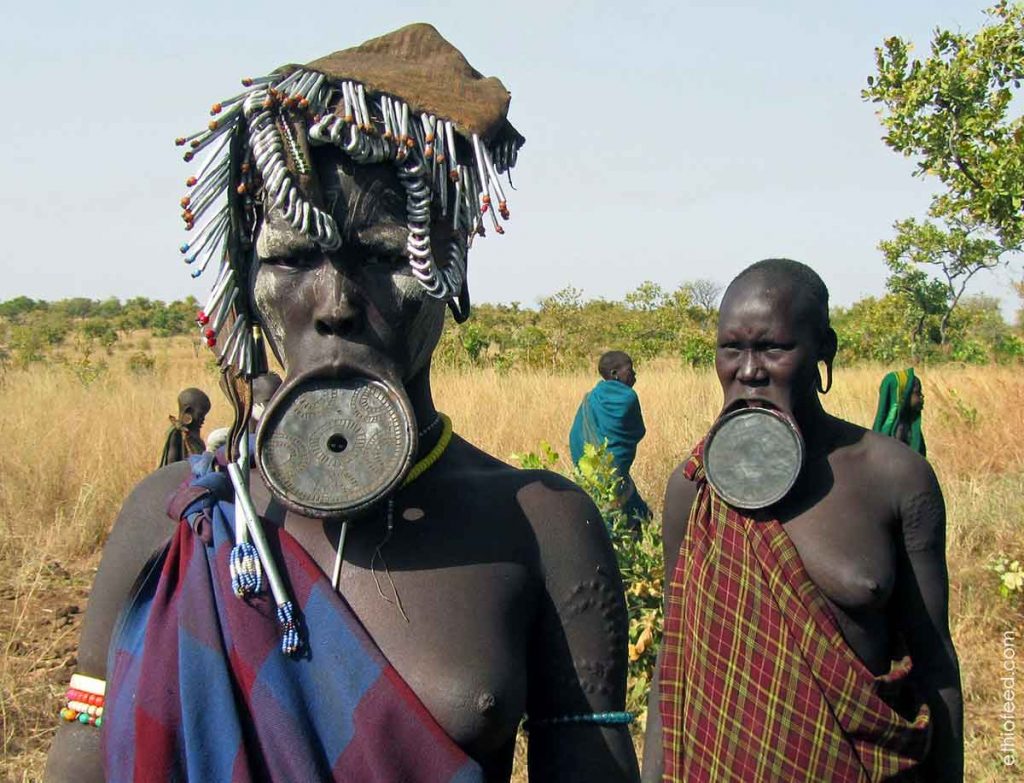
mursi people

9.   Mursi Tribe

The Mursi Tribe is thought to be one of the most aggressive and warrior tribes in the Omo region. They are known with their culture of getting a wife and respect thought intense stick fight.

The women are known with their round clay plates on their lips. Like the Hamar, they have their own jewelry on their ears and neck.

They scarify their full body as a symbol of strength.

https://www.youtube.com/watch?v=5a4oiIyTNr0

10.  Somali Tribes in Ethiopia

The present-day Somali is located The Somali tribes in Ethiopia are known throughout the horn of Africa. These tribes in Ethiopia were first appeared in the area in 1200 and later expanded to west and south. The Somali tribes are known with the faith of Islam, that is thought they were first converted in 1550 due to Arab traders. It was in 1650 the Somali people entered into Ethiopia.

The Somali tribes are sheep and cattle herders and the camel is a wealth for the owner. Camel milk is much known in this region. The Somali tribes live in a very divided clan, and clashes often appear in this area.

They also live in temporary huts and survive as nomads, and this is usually due to the harsh climate. They travel from place to place looking for water.

They are known with their music, and fancy women dress.

11. What Is the Biggest Tribe in Ethiopia?

The biggest ethnic group in Ethiopia is the Oromo. In 2007, according to the central statistics agency of Ethiopia, the population of the Oromo people was almost 34 %.  Amhara is the second-largest tribe in Ethiopia and the Somali was the third largest tribe in Ethiopia.

-Oromo 34.4%, Amhara 27% Somali 6.2%,

-Tigray (Tigrinya) 6.1%, Sidama 4%

-Gurage 2.5%, Welaita 2.3%

-Hadiya 1.7%, Afar 1.7%

-Gamo 1.5%, Gedeo 1.3%

-Silte 1.3% (Based on the 2007 population projection)

Find the Central Statistics Agency(CSA) data here.

12. Ethiopian Tribes Map

 Final Words and Necessary Tips

  • The Tribes in Ethiopia are truly diverse and have their own colors. Visiting each tribe is difficult but you can always taste the good offerings of each culture. Most restaurants serve the foods of tribes of Ethiopia. The Gurage and Amhara and Oromo foods are much known in these traditional restaurants. You can still taste the culture and the food from the comfort of a restaurant.
  • Minority tribes of Ethiopia and other bigger tribes exist at a border of Ethiopia. It is always the best option to avoid such extreme locations, that are at a border to neighboring countries. Clashes could arise at any moment and government and US embassy advise to ignore such places.
  • There are more than 80 languages in the country and these are categorized under 4 language branches: the sematic, Omotic, Kushite and Nilotic.
  • You probably don’t have to enter remote tribal settlements; you may need a guide.
  • Ask before taking pictures, or you may end up paying too much.
  • The best time to see the Omo valley is between October and March, where the rainy season pass and the dry season returns. Most of the internal roads are not paved and it would be hard to visit around the area.
  • Each tribal group or ethnic group has its own culture, a hair braiding style, clothing and even food that is uniques to its place. Many urban populations do not cloth in a traditional way. Instead, these cultural attributions are usually seen in the times of celebration and holidays. If you plan to witness these cultural attributes, then you should know the times of celebrations.
  • Irreecha is celebrated in October, probably a good time to see the Oromo culture.
  • Timket is celebrated in Lalibela on January 19 or 20, then it is the best time to see a northern Christian culture in Lalibela, Gondar and Addis Ababa.
  • Meskel, on September 27 is the best time to see culture in the Gurage area and the southern area and even in the Oromo people areas.
  • The Islamic holidays are the best times to be in the Somali and Harari regions.

Adopting Children From Ethiopia, The Bitter Truth, And 3 Tips

0
Ethiopia Country Code -

Adopting children from Ethiopia…It was in 2011, a story of Hana Williams, a 13 years old adoptee from Ethiopia died due to constant abuse at the home of adoptive parents in the US.

Can I adopt a child from Ethiopia? Adopting children from Ethiopia has been banned by the parliament in January of 2018. So, the answer is probably no. But I will show you the problem in Ethiopia, the reason adoption was banned and how you can continue with your options.

Children from Ethiopia have been a hot issue especially after movie personalities such as brad Pitt and Angelina Jolie adopted one from Ethiopia. Many people wanted to do that for its ease of access and affordability as well.

However, through time the whole process became a place of misuse and corruption. Many people who were connected to adoption agency said that the corruption in the local agencies creates a complicated situation. Parents pay a lot of money, often bullied by the agency, for their children to get priority for adoption. Poor families have been abused and even children were neglected in the process.

Falsified documents have been the center of the talk as well. Many children were shipped off with forged documents and falsifying about the status of their families, and their own ages to fit certain criteria. Adopting families were told, n some cases, that the children were orphans but later they found out that it was not true. Others were older than the document said they were.

Besides, the foreign adopting parents abusing children from Ethiopia was another issue.

The parliament and local institutions that work on children in related issues have been vigilantly following the complaints against abuse on adopted children from Ethiopia.

What Are the Problems of Children from Ethiopia?

The population of children in Ethiopia, from the age of 0-14 takes almost half of the population. These children have a low-quality of life and a family that could afford to send them to school or to take care of them. Due to the low financial capacity of a family, children usually end up on the streets, and in hard labor work.  

Malnutrition is another big problem in the country. Unbalanced nutrition and lack of food all together puts about 38 % of children in malnutrition. Many aid institutions declare a shortage of food and medical assistance among the children from Ethiopia and among children in other parts of the third world.

Almost  5% of the children die before celebrating their 5th birthday. About 27% of the living children are estimated to be in child labor.

Related: Ethiopia life quality

The girls are taken for granted in most families. These are beings that bring endowments. Most families don’t appreciate having a girl as they would not work and bring back the money. Therefore, they would rather sell them into marriage as early as 15 years old.

Today, almost 17% of girls between the age of 15 and 19 are married. 1 in 15 of these girls who are in early marriage give birth and are forced into the responsibility of raising a child.

This figure is scary when viewed from the general country perspective. More than half of the population is illiterate. That means they can’t read or write being over the age of 15. This is also true for girls under the age of 15. About 60 percent can’t read or write either. Therefore, they have no future hope of getting independent.

The challenge of poverty in the country extends even into a lack of health care and education for the children. Most children have to talk kilometers before getting to school. Some have to take care of the family first before walking for hours to their schools.

Recently, many endeavors have been made by the government to alleviate the school and health problems, but the problem still persists. Even the lucky children who got a place at school will have other related problems such as unable to get food on time. Many students fainting in class has been reported.  

Children From Ethiopia: Challenges Summary

  • The challenges of children from Ethiopia begins with the overall poverty of the country. The country that lives on less than 2 or fewer dollars a day, cannot afford to support the whole family. Children are expected to support the family in any way possible. Poverty forces boys into urban areas into day labor, and girls into domestic work, into urban nations and even into prostitution.
  • The infant mortality rate is also related to poverty as well. More than 10 percent of children die at birth for treatable diseases. 54 % of death among children is due to malnutrition.
  • Thousands of children from Ethiopia live on the streets as well. Recently the mayor of Addis Ababa and known people started a movement to help the street children get back to their family or get help. Many street children have been taken away from the streets into a shelter. Some studies show up to 150,000 street children exist in Ethiopian cities. Most have a dangerous addiction, sniffing petroleum to get them high and physically warm to get through the cold night.
  • Lack of education – Although school attendance of children between 7 and 16 is deemed mandatory since 1997, many families refrain from sending their kids to school. A cheap school payment is still too expensive for many. The necessary requirements such as uniforms and textbooks, that should be bought by the parents.
  • Child trafficking has been an issue for some time in Ethiopia. The country is one of the 10 highest slave-trading countries for African children. Thousands are sold away from their home, usually by their parents, with a hefty amount of money. It is a pity that they are forced into sex slaves, forced labor, or work in dangerous areas.

Child trafficking for marriage has been an accepted part of the culture for some time. This time the law is hard on such practices, and yet many girls are snatched away from the fields and streets into marriage.

  • Child labor- Thousands of children in the country are forced to work in hard labor, trying to support their families. Usually, the boys are sent into the city for day labor, and the girls to work in domestic housework. Children are forced into sex, usually end up with sexually prevalent diseases. Most children, for lack of maturity or for lack of information, don’t have the basic steps to protect their health. Most end up getting STDs.
  • Child malpractices- Genital mutilation in female children has been a widely known practice throughout the country. It has been a favored culture in many places. With countrywide work to educate society, the number dropped throughout the years.
children from Ethiopia flag

Is there a ban against adopting children from Ethiopia?

The US department of state says there were more than 15,000 cases of adoption children from Ethiopia since 1999. The country was one of the largest international adoption places by US families, taking 20% of the total.

In January 2018, Ethiopia banned all foreign adoptions, affecting more than 4.5 million orphans in the country.

Can I adopt children from Ethiopia now?

The simple answer is NO.

It was in 2011, a story of Hana Williams, a 13 years old adoptee from Ethiopia died due to constant abuse at the home of adoptive parents. The news was not only a shock to the community, but it was also a terror wake up call for the Ethiopians. Hana’s stories and other cases of abused children cases caused a big backlash on the adoption trend. Since then the number of adopted children decreases dramatically until 2018 the Ethiopian parliament blocked any was of adoption by foreigners.  

A lot of stories that involved corruption in local adoption agencies and giving off children without proper data were a few of the challenges found. Some families said they gave hundreds of dollars to help their child to get adoptive parents. Others didn’t know where their children went and they have no contact since then.

These types of stories are repelling to the Ethiopian community that lives together like a family.

Those stories may have shown the good deeds of many adoptive parents in America and other countries. Many poor children from Ethiopian had an opportunity for health care and school and a better life than they would not get otherwise.

After the death of the Hana, the families were convicted of manslaughter, homicide by abuse, first-degree assault of a child.  

However, the discussion continued back in Ethiopia as well.

Related: The other face of Ethiopia

Where Else Can I Adopt A Child?

Three are several countries that need adoption, due to a large level of poverty and no immediate care for children.

1-US has poor places that are hidden away from the world and even from America itself. If you see deeper there are many poor or incapable families that need immediate attention from you. Your country is a better alternative to start your adoption process.

2- China- China is another big country that needs immediate adoptive families. A large number of the population is poor yet and need assistance. The country follows the Hague convention on adoption. If you want to adopt children, you need to be between 30-50 years old and must be married for 2 years or 5 years if you are divorced. Only heterosexuals and two times divorcees are allowed.

3-Congo has similar criteria for china.

4-Ukraine has lesser requirement on the adoption, You only need to be 15  years older than the child and be married, you are good to go.

5-Asian countries such as South Korea and India also need your assistance.

See adoption policies around the world.

How can I check if I can adopt children from Ethiopia?

The US, Department of State advises not to begin any adoption process for children from Ethiopia this time. Only those who have been in the process before the enactment of the banning law are permitted to follow up to adopt children from Ethiopia. If you have questions on whether you are allowed to follow up on the process contact the office of children’s issues at [email protected] or the U.S. Embassy in Addis Ababa at [email protected]

If you have further questions, contact us here.

Ethiopia calendar behind the rest of the world, and 3 tips

0
ethiopian-celebration

Ethiopia calendar has been a topic of discussion lately among tourists and foreigners. If you have been to Ethiopia, you already know the country has its own calendar and timing system. This system is seldom confusing for newcomers as it creates a mix-up on which calendar or time system the locals are using. I have heard stories of missed meetings and schedules due to the mixup of time and date between the locals and foreigners. Many investors, visitors and tourists get used to the whole mess after a while. They even prefer using the local timing and Ethiopia calendar while they are in the country. For beginners, the new year in Ethiopia doesn’t begin in January, it rather begins in September where the winter ends and the summer begins in the country.

The Ethiopia calendar amazingly has more in common with the Coptic calendar, which has 13 months, and 30 days in each month. This means there is not 28 days or 31 days in a month. Every month has 30 days. And the 13th month is a leap year. The leap year becomes 5 and 6 interchangeably every other year, making 365 or 366 days of the year.

The Ethiopia calendar uses a different calendar, that is different from the Gregorian calendar. They use the incarnation era, that uses the annunciation of the birth of Christ that is 9 AD in the Julian calendar. The western system of annunciation calculates it as 8 years earlier. That is the Coptic calendar.

Related: What time is it in Ethiopia and other tips that save your frustration

The Coptic and Gregorian calendars are not the only calendars in the world. Here are other at least five known calendars with their own systems. These are the Hebrew calendar, the Balinese Pawukon, the Persian calendar, the Islamic calendar, and the Chinese calendar.

There is 8 years gap between the Ethiopia(Coptic) calendar and the Gregorian calendar.

How to convert the Gregorian calendar to Ethiopia calendar

It is not that hard to convert the Ethiopia calendar to Gregorian. Most Ethiopias communicate with foreigners using the Gregorian calendar just to avoid confusion. They even indicate which calendar or which timing system they are using. If you need to convert the gregorian calendar to the Ethiopian calendar use this page.

What are important dates in the Ethiopia calendar for tourists

There are a few dates that help you decide on your tour. These dates are one of the most active, which will help you see the social dimension of Ethiopia. These dates are listed as follows

1- The Ethiopia new year

The Ethiopia new year or Enkutatash falls on September 11 in the Gregorian calendar. This day is September 1(Meskerem 1) in the Ethiopia calendar. You will know the Ethiopian new year is closer when you hear the boys go from house to house handing drawings and singing on doors in exchange for threats or money. In the next week, the girls do the same, but the tone and the atmosphere would become serious and everyone would be prepared to accept the new year.

The overall preparation includes cleaning houses, buying new clothes for children, buying books and notebooks for students who will start school in 15 days or less. Families celebrate the day at home, killing a cattle or hen and making Doro wot or Sega wot and eating together with relatives and neighbors.

2- Ethiopia Christmas- Genna- January 7

The Ethiopia Genna celebrates the coming of Christ. On January 7, all Christian religious followers gather in their congregations to celebrate the day together. The day usually begins at religious places. After long church programs, the people return to their homes to pass the day with their families.

The day involves eating chicken stew made with a local method and drinking coffee.

ethiopian-celebration

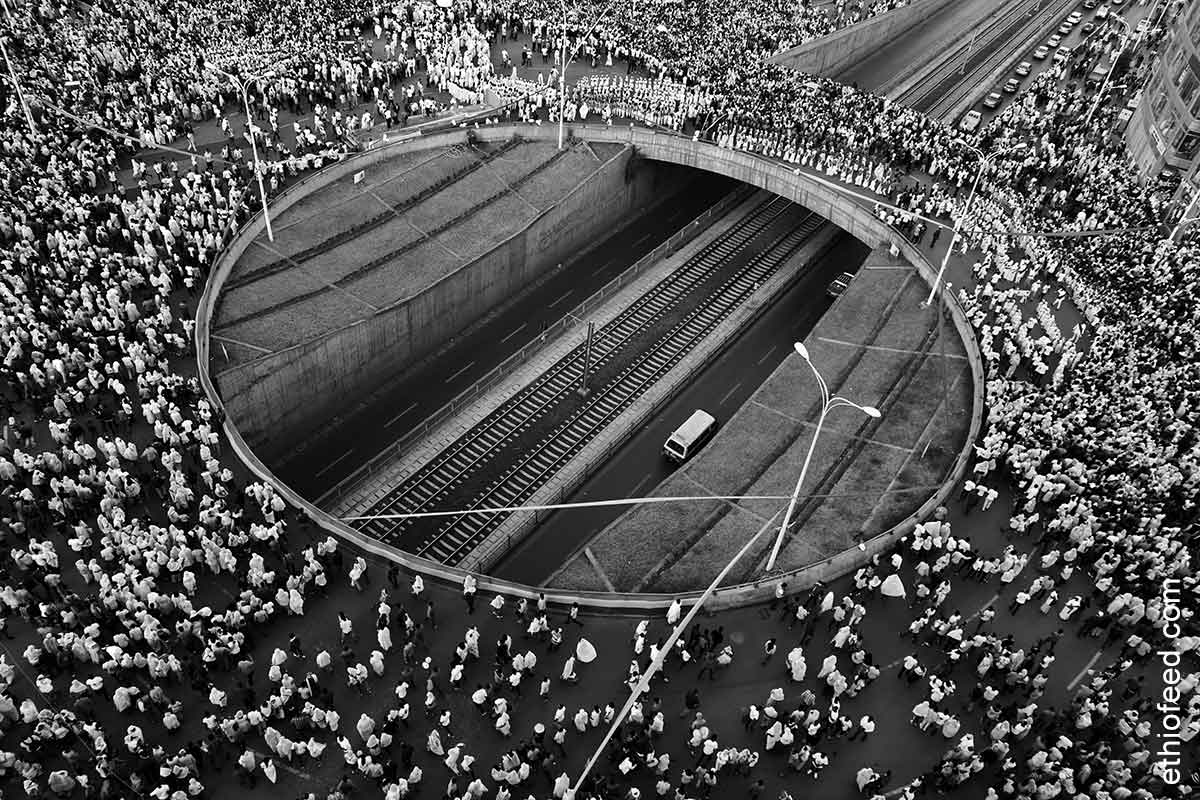
3- Meskel

Meskel attracts many visitors into the country. By the end of September, the rain is almost gone and the land is full of sunflowers, which usually indicates the new year. Meskel, that is the discovery of the true cross,  is celebrated at a place called Meskel square, in the center of Addis Ababa. The participants celebrate clothed in white, chanting and singing together and burning a huge bonfire.

4- Timkat – Ethiopia Epiphany (January 19th or 20th)

Timket celebrates the baptism of Christ. This ceremony is much famous among the orthodox Christians. The day may differ based on the leap year. The celebration begins a day before with a celebration called ketera. Tobot or replica of tablets of the law came out each church carried on the heads of the priests. It stays near water overnight. The crowd chants sing and play on drums on the way there. The Timket is much celebrated in Lalibela, Gondar and Addis Ababa. These are the best places to be on this date. Jan Meda is a famous celebration place on this day in Addis Ababa. The overall religious ceremony, the horse people, the baptism make the day attractive.

Related post: Ethiopian traveling on a budget. How much does it cost?

National Holidays in Ethiopia

The national holidays and celebrations in Ethiopia have a different date than the rest of the world.  The Ethiopia Christmas is celebrated on December 29 every year, not on January 7. The Ethiopia Christian holidays are much influenced by Orthodox Christianity in the country. The Islamic celebrations, however, have a similar date with the rest of the world calendar.

Western Calendar Ethiopia calendar Ethiopia public holiday Ethiopia holiday name
January 7 December 29   Ethiopia Christmas Genna
January 19 January 11   Ethiopia Epiphany Timkat
March 2 February 23   The victory of Adwa Day  
March 13   Id Al Fetir   
April 17   Id Al Adha   
April 25   Ethiopia Good Friday  
April 27   Ethiopia Easter Fasika
July 17   Moulid  
September 11 September 1   Ethiopia New Year Enqutatash
September 27 September 17   Finding of the True Cross Meskel

What Year Is It in Ethiopia Calendar Right Now?

Ethiopia has the Ethiopia calendar that has been influenced by the country Christianity. The Ethiopia calendar year is 8 years behind the rest of the world. If you are in 2020, the Ethiopia calendar is in 2012 or 2013. Since the Ethiopia calendar begins in September, and the gregorian begins in January 2020 in the Gregorian calendar is 2012 up to Nehase or August. Since the new year begins in September in Ethiopia, the next year from September to the end of December, the same Gregorian calendar of 2020, is 2013 in the Ethiopia calendar.  

Ethiopia Month Gregorian Month
Meskerem (the year begins year) September
Tikimt October
Hidar November
Tahsas December
Tir January (the year begins here)
Yakatit February
Magabit March
Miyazya April
Ginbot May
Sene June
Hamle July
Nehasae August
Pa’gumne (leap year, 5 or 6 days every other year)  

Why does Ethiopia have 13 months?

Unlike the gregorian calendar that has various days in months, the Ethiopia calendar has consistent 30 days in a month. Then, the rest of the five days will make the 13th month.

Which country has 13 months in a year?

When the rest of the world adopted the Gregorian calendar, that as 365 days in a year and 366 days in a leap year, Ethiopia could be the only country that accepted the Coptic calendar that has 13 months.

Related: What time is it in Ethiopia and other tips that save your frustration

What is Ethiopia’s 13th  month called?

The Ethiopia 13th month is called pagumiene. It doesn’t have an English equivalence to it. The pagumiene is usually between September 6 to September 10 in the gregorian calendar. The 13th month is a few days before the Ethiopia new year, which is September 11 in gregorian and September 1 in Ethiopia.

The 13th month is also the end of the rainy season and the beginning of the new summer. This is the month of preparation for the new year.

Ethiopia calendar

Which countries don’t use the Gregorian calendar?

Many countries in the world use the gregorian calendar as an only calendar except few countries. Afganistan and Iran use the solar Hijri calendar, Ethiopia uses the Ethiopia calendar and Nepal uses the Vikram Samvat.

Related: What time is it in Ethiopia and other tips that save your frustration

Countries such as India, Bangladesh, and Israel use the gregorian calendar with their own calendar. The Isreal has a Hebrew calendar, India has an Indian national calendar and Bangladesh has Bangla calendar.

Amazingly countries like Taiwan, Thailand, Japan, and Korea use a modified version of Gregorian cleaner.

Ethiopia calendar 2020 ( Ethiopia calendar 2020 in Amharic )

source

Ethiopia calendar download

There are various Ethiopia calendar apps on google play. Here are the few that come on top.

Ethiopia Calendar (ቀን መቁጠሪያ) 

This app has more than 2500 users in 2020. It is minimal and simple to use. It has past and future events tracking support. The Ethiopia and calendar Ethiopia calendar together displayed in a single calendar makes it easy ouse. The marks on each event in a month, that is visible on a single view is efficient. The app has 4.5 out of 5. It doesn’t have Ads by 2020.

Ethiopian calendar app

Ethiopia Calendar 2 – ቀን መቁጠሪያ

This app has more than 1000 users. The app contains ads. But it has a 4.7 rating out of five. It has similar features as the first Ethiopia calendar app.

Ethiopia calendar

Ethiopia calendar 3

This calendar has a bit less than 2000 uses. This third Ethiopia calendar app does not have Ads. The explanation pages and the event page is a plus. Besides, it has a similar feature to others.

Ethiopia calendar app

Final words

The Ethiopia calendar follows the Coptic calendar and this makes it different from the rest of the world. Ethiopia also uses the Gregorian calendar as an alternative calendar, especially in communication with foreigners. Since English is also a working language in the country, the overall communications should be easy for foreigners.

The leap year came from the collection dates from each month, as the Ethiopia months have only 30 days. The 13th month has 5 or 6 days every other year.

However, it is always good to confirm if the time and date of your schedule is in local time or if the calendar is Ethiopia or Gregorian. This will avoid confusion.

It is also good to communicate in the Gregorian calendar in Ethiopia, and you can add which calender you are quoting, just to make sure.

The celebrations such as the new year and Christmas differ from the gregorian calendar. This means you may have tow prepare for two holidays.

You need to adjust your visiting time based on the local event.

Addis Ababa Airport, 26 tips that save you from frustration

0
ethiopian airlines closer

Addis Ababa airport has been a story of a crash that killed 157 people, but it is one of the top airlines in Africa. The Addis Ababa bole International airport is located inside the city of Addis Ababa, in the Bole sub-city. The Airport is one of the busiest in the world and has nonstop service to various continents including Europe, Asia, and north and south America. It has two terminals: domestic and international. More than 400 passengers use the airport every day.

Ethiopian Airlines voted the best airline in Africa, has good accommodations and services in a small space. It joined the start alliance network and is working with international airlines and on more routes.

The airline was founded in 1945 and in march 2019 it had about 111 planes and 127 destinations. In a year’s time, more than 10million passengers used the airline, the Addis Ababa airport.

Here is the most necessary information about Addis Ababa airport and your travel and transit through Addis Ababa.

Basic

1.   What is the Addis Ababa Airport Code?

ADD – Addis Ababa Airport

2.   Location of airport Addis Ababa

The airport is located in Bole sub-city, 8 km or 5 miles southeast of Addis Ababa, Ethiopia.

Related16 important things to do in Addis Ababa

Addis Ababa’s quality of life and how much it costs in Addis Ababa?

Arrival and departure

3.   Addis Ababa Airport Arrivals

Upon your arrival, the first things you will be looking for will be a taxi to take you to a hotel. The airport doesn’t have its own taxi, but you will find a taxi outside, at a parking spot waiting for arrival. These taxis could cost up to 10 dollars based on distance traveled. You can always book through tour operators, for which case they should wait for you at the exit. People are not allowed into the airport building, only travelers, therefore, they should be outside the building.

The best option is to ask the hotel you booked to provide you a pickup. Most hotels in Addis Ababa have that option in their packages.

See arrivals here.

4.   Addis Ababa Airport Departures

See departures here.

Terminal

You can travel through from terminal 1 to 2 or from terminal 2 to 1 using a passage provided. There is a free shuttle service as well. Addis Ababa airport terminal 2 is a three-story building. It has 28 check-in counters and 7 airline gates. It also accommodates shopping post office, bathroom, telephone, VIP lounge and more. (read about lounges in terminal 2 below to learn about the lounges)

5.    Addis Ababa Airport Terminal 1 To Terminal 2

There is a bus shuttle to take you from terminal 1 to terminal 2, or you can walk through the building to arrive at your desired terminal.

6.    Addis Ababa Airport Map

It is rather hard to find the Addis Ababa airport map. However, the airport is small and easy to navigate even for first-time travelers.

Map: Addis Ababa Airport Terminal Map

Accommodation

7.    Terminal facilities

The Addis Ababa airport terminal has various basic facilities. At your arrival at the airport Addis Ababa, you can look for a money change desk, on your way out. The change is usually more expensive than the banks, some have noticed. But that is the best way to stay your journey into the city. You can always change the rest of the city banks. They will be happy to take your dollar or Euro.

While you are at the airport, you have an option to enjoy a duty-free shop. These have no newspapers or magazines. However, you can find drinks to clothing to souvenirs.

There are food courts where you can enjoy local and international cuisines.

Look at lost found section, if you miss your luggage.

You will also find a telephone in the airport Addis Ababa and the post office is also available.

Based on the request before traveling, the disabled facilities could be provided to you.

8.    Addis Ababa airport new terminal

The new 363-million-dollar terminal was opened at the end of 2019. The new terminal is believed to double the airport capacity to 22 million annual passengers.

The new terminal has new lounges, shops, dining places.

9.    Addis Ababa Airport Hotel (Addis Ababa Airport Transit Hotel)

The Addis Ababa airport hotel was opened in 2019. The hotel has 373 rooms and is called the Ethiopian skylight hotel. The property is financed by China and it is not surprising to find the biggest Chinese restaurant Africa, inside the hotel. It also has a sports facility, shops, food court, and a swimming pool and a conference hall.

ethiopian airlines closer
“Ethiopian 70 anniversary” by Martin J. Gallego. Siempre enredando is licensed under CC BY-NC-SA 2.0 

10.  Addis Ababa Airport Wifi and inflight wifi– is there wifi?

Free Wifi Addis Ababa Airport is available at the airport. However, the current Addis Ababa airport Wifi is not reliable. Many costumers complain about the airport Wifi on many rating platforms. However, the Addis Ababa airport is working towards solving this issue. The issue of unreliable internet is a county-wide problem, and we hope will improve with the progress of the country’s economy.

All A350 flights have wifi. You need to purchase vouchers at the Ethiopians airline customer service office or from the cabin crew in the plane or even online.

11.  Addis Ababa Airport Lounge Shower

The shower in Addis Ababa airport is still lacking. The weather, however, in Addis Ababa is optimal as the city is above 2300 meters altitude. You don’t need AC in buildings, in the city. So, you should be fine. If you have a long layover, then it is better to look for showers outside of airport Addis Ababa.

12.  Cloud Nine Lounge  

A lounge at the departure hall of terminal 2 in Addis Ababa airport is exclusively for cloud nine passengers. The plus side of the lounge area, the better comfort than other lounges in the Addis Ababa airport. Besides the variety of refreshments and snacks, the customer service agents will come and announce departure time for your flight.

13.  Star Alliance Gold Lounge

Located at Departure Hall of Terminal 2, the star alliance gold lounge is only for ShebaMiles Gold and Star Alliance Gold members.

14.  ShebaMIles Silver Lounge

Located at further away from other lounges, ShebaMiles Silver lounge is for members with silver membership cards.

Check-in

15.  Ethiopian Airlines Check In

The Addis Ababa airport online check-in works between 2 hours and up to 36 hours before departure. You can use the online checking to reserve a seat or confirm attendance. This is probably the easiest way to the airport at peak traffic hours.

The Addis Ababa airport check-in usually opens three hours before departure time and stays open to one hour before departure. You need to visit the check-in desk.

It is always advisable to arrive three hours before departure for your check-in.

Ticket

16.  Ethiopian Airlines Ticket Office

Global Call Center- Ethiopia airlines phone number

Address: Ethiopian Airlines Head Office

Phone no. no.:   +251 116 179 900 (6787 to be used within Ethiopia)

Working hours: 24/7 throughout the year

Main City Ticket office- Ethiopia airlines phone number

Address: Churchill Road

Mailing address: P.O. Box 1755, Addis Ababa

Phone no. no.:   +251 115 154036

Working hours: 07:00 – 19:30 Monday to Sunday including Public Holidays

Hilton Ticket Office – Ethiopia airlines phone number

Address: Inside Hilton Hotel

Phone no. no.:   +251 115 511540

Working hours: 07:00 – 21:00 – Monday to Saturday

Sunday and Public Holidays 07:00 – 17:00

Bole Ticket Office- Ethiopia airlines phone number

Address: Adika Building, In front of the Friendship Hotel

Phone no. no.:   +251 11663 3162/63

Working hours: 07:00 – 19:00 – Monday to Saturday

Sunday and Public Holidays 07:00 – 17:00

Addis Ababa Sales Office- Ethiopia airlines phone number

Address: Ethiopian Airport Enterprise Building, Ground Floor

Mailing address: P.O. Box 1755, Addis Ababa

Phone no. no.:   +251 11 637030

Working hours: Monday to Friday 07:00 -17:00

17.  Ethiopian Airlines Flight Schedule

Find our Ethiopian airlines flight schedule here.

18.  Ethiopian Airlines Baggage Allowance

Free baggage allowance on international and local Ethiopian airline routes is available based on the weight and size of your goods. The maximum weight for single baggage is –

-32 kg of single baggage for business class, max. the dimension of 158 cm (62 inches)

-23 kg for single baggage for economy class, max. the dimension of 158 cm (62 inches)

More weight per baggage won’t be accepted for check-in.

Find detail info here.

Tourist Visa and Transit Visa

19.  Visa

A tourist visa to Ethiopia is an electronic single-entry visa issued by the stage for tourism or other non-business-related purposes. Any applicant from any country who has a recent passport size photo and passport with more than 6 months left before expiration is eligible for a visa.

The visa process could take up to 3 days, therefore you may need to submit an application 3 days before arrival. If the arrival date changed, you need to contact the e-visa team [email protected]. You need to pay 52 USD for 30 days single entry and 72 USD for 90 days single entry.

Apply online for a visa into Ethiopia.

20.  Addis Ababa Airport Transit Visa  

As long as they say in a permitted transit area and depart in 12 hours, you don’t need Addis Ababa airport transit visa. You only need a visa if you stay longer for 8 hours or if you want to leave the airport. You can obtain a transit visa from the Addis Ababa bole airport or from the Ethiopian embassy or consulate. Everyone who enters the country except Kenya and Djibouti, need a visa to enter Ethiopia.

Transit visas could cost from 27 dollars for 12 hours to 63 dollars for 72 hours.  

Layover and Transit

21.  Transiting Through Addis Ababa Airport

What to do in Addis Ababa airport for a 20-hour connection?

Many people who are in a layover in Addis Ababa ask if they would be bored or would get basic accommodations in the city. It is always good to have in mind that Addis Ababa is not a bad city for visitors. With various service costs and a peaceful environment, you will surely enjoy your layover on a budget.

There are a few things you have to understand. First, if you are traveling both flights on Ethiopian airlines, and if your connecting flight is over 8 hours to 24 hours, then you surely will have a free hotel accommodation outside of the airport. You may have to ask on your first check-in. You will get a boarding pass and hotel voucher.

Second, with your passport, you may not enter the country. You may need a visa. Therefore, purchase one before your flight or request one at your arrival. It should serve you for a month. The hotel is very close and a bus shuttle will take you and bring you back on your flight schedule. At that time, you can visit the city with a tour bus or private tour.

How much do things cost? Breakfast would cost up from 2 dollars to 5 dollars depending on where you have it. Lunch and dinner also fall between these costs. Between entrance fees to museums and tourist destinations, and for a taxi you will pay up to 30 dollars. (of course, that is a lot if you know what to do you can save more than half)

Option 2 is to take a voucher to your hotel and take a taxi directly to local cultural restaurants. There you will experience the local food and local culture. A 4 dollars taxi will get you there.

22.  5 Hour Layover in Addis Ababa, can I get leave the airport Addis Ababa?

As discussed above only above 8 hours layovers get a visa. You can still enjoy the lounges. (See Tourist Visa and Transit Visa #25 and #26 section for more)

Related16 important things to do in Addis Ababa

Addis Ababa’s quality of life and how much it costs in Addis Ababa?

Destinations

23.  Local and international destinations

Ethiopian Airlines fly to 23 cities in the country. These include Addis Ababa, Arba Minch, Assosa, Axum, Bahar Dar, Bale Robe, Dembidollo

Dire Dawa, Gambella, Gonder, Gode, Hawassa

Humera, Jijiga, Jimma, Jinka, Kabri Dar, Kombolcha, Lalibela

Mekelle, Semera, Shire , and Shilavo.

The airlines fly to 61 cities in Africa, 20 cities in Europe and north and south America and 25 cities in the Gulf, Middle East, and Asia.

Africa – 61 Cities (including Ethiopian cities)

Abidjan, Abuja, Accra, Addis Ababa,Antananarivo ,Asmara,Bahir dar,

Bamako, Blantyre, Brazzaville, Bujumbura,

Cairo, Cape Town,Comoros, Conakry, Cotonou,

Dakar, Dar-Es-Salaam, Dire dawa, Djibouti, Douala, Durban,

Entebbe, Enugu, Gaborone, Goma, Harare, Hargeisa,Johannesburg,Juba, 

Kaduna,Kano, Khartoum, Kigali, Kilimanjaro, Kinshasa,Kisangani

Lagos, Libreville, Lilongwe, Lomé, Luanda, Lubumbashi, Lusaka

Malabo, Maputo, Mbuji-Mayi, Mekele, Mombasa

N’Djamena, Nairobi, Ndola, Niamey, Nosy Be 

Ouagadougou, Pointe-Noire, Seychelles, Victoria Falls

Windhoek, Yaoundé, Zanzibar.

Europe, North and South America 

Brussels, Dublin, Frankfurt, London, Manchester, Madrid, Rome, Milan, Oslo, Paris, Stockholm, Vienna, Paris, Chicago, Washington DC, Newark, Canada, Buenos Aires, Rio De Janeiro.

Gulf, Middle East & Asia

Bahrain, Bangkok, Beijing, Beirut

Chengdu

Dammam, Delhi, Doha, Dubai

Guangzhou, Hong Kong, Jakarta, Jeddah

Kuala Lumpur, Kuwait

Manila, Moscow, Mumbai, Muscat

Riyadh, Seoul, Shanghai, Singapore, Tel Aviv, Tokyo.

Related16 important things to do in Addis Ababa

Addis Ababa’s quality of life and how much it costs in Addis Ababa?

Accident

24.  Ethiopian Airlines Crash

An Ethiopian airline passage flight from Addis Ababa to Nairobi crashed killing 157 people on board in March 2019. The eight were crew members. The ET302 only flew 6 minutes before it crashed in a town in Bishoftu. Passengers from Kenya, china, the united states, and Canada lost their lives.

According To a flight tracking platform flight radar24, based in Sweden, claimed that the vertical speed of the plane was unstable after take-off. Sadly, the same aircraft Boeing 737 Max has been crashed in Jakarta, a year prior.  

Necessary Gadgets

25.  Ethiopian Airlines App

Ethiopian airline’s app has few features. The first is a booking. You can book your flight, choose your meal-type and seat and even pay and purchase a ticket. The Sheba miles option is integrated as well. You will also see your past trip summary. You can check-in using the app and even see the flight status. The airline’s app is a great tool for traveling.

Find the free app here.

26.  Ethiopian Airlines Contact Number and address

-Ethiopian Airlines Official website

-Ethiopian Airlines Online Check-in

-Check Ethiopian Airlines flight status

Airport Offices- Ethiopia airlines phone number

Address: Bole International Airport

Phone no. no.:   +251115178320/455

Working hours: 24/7 throughout the year

-Manager of Corporate Communications

Tel: (+251-11) 517 8407 / 8907 / 8165 / 8529/8913

Fax: (+251-11) 661 1474

E-mail: [email protected]

-Baggage Service- Ethiopia airlines phone number

Phone no. no.: +251 11 5178306/+251-11-6650304

-Airport check-in counter

Phone no. no.: 251-11- 5178455/955

-General Mailing address-

P.O. Box 1755, Addis Ababa

Final words

In Addis Ababa or even the whole of Ethiopia, it is always better to ask questions if you are lost or if you need any help. The workers in the airlines are eager to help you.

There is sometimes high traffic, therefore, you may get off the plane to finish processing. The new terminal surely will help alleviate this problem soon.

You need to obtain a visa only if you are a tourist or if your layover is more than 8 hours and you need to leave the airport. A transit passenger doesn’t need a visa. If you stay at the airport (although you have above 8 hours layover, then you may not need a visa.

The best way to experience Addis Ababa with your few hours of transit visa is to catch a taxi to a local cultural restaurant and have the food and have fun with the ceremony. Don’t drink too much.

If you have more time, then go wild in the city. Take a metered taxi and go around the city and visit tourist destinations.

Using the Ethiopian airline’s app is the best way of booking and following your track record and even to follow your flight.

Although the airline had an accident recently, thought is a fault of the plane manufacturer, not the airline, the airline is growing each year. The new terminal will provide better service for its users.

Image source: “Bole Road, Addis Abeba” by Samuel Santos is licensed under CC BY-NC-SA 2.0 

27 Things You Wish You Knew Before Visiting Addis Ababa

0
Ethiopia weather -

Addis Ababa is a very diverse city, with various religious and ethnic groups and socioeconomic groups. It is a dramatic scene for many visitors and a new context. We don’t usually see a gap in communication but there are some things that tourists miss or don’t understand when they come to Addis Ababa.

Here, I will briefly tell you everything you need to know before coming to Addis Ababa.

1.    The Climate

Addis Ababa is not a desert or a hot balloon as you may have heard. The city, unlike many African cities, has optimal temperature throughout the year that is better than many American and European countries. It is not called the land of 13 months of sunshine for no reason. The land really gets sunshine all the months and gets a shower of rain at least for 3 and 4 months.

The rain doesn’t persist all day either and comes and goes within hours, either in the morning or in the afternoon. The city’s location that is around the equator makes the weather constant. In January the temperature ranges from a high of 68°F (20°C) to a low of 53°F (12°C). Source

The day is sunny from January to May, sometimes hotter. Recently the rapid construction seems to have increased the city’s temperature. The open spaces are disappearing following these activities.

Tip: choose clothes based on the month you visit

addis ababa rain

2.    Geography of Addis Ababa

The city is a land in-between mountains, Entoto is located in the north at the highest point of 2440 meters and 8000 feet altitude. Yerer mountain is on the east and Mount Wochecha is located on the west.

Addis Ababa as a ring road, constructed to alleviate the traffic flow. And the east wet road takes traffic from the Tor Hailoch area to the CMC area. That is a good reference for studying the city’s map.

Tip: visit Entoto to understand Addis Ababa

3.    The population of Addis Ababa

Since Addis Ababa is a capital, many people from the nearby town migrate for work. The city had residents of 3.4 million people in 2007. The population is growing at 3.8 percent annually and the 2007 estimation is expected to double in the near future. The city has 527 square kilometers and about 5000 people per square kilometer lives. The center of the city is probably one of the densities settlements in the country.

Ethiopia woman standing

4.    Language

Ethiopians have never been under colonialism. You will not see much European influence, except for some Italian like buildings and Italian names.

Hollywood seems to have a grip on the social life of the society. English is widely spoken in the city. Most of the education has English courses in them and students are expected to learn with English after the sixth grade. However, many people have a poor command of the language.

You can always use English to ask for directions or communicate with locals.

Tip: English could be bad, but many people understand and respond to English. The shops and directions use English as a second language as well.

5.    History

Addis Ababa was founded in 1887, by Menelik the second. Before settling at the present-day area, the king moved around various encampments, finding a place with sustainable firewood and security. There was no other place with optimal temperature and with an abundance of eucalyptus trees (that was originally imported from Australia) and with higher altitudes such as Entoto for security issues.

After settling on the mount Entoto, later legend says that the empress was attracted to the area, especially to the hot springs in the Fil Wuha area. Later, she called the area, Addis Abeba which is translated as ‘New Flower’.

Tips: visit museums and monuments to understand the history of the city

Italian Invasion of Ethiopia -

6.    Colonization

Ethiopia has never been colonized, therefore, has no European influence in the country. However, the city fell under the Italian army for 4 years in 1936 where the capital was captured. This led the emperor Haile Selassie into exile. The Italian army used prohibited gas in the fight and about 5000 Ethiopian fighters lost their lives, and 1537 Italians died in the action. The Italians, on the other hand, estimated that 16,000 Ethiopians and 2700 Italians died in the battle.

In May 1937, to stop resistance against the Italian army, the Italians began a rampage of murder throughout Addis Ababa and killed more than 5000 people. Many leaders and church people were killed throughout the country.

With infrastructure development and buildings, the Italians also left their footprint in Addis abba. They built a road between Addis Ababa and Massawa, Addis Ababa Mogadishu and Addis Ababa Assab roads, and the railway to Djibouti. They also created an airport and started a flight to Rome.

In 1941, Haile Selassie returned to Addis Ababa to reclaim his throne.  with the British assistance, the Italians left Ethiopia.

Tips: Ethiopians are proud people. Treat them like one.

7.    African Capital

Addis Ababa’s diplomatic and pollical position throughout history. The African Union is located in Addis Ababa. The new building is also a tourist attraction.

Tip: You may see traffic disturbance in the meeting days.

8.    Slum

They say 80 percent of Addis Ababa is categorized as a slum. A slum is a place not good for living. Most places have a constant upgrade but stayed low quality and without the proper amenities. The new condominium housing ventures have stayed short due to financial reasons. Even these are in the suburbs where there is no infrastructure and increasing commuting time, creating more problems.

It is nice to visit slums to have a glimpse of the urban poor. But do not enter into the neighborhoods and limit your activities on the street for your own safety. (It is to be careful. But most neighborhoods are peaceful)

Tips: visit the slums, safety first

9.    Budget stay

Budgeting in Addis Ababa seems impossible since the price is not fixed in many places. But it is still possible to have a great stay on a budget. Therefore, you may need to identify economical services. For example, you will find places to stay from a 20 dollars nice hotel to 30 dollars per night Air BNB to 50 dollars high-end hotels.

The food also differs based on locations. The food quality in many places seems to be similar. However, prices differ based on the quality of the restaurants, not the food. Many restaurants and hotels have hidden costs for extra services such as WIFI and plumbing.

Only a few have really trained chefs and world-class services. If you are sure that the cafes and restaurants are neat and the places are alive and comfortable, you can always stick to that place.

I would also advise you not to pay for long days, instead, pay for a few days and see if you like the place you rented. You can always talk to the front desk for any uncomfortable situations.

Tips: find your stay based on your budget, there are lots of options

10. Transport

The Ethiopian airlines have two terminals, domestic and international. A new international building started working only recently, to ease the high need. The flight time from Addis Ababa to London is usually about 8 hours long, depending on the route. Travel to most European counties is five hours or sometimes more. Travel to America is up to 14 or more hours long.

For visitors, traveling in Addis Ababa on a bus or minibus taxis seems a bad idea. Many tourists complain about the delay in public transport including local air travel. You will surely be disappointed if you expect a world-class public transport service. The overall service lacks quality and doesn’t even oblige the basic demand.

Instead, using a contract blue taxi or the recent Uber type drives would be the best option. Especially the Uber type drives have an app where you will call for a taxi and even know the distance and rate you traveled. An average distance could cost up to 150 birrs or less, that is about 5 dollars, for a long-distance trip.

If you travel from Addis Ababa to another city, air transport is still the best option. You will find ticket offices everywhere inside the city. If you used Ethiopian airlines to travel internationally, then you would have a big discount on your local flights. You need to take a flight to the Bole airport in the domestic section.

Long-distance buses are also an option for a trip to another city. Ethiopia is a vast nation and travel would be tedious, and you may need to travel through various altitudes and temperate regions.  This could mean you need a bit more resistance to rapid weather changes. Traveling from Addis Ababa to Axum could take more than a day and you may need to rest on the way. Most direct route roads are asphalt paved; therefore, you don’t worry about discomfort. The buses are also standard and are comfortable. You may need to purchase a ticket a day before and know the departure location and be on time.

However, some buses, especially that you take from a small city to another may not be as comfortable. You would have to seat on old chairs, and with people standing next to you. You may need to get prepared as you would be traveling with rural residents, and smell from working clothes and stuff they carry would be obvious and sometimes hard even for the urban residents in Ethiopia.

Most buses begin at stations in the city, at Autobus Tera, near Merkato or Akaki Kality station or other similar stations at the exit of the city. Some start at Meskel Square. You may need to make sure where to take them before your departure date.

Tip: Avoid public transport in Addis Ababa, instead use Ride, a Uber type app.

gurage -

11. Vegan

A year before while engaging with some Americans and European visitors, I noticed how they were amazed at how slim Ethiopians are. Everyone was cheerful and wondered how it happened. They saw the Ethiopians were eating a lot, even more than some of the visitors, but they stayed fit.  The secret probably is the injera that has low calories.

But the main one could be the religious celebration of fasting twice a week, that discourages eating animal products. On these days, the followers of religion avoid dairy or meat and only consume vegetables and crops.

This would continue once a month for a few more days. This may seem trivial for some, but this simple way of life has a huge impact on the daily life of the people.

For this, the foods such as Beyaynet ( Injera with vegetables on a single plate), Suf Fitfit (injera immersed in a sunflower seed sauce) became top choices.

For non-veggies, you can always have tibs, meat Firfir, Kitfo (may be hard for some new eaters as the raw meat is immersed in locally made butter) and Doro wot (stewed chicken with the local way of cooking). These foods are eaten with butter (locally made), Ayieb( local cottage cheese).

Tips: Don’t eat much of some traditional foods at a time. Start small.

12. Shop

Shopping in Addis? Yes, it right. You can always shop in Addis Ababa and surely, you would find great choices that you won’t regret. Besides the choices, that are from China, you will find amazing locally made garments and cloths and artifacts in the city. Merkato would not be the best choice to go alone. Even if you do, you probably get lost than buying anything worth. Instead, visit Shiro Meda, a locally made clothes market, near the US embassy. The place has shops full of Ethiopian clothing and artifacts. If you bargain, with the normal price on your mind, you may get the best price.

If you are interested in local spices, then you need to visit the shola market in the eastern part of the city. Many shops sell locally made honey, and spices and locally made coffee pots and cups.

If you are interested in historic artifacts and jewelry, then you should visit the national theatre area, behind the post office. You need to bargain at every option, or you will end up paying more than the original price. The best option is to know the price before going there or go with a local person.

13. Crime

Many data show that Addis is one of the safest cities in Africa. Except for a few pickpockets and con artists, the city is safer than even other cities in the country. There is always a risk of going to highly chaotic and dense places like Merkato and places that have no traffic. It is better to leave personal belongings back in your room before walking on the street. Don’t engage in arguments or fights. These could be con artists trying to check your pockets.

Fights on the streets are rare. Don’t let strangers wipe your cloth after they throw garbage on you. This is a trick to get close to you. Don’t engage in an argument if people force you to buy something. Some places, they may push you to take food telling you it is free, and they may tell you to pay after you eat.

Public transport is another comfortable place for pickpocketing. Don’t carelessly put your phone or wallet where it is accessible for thieves.

Report to the police station nearby or to a policeman on the streets near you if you encountered any problem.

Have a hand torch, as blackouts could appear at any moment. These usually don’t stay long unless it is a serious problem and yet they appear annoying for visitors. Be aware of stray dogs and feral cats.

Tips: The police number in Addis Ababa is 991.  

14. Pollution

Pollution is obvious in the city. The old cars on street pollute the air. The new construction also has a huge impact on the city’s air quality. The air is dusty and trees appear grey. It is not usually noticeable but there definitely air pollution.

Due to a lack of garbage disposal systems, some residents remove garbage directly into rivers. Even factories prefer rivers to remove their toxic disposals. In some areas, we witnessed dried trees and dying soil due to toxic disposals. Some say that there is heavy metal in the vegetables grown next to rivers.

Sanitation is sometimes low on street-side kiosks since dust and dirt are not controlled. Avoid eating in cheap street-side small places.

15. Sport in Addis Ababa

Addis Ababa has not many sports facilities. Many hotels, however, host swimming pools and tennis fields. There are few stadiums being built in the city. Many young people frequent at Jan Meda, a field near sadist kilo and others on Meskel Square.

You probably don’t see joggers on the streets, as most of them do them early in the morning.

16. Embassies

Addis Ababa is a seat for the world embassies. You can directly consult or call your embassies. The US embassy, for example, encourages citizens to contact them if needed. Find a printable document of addresses of embassies in Addis Ababa.

17. Important Addresses- Emergency

Find important addresses in Addis Ababa.

18. Time Difference

The most confusing part of the Ethiopian culture is time usage. Time doesn’t start at 7 here, it starts at 1 and ends at 12. The evening starts at 1 and ends at 12 in the morning. Since Ethiopia is located at the equator, daylight saving is not necessary and the day and night stay equal. Therefore, you may need to ask if your schedule is with local time or international time. Or you may miss your meeting. Ethiopia has its own calendar. The country also has 30 equal days in a month and a five- or six-day leap year.

The country is located at +3 UTC. You need to calculate the time difference based on that. New York is at -8, therefore, there is an 11 hours difference and most American cities have 8hours difference Europe have equal or not more than 3 hours difference to Addis Ababa time.

Related: What Time Is In Ethiopia?

19. Best Time to Go

The best time rather depends on your goals. If you are planning to visit and to go around trekking and outside activities, then the winter is a bad time to visit Addis Ababa since the rainy season begins in June and ends in September. Mostly the rain would come and go in half a day. The sun always shines even in wintertime.

Therefore, the best time would be in the dry season from September to May. In September and May or June, there are a few showers of rain and the rent prices get cheaper in some areas.

20. Views

The city is much visible from the Mount Entoto.

Related Post: 16 Important Things to Do in Addis Ababa

21. Discover Addis Ababa

At first sight, there seems not much to visit in the city. The city is truly different from many other cities you have visited. The vast language, ethnic diversity, religious diversity all make the city remarkable. On the other hand, Addis Ababa has large slum settlements, the UN classified as an unliveable place. It is a pity that the city’s policy and the economic situation held back the city from growing. Most of society lives in a poor situation. Well, that is a dream killer.

But Addis Ababa has much wealth that needs attention. You can visit many historic, religious, social spaces and be part of it to experience it. These places include the national museum where you will visit Lucy, ‘one of the first humans’, and other hominid skeletons and charts and historic artifacts. Meskel Square is another social space where you will meet different people from many classes and social groups.

Monuments express the dark and bright histories of the city. The Derg monument tells stories of a socialist government. The lion of Judah tells the story of royalty. The red terror museum displays true horror stories of the socialist era.

Merkato is another depiction of chaotic but organized spaces of Africa. It is the top open market in Africa as well. Besides, the informal activities and economic structure make the place worth visiting.

Related Post: 16 Important Things to Do in Addis Ababa

22. Health and Pharmacies

I read some guides talking about not eating foods in Ethiopian restaurants and not to drink tap water. The whole advice seems a good tip for any traveler who changes places and eats foods they have never eaten before. Of course, one would expect some dysfunction inside that belly.

I am reminded of a time I went to see a doctor after I first moved to Europe years before. After I heard his explanations, I replied saying that I became sick only after drinking the tap water. The doctor was confused and pissed at the same time. And egoistically, he continued explaining how tap water was the best in the world. After all, the disease I had was only imaginary.

The tap water is drinkable but some locals avoid it.

Use filtering or warm the water before drinking. Instead use it only to wash your face, your clothes and to cook with it. Instead, use plastic bottles. Two liters of bottled water is about 40 cents USD.

23. Car Free Days

With the objective of promoting healthy living and air pollution free day, Addis Ababa has car-free days once a month. These days, usually on weekends, some main streets will be closed for traffic. One these days kids and young people who had no park or open space in the city would come out on the streets to play soccer and to skate.

24. Internet and SIM

Addis Ababa has internet access from the solo provider Ethio-Telecom. Most hotels provide free internet but the speed is not that good in many of the places. In a few places, there is good internet speed, especially on the high-end hotels. Most internet cafes have a dial-up connection and the speed are unreliable.

If you stay longer, and if you have the budget, Ethio telecom has unlimited 4G service for 130 dollars a month. The rest of the service is not reliable or is very expensive.

You can obtain a sim card for a dollar once you get to Addis Ababa. You can get it from any telecom shop. With topping with different priced cards, you can get 4G internet and voice and texting time. It is an expensive option to use this service for video streaming.

girl with ethiopia coffee

25. Coffee

Well, it seems cliché to advise someone to have coffee before leaving a city. But this is true. Ethiopia probably has one of the best homemade coffees. It is said that the first quality of arabica coffee in the country is exclusively for export. Most cafés don’t serve first-grade coffees, yet, the coffee remains good. Ask for ‘ye jebena Buna’ at a local café and you will have a good traditional coffee. Buna is translated as coffee and Ye jebena Buna is a coffee made with ‘Je Bena’ (traditional kittle).

The best place to have coffee could be at Tomoca, small cafes that exclusively serve coffee. Since the coffee is from machines and is very strong, I would not advise you to drink only coffee. Instead, order a Macchiato. That will surely make you hyper like the Khalid’s goat.

Coffee is about 2 dollars inexpensive houses and about 50 cents USD in average cafes.

Related: How to Make Ethiopian Coffee at Home

26. Taking Pictures in Addis Ababa

Everyone takes pictures these days. But the locals don’t take pictures of the dirt on streets, or street boys or random people. Only visitors do. It is always best to ask to take pictures of people before doing so. Ethiopians are not violent most of the time, but you may need to respect boundaries. This is a problem I see in many places including in African nations. Foreigners taking pictures of random people on a train or on the street. Better to respect boundaries.

Final Words

This article is not the ultimate fact, rather it is a simple guide to help you what to expect. Use it as a baseline for your actions and for what to expect. 

16 Important Things to do in Addis Ababa, Ethiopia

0

Being home to 3.3 million people, and foreigners from various countries around the world, Addis Ababa is a multiverse city, that has an amazingly diverse background, culture and looks. It is one of the most chaotic, but still inviting places you would be around the world. Visiting Addis Ababa is one of the best things you should do while you are in Ethiopia.

Since Ethiopia has never been under colonization and it is a seat of the African Union office, the capital Addis Ababa is called the capital of Africa. Its recent visa on arrival access to all African countries, and it has become a reality to its name.

Located at 2665 meters above sea level the city has optimal weather and has an active outside life. The winter has a fair amount of share of sunshine and rain in a single day, therefore, there is no extreme weather.

The diversity of the people and the culture created economic and social diversity. It is a formal setting in chaos. It might seem a random act of human gesture, but everything has a reason and every motion has its own beauty. The expensive cafes or the small street-side kiosk have their own place and beauty. You will truly witness a unique context.

Besides, you will experience the coffee, the culture, the religious activities, the chaos of Merkato, the slum and more. Addis Ababa is a story you will tell back in your country.

Here I will show you 12 things to do in Addis Ababa Ethiopia.

Social setting- Addis Ababa

merkato addis ababa chaos

1. Merkato, Africa’s largest open market

Merkato is not your ordinary street market. It is one of the most chaotic and crowded places in the city with various types of businesses and a diverse group of people. In its vast land, are various activities including the informal market, street markets, low-cost residences, recycling spaces and more. The vast activities, such as carrying objects from place to place, car and people in the same street is both risky and memorable to visit.

You will find almost anything in Merkato, from food to Chinese clothing to recycled furniture to souvenirs.

Merkato is not a place for visitors to go in without a guide. It is a complicated space with its health and security issues. It is always better to go with a guide and of course without your valuables.  Since the place is hard to secure, there always are street pickpockets in these areas.

There are security people in the area and you will be safe but you will be safer with a guide. Someplace can become health issues, especially Atikilt Tera, that is a vegetable and fruit section, due to unorganized garbage spaces.

EAYOR. That means ‘Enter at Your Own Risk’, by the way.

2. Shiro Meda Market, Addis Ababa

Shiro Meda market is another competitive market to the Merkato. Shiro Meda, located few meters away from the US embassy, specializes in local dresses. If you are looking for a choice of local clothes and crafts, it is always best to visit this place.

The chaotic character of Merkato extends to this space in its own way. The movers, people carrying objects, cars with no separated way from humans and the negotiations, all make the scene surprizing. If you are looking to buy beautiful Ethiopian cultural cloths or local artifacts, this is the right place.

The cloths and artifacts are colorful handwoven and locally made.

Expect informal markets, negotiations, and a chaotic environment. This market is on the way to Entoto.

3. Meskel square

A giant square with stairs and paved surfaces, in the center of the city used to be a marching ground for military shows and gathering spaces for live government announcements. It was also used as event space before the LRT (light rail transit lines) were constructed changing the importance of the place.

Today, Meskel Square is used for Meskel event, which is celebrated on September 28, which is the best time to visit the place as well. You see passionate followers with their robs and white cloths chanting and singing. A religious celebration with its twist, burning a huge bonfire, and candle lighting in the evening, all is a nice experience to be part of.

If not, visit Meskel square on weekends where locals came to the place for a workout. This space probably has produced a lot of athletes or has inspired the fantasy of being a great runner in the future. Besides the square is Addis Ababa museum, book world, and Red Terror Martyrs Memorial Museum. (see no. 8)

You can always go jogging with the locals at the square. That will be a great experience.

4. The slums

 It is a pity that slums became a point of tourism. Many places in the global south used them as tourist destination sites, to make money off the poor. Some, especially in Latin America, created a system where the collected money helps the poor gain more economic stability.

Slums are unique places, that you may not find in your home town. Organically built, they show the history of an area. Addis Ababa is full of such opposing spaces where the poor and the rich and completely different ethnicities and religious groups together live. You will see the overall social and socio-economic structure of the society in these areas. You will find how people interact and survive together. Know when to take pictures and ask for consent.

Religious Places

5. Giorgis Church

St. George church is one of the historic churches in the city. With its rich paintings, memorabilia of ancient scripts, crosses and religious garments, this Ethiopian orthodox church, is located in Menelik square in the Piassa area. With up to 3 dollars as an entrance fee, you can visit inside and around the church and see the history of the church, and its influence on the city.

6. Holy Trinity Cathedral, visit Haile Selassie tomb, historic artifacts

Holy Trinity Cathedral (Kidist Selassie Cathedral) and Museum is another significant church in the city for their historic influence and the ancient artifacts it holds. The well-detailed stone walled medieval impression churches are also a seat for religious leaders.

The museum contains historical memorabilia, crosses, emperor clothing, artifacts, religious manuscripts, and a tomb of Haile Selassie, Ethiopian king.

A place is also a burial place for a famous Sylvia Pankhurst that is known for her English campaign for the suffrage movement and her activism in the cause of anti-fascism.

Expect up to 6 dollars per person entrance fee.

7. Entoto Hill, St. Mary’s

At 3200 meters elevation, Entoto is the highest point in Addis Ababa, you can easily see the whole city at a single glance. Entoto was one of the places, before the Fil Wuha area, that king Menelik II lived in 1886, during the founding of the city. The palace has no much impressive things but still sits on the mountain, and yet is worth to visit.

Not far from the palace is a cathedral called into Maryam cathedral (St. Mary cathedral). Make sure to have your own car or you will have to walk steep slope roads for minutes before arriving at the locations.

2 dollars or less entrance fee.  

8. Medhane Alem Cathedral

Located at Bole where the airport is located, and it will be one of the places that you will see on your arrival. It is a better and organized part of the city and has various services for all groups. Medhane Alem church is located at a place commonly known as Edna mall, with its graceful structures and minimal decorations.

 Museum and History

9. The Red Terror Martyrs Memorial Museum

This museum, located next to Meskel Square, is a place to learn the history of a socialist government in Ethiopia and its aftermath in the 1980s. Located in a small space, this museum unveils the dark history of the time in detail.  It displays the rise and reign of the communist regime of Derg, and its deeds that killed its own population, estimated from 30,000 to 750,000. Prepare to watch a real horror story and extremely terrifying display of skulls and malevolent stories.

10. National Museum of Ethiopia (Visit Lucy, early humanoid and more)

National Museum is located on the same street as the Holy Trinity Cathedral (Kidist Selassie Cathedral) and Museum. Being a secular museum, it contains local historic artworks, archaeological findings including the skeletal remains of Lucy, said one of the early hominids, remains of kings and royal families and more. Lucy is an almost fully collected skeletal system of humanoid that is 3.2 million years, found in the Afar region in northern Ethiopian in 1974.

In the national museum, you will find archaeological charts, images, videos.

In fact, this should be your aim, if you have time for the rest. This will show you most of what you will see in other areas. It will give you inspiration for what life looked like with a simple guided display.

Expect up to a dollar or much less per person entrance fee

11. Ethnological Museum and Addis Ababa University

Addis Ababa University, is a once palace of King Haile Selassie, is located at Sidist Kilo avenue, few meters away from the National Museum and Holy Trinity Cathedral (Kidist Selassie Cathedral) and Museum.

With or without a guide, you will have a chance to visit the university compound, the is once palace ground, and a building with rich historical memorabilia. Visiting the beds, the closets, the chairs and the rooms of the once palace building, you will learn how the royal family lived at the time.

Entrance is usually free, but expect up to 3 or more dollars or half if you have a student card. Only pay at the building entrance if asked formally.

12. Unity park/ Grand Palace

A palace turned to a tourist spot, unity park is one of the recently opened places in Addis a baba. The 20-hectare land that was a residence to top leaders of the country, is not turned in to a park. The park is officially opened at the present of Head of different States and IGAD members.

The place ahs zoo for black-maned lions and more than 300 animals, articulated gardens, culture corner, play space for children, sitting spaces, food court and shopping area. You will have a tour guide, that could take up to three hours. The cost of entry at the beginning of the opening of the park was 20 dollars for foreigners.

The park hosts more than 1000 tourists every day.

Location: Niger Street and Menelik II Avenue, Addis Ababa, Ethiopia

Working hours: 9:00 AM – 12:30 PM, 1:30 PM – 4:30 PM

Related: Is Addis Ababa Airport Safe?

Monuments and History

13. Monuments, Lion of Judah

Monuments are not well-serviced places in the city. This may not inspire you much unless you are into photography or documentation or into history. However, the monuments are very beautiful and are great sights to visit.

The lion Judah, located at Legehar Station, represents a lion of Judah that is used to represent the blood lion of the royalty that were thought to emanate from biblical Solomon, at the time Queen Sheba visited him, as indicated in the bible.

14. Derg Monument

The Dreg monument is another free-standing monument with no much protection and no many visitors. You may only have to visit this monument on your way to Piassa while you are in your car.

If you want to experience it first-hand, it is a pretty place to visit, the waterfall (rarely opened), the stairs, the monument, and the background forest all make the space attractive. It is one of the socialist monuments that persist until today.

 Cultural

ethiopian coffee

15. Food and coffee

Being a place for local food, local culture, and local Ethiopian music, many cultural restaurants are fun places to be in. In many of these places, you will have cultural food, cultural drinks and dances, and local music. You will truly enjoy the whole set including dancing the local beat, that you will regret doing. There are various options for the cultural food and cultural setting restaurants in Addis Ababa ET.

Related: How to make Ethiopian Coffee at Home

-Tomoca is a choice for coffee drinkers. Its variety of Ethiopian coffee is a choice by many visitors.

-2000 Habesha Cultural Restaurant- 251 11 551 8358

Yod Abyssinia Traditional Restaurant

Location: Bole Brass Area

Tel: +251116612985

Time: Lunch, Dinner

-Itegue Taitu Hotel        

Piazza, Arada

Tel: +251111560787

Totot Kitfo

Anbessa Garage, 24 Gergi

 Kategna

Africa Avenue, Addis Ababa, Ethiopia

Tel: +251911520183

 Fun

16. Hot air balloon

Hot air balloon trip over the capital and the suburbs is a great way of having fun and learn about the city as well. If you have half a day, you can book a balloon trip and enjoy the day with your beloved ones. The balloon flight starts at Menegesha, HOletta area, 15 km west of Addis Ababa. You should schedule your flight on their website or call 251-926-845086

Final

Things to do in Addis Ababa are much of an experience rather than visit and pass things. There are always new things that you will learn in the city. The diversity of the people in religion, culture and ethnicity and even income group makes a very diverse city.

While visiting Addis Ababa, you will need to follow a few rules.

  1. Never judge the people based on any persona standard, or never voice it in a way that provokes others. Ethiopians are very polite people and treat them as one
  2. Never carry a lot of money or valuables. Leave it at your hotel desk, not in your rooms.
  3. Never take a photograph of people without their consent. This is something that many visitors forget. Never forget these are human beings too.
  4. Always take pictures.
  5. Use a personal taxi, preferably a recent UBER type applications. The first one in the city was an app called a ride. These are metered and are cheaper.
  6. Pay only when asked. You may be asked for tips if you are visiting off the normal hours. But you have no responsibility to pay extra money.
  7. Respect rules, no matter how silly they seem, in the churches and in museums.
  8. Merkato seems chaotic even for the locals. It is always to be in groups and contact police if any problem arises.
  9. There are not many places that don’t allow taking photographs at this time( it was an issue for long). How ever, you should be careful when and where to take pics in Addis Ababa.
  10. Police phone number is 991, Redcross ambulance service is 917.

Generally, Addis Ababa is a worthy place for a visit. The social and economic differences in society and its historic past created places that need a visit. While visiting Addis Ababa it always to have in mind the historic past fo the city. When you understand the past you will easily understand where things fit on the historic line.

Some of the tourist designations are not formally designed or carefully protected. You may need to fit the puzzle your self.

What is the time in Ethiopia, and other best tips

0

Time in Ethiopia? How could that be different from the rest of the world? Well, it is. Timing in Ethiopia is much different from the rest of the world. Not only the time, but the calendar is different as well. September is the beginning of the year, not January. You will have to celebrate two new years if you live in Ethiopia. Christmas in local is on January 7 not on December 29. Better get prepared for two Christmases as well.

This is surprising for many foreigners in the country. We heard stories of confusion in setting meeting time or at least in discussions. Time in Ethiopia is much different and you should know how to count it if you are traveling there. You will probably get confused as well or might even miss important meetings and events.

Here, I will show you the local timing in Ethiopia, the time difference between time in Ethiopia and time in other cities, and the best time to visit Ethiopia.

What is Ethiopia time?

‘It is like time travel’, one tourist from the US said, trying to contain her amazement. ‘What year is it again?’, She asked again, trying to confirm the new fact she learned. ‘It is 2012, one of the guides’, replied, ‘we are 8 years back from the rest of the world.’ It is not only the year that is different in Ethiopia, but also the time. The days have twelve hours that start from one and the evening starts with one again. Therefore, seven in the morning is one in the morning in Ethiopia. Noon is 6, not 12. The evening starts at one again.

Therefore, the time is determined by sunrise and sunset. The day and the night are equal and do not vary like the northern hemisphere.

Ethiopia Local Time vs everyone’s time

‘What is local time Ethiopia?’, is what visitors in Ethiopia usually ask locals, trying to simplify the communication, and trying to know the time as well. Local time in Ethiopia is easy to understand. Here is how you should understand time in Ethiopia, or what time Ethiopia uses.

First, the day has 12 hours and the night has 12 hours that gives 24 hours as a total. Most of the seasons have equal day and night, unlike many European, and American countries.  The slight time difference in the middle of the year (the beginning in September, not January, by the way) is short or not noticeable. Ethiopia does not observe daylight saving time.

Therefore, why not start your day from 1 o’clock, and not 7 o’clock. Then count to 12, until evening. The evening begins at 1 and till 12 in the morning.

You time Local
Morning 7 PM 1 o’clock
Lunch time(noon) 12 PM 6 o’clock
Day ends 6 AM 12 o’clock
Evening begins 7 AM 1 o’clock
Midnight 12 AM 6 o’clock
Morning 6 PM 12 o’clock

In short, the day begins at 1 and ends at 12 and the evening begins at 1 and ends at 12.

Ethiopia time now

Ethiopia Time Zone

Offset Time zone abbreviation and name
UTC +3 East African Time EAT

Ethiopia time zone

Ethiopia Time Difference

There is no time difference between Addis Ababa and Ethiopia. However, Ethiopia time difference is obvious compared to other countries and cities. New York is 8 hours behind Ethiopian time. London is five hours behind the time in Ethiopia.   

City  difference Ethiopia
New York -Time Zone: America/New York -Universal Time Coordinated, (UTC): UTC-5 -Daylight Saving Time, DST: UTC-4   -8 -Time Zone: Africa/Addis Ababa -Universal Time Coordinated: UTC: UTC+3 -Note: no Daylight-Saving Time in use.
London -Time Zone: Europe/London -Universal Time Coordinated, (UTC): UTC+0 Daylight Saving Time, DST: UTC+1 -Standard Time: UTC+0 -5
Berlin (City) Time Zone: Europe/Berlin Universal Time Coordinated (UTC): UTC+1 Daylight Saving Time ( DST): UTC+2 Standard Time: UTC+1 -2

Add these numbers to your time to know Ethiopia Time Difference (what time it is in Ethiopia)

Following this, guide here is Ethiopia time differences to world cities, in different continents and time zones.

USA

  • Los Angeles        -11 hours
  • Mexico City         -9 hours
  • New York             -8 hours
  • São Paulo            -6 hours

UK

  • London -3 hours

Europe

  • Berlin, Rome, Paris, and Madrid        -2 hours
  • Istanbul 0
  • Moscow 0

Asia

  • Mumbai               +2:30 hours
  • Hong Kong          +5 hours
  • Singapore +5
  • Tokyo    +6 hours

Australia

  • Sydney +8 hours

Best Time to Visit Ethiopia

The best time in Ethiopia (to visit Ethiopia) is in the summertime. Ethiopia is a high-altitude country, as most cities are above 1600 meters above sea level. Addis Ababa is 2355 meters above sea-level, Lalibela is 2,600 m (8,500 ft) located between Lasta mountains in the eastern highlands and Siemen mountains in the north are up to 3200 or higher meters above sea level. Fog and continuous rain are normal in these areas and it makes trekking and other activities harder. Therefore, the best time to visit most cities in the country is from September to April, where the rainy season ends and the summer takes place.

Related: What is Ethiopia known for?

There are only two big seasons in the country, the summer, and winter. You obviously don’t recognize the rest. Summer is dry time and winter is rainy season. Rain begins in June or July and up to august or to the end of September. The number of tourists might vary in these months but the time should depend on what you are looking for. After all the climate differs from what people from the northern hemisphere got used to. Three is no harsh or extreme weather here. There is always sun shining, even in the middle of the winter. After all, Ethiopia is called 13 months of sunshine.

Best Time to Visit Ethiopia is, therefore, between October and March, months that the land is dry. The worst time is between July and August. The rain is the best visitor in these months.

Time in Ethiopia: Final words

When you plan to be in Ethiopia it is best to understand three things about the time. First, counting time in Ethiopia is different from the rest of the world. Ethiopian time begins at 1 in the morning and end at 12, not begins at 7 and ends at 6. Since there is no daylight saving in this time zone, the day and the night hours are equal. Therefore, it is better for the local to count time from 1 to 12-day time and 1 to 12 night time. When you visit Ethiopia, it is better to get prepared for time confusion, telling time in Ethiopia. When the locals ask you to come at 3 in the morning, they are referring at time 9 in the morning. You can always deduct 6 hours to know the local time or you need to ask if it is in local time or ‘Ferenji’ (name given for tourists) time?

It is not only the time but also the calendar. Like the Jews and arabas, Ethiopia also has its own calendar. It is September the new year, not January in Ethiopia. Christmas is also the not same day as the rest of the world. It is always to ask or to check before making an appointment with Ethiopians, especially when you are there.

Second, a thing to know about time in Ethiopia is the time difference with your city. Ethiopia is located at UTC +3. If you are in Las Angeles, for example, your UTC is -8. Therefore, there is 11 hours difference between your city and Ethiopia.

If you are in India, your UTC is +5:30, therefore, there is 2:30 minutes difference between your time and Ethiopia time.

Third, the best Time Ethiopia for tourists is between October and March, months that the land is dry. The worst time is between July and August. The rain and the cloudy days make it hard for tourists that have less time to stay. Although it is an experience itself to see a day with sun and rain, as there is not extreme weather here, it is better to plan based on the objective of your travel. If you are serious about animals, then summer is better. If you into the tourist destinations, then any time is good, as long as you dress for the occasion.

Related: What Time Ethiopia Now, Ethiopia Local Time Now, Ethiopia Local Time And Date, Ethiopia Current Time, Ethiopia Time And Date, Ethiopia Time Clock, Ethiopia What Time Now, Ethiopia Time Right Now, Ethiopia Time And Date Now, What Time Ethiopia Right Now, Ethiopia Current Time And Date, Ethiopia Addis Ababa Time Now

What Ethiopia Looks Like and 7 Unpopular Points

0
blue nile

Many people wonder what Ethiopia looks like. You probably have seen pictures of bare feet and nude people with weird piercings and body scarification. You at least have watched one advertisement about poor Africans with flies with a message ‘a dollar a child’. That is how the media portrayed the country to the rest of the world. This is how the NGOs created the image of the continent.

While going out shopping in Addis Ababa, a European student once confessed to me how she feared being robbed on the streets before she came to Ethiopia, and she left her valuable clothes back in her country. We heard similar stories that are strange to local people and surprising to the visitors. How did these stories begin?

Most of the stories that shaped the images of what Ethiopia began with the 90’s famine story, the time Ethiopia was under a socialist dictator government. Between 1983-1985, famine had affected the northern part of the country, and it killed 1.2 million, left 400,000 refugees, and displaced 2.5 million. At the end of the famine, almost 200,000 children were left orphaned.

Human rights organizations including Oxfam concluded that the famine was not because of drought but because of the country’s policy that was aimed to undermine the resistance in the northern part of Ethiopia by restricting food supply. The plan failed hugely and fueled a civil war in that part of the country and brought unanticipated famine.

A BBC news crew, who is responsible for the news, documented the famine and portrayed the situation as ‘the closest thing to hell on earth’. Everyone heard, and Ethiopia, a country that was civilized long before any western country, a country that inspired many countries in the world, a country that contributed to the civilization and to the African liberation, all of a sudden became an image of famine and poorness.

Many charity organizations followed creating an image of Ethiopia, and being able to convince the world to collect money as donations. A new era of aid policy came about that only made the government rich and the donors richer. But the image of what Ethiopia looks like stayed overly exaggerated and pessimistically painted, and as an illustration of poverty and famine, even in dictionaries.

Ethiopia, however, is a diverse nation, with peaceful people and ancient civilizations and with massive landscapes, untapped resources, and a huge future.

blue nile

What Ethiopia Looks Like: Nature

Ethiopia is a diverse nation in terms of its climate and weather. It has different landscapes and faunas that are unique to different parts of the region. One of the most amazing landscapes is the simian mountains national park.

It is located in the northern part of the country and it contains deep valleys a mountain peaks making the extraordinary scene. The area is known for it’s endangered wild like such as Walia ibex. Visitors choose the place for trekking.  

Lake Tana is another surprising feature in the northern part of the country. The place is a choice for bird watchers. Great while pelicans and African darters exist near the lake. The most amazing part is the highlands in the center of the lake that have monasteries and religious places. These existed since the 13th century. 

The Blue Nile falls is another amazing site in the region. The fall plunges from a 45 m (150 ft) basalt ridge, creating white smoke. The whole scene is striking. Although it requires a walk of a few meters to arrive at the falls, many tourists and visitors don’t shy away from it.

dallol afar ethiopia

The Omo national park in Jinka, in the south, is another natural feature that shapes what Ethiopia looks like. The tribes, with a very unique life than the rest of the country live there.

Many visitors went there to visit the natural attraction as well as safari ride the park and river.  He park is full of wild animals including elephants, cheetahs, and buffalos. Entoto in the capital of Addis Ababa another mountain that lets you see the whole city at a glance.

Afar is another unique destination in the country. Afar is not a walk in a park, it is one of the hottest places in the world. Only a few kilometers from a normal climate a completely different landscape exists. Afar is known for Danakil depression, the lowest point above sea level, which is 400 feet below sea level.

It’s a colorful landscape, due to chemical reactions on the land, the salt land, and the open lava that is mesmerizing to watch. The dusty desert color change when you see them from an above point and the orange, green, and yellow colors give dream-like images. The colors emanate because of sulfur and other minerals.

The place is called a land of 13 months of sunshine.  ( Ethiopia has only 30 days in every month and 5 or 6 days of a leap year) The climate in many areas is mild.

What Ethiopia Looks Like: Nature

What Ethiopia Looks Like: History

Ethiopia is an ancient civilization. Its name is associated with many biblical stories. The ancient Axum (Aksum) civilization goes as far as the 1st century. Lalibela goes as far as 12th c. The present territory came about with European powers who were interested in the country’s past. Ethiopia only became a topic in foreign stories after defeating Italy in the battle of Adwa in 1896. Ethiopia is the only independent sovereign state that didn’t fall under a colonial rule. This shaped what Ethiopia looks like in many ways. Rastafarianism paved away based on this story. It also inspired many black American movements and even many marginalized black people travel to visit the courtyard and get inspirations.   

What Ethiopia Looks Like: History

What Ethiopia Looks Like: People and Culture

You probably have heard how many countries, including the west, mechanically try to make a diverse population by migrating people from other countries. The diversity visa, the scholarships are part of this process. Many countries seem to have a homogeneous culture and population, that they don’t have an experience of other cultures. Many people from these nations speak a single language.

It is interesting to see such a diverse population in a single country. There are up 77 various tongues in Ethiopia and many cultures and ethnic groups. 33 percent of Ethiopians speak oromigna, 29.3 speak Amharic and 6.2 percent speak Somali. There are many ethnic groups that are different and unique in their culture, looks, and living styles.

Ethiopian women wedding

There are various religions as well. Christianity and Islam have a major following. Fasting twice a week, which is not consuming meat and dairy products, resembles veganism that is a fresh topic in many nations.

Ethiopia is also associated with the first Islamic stories, where it is said that the prophet sent the first followers to Ethiopia seeking refuge.

What Ethiopia Looks Like: People and Culture

What Ethiopia Looks Like Sports

Football( soccer) is popular in Ethiopia. It has been a place of violence recently, associated with the recent unrest in some regions. Although it didn’t have quite significant results in any form, soccer remains an emotional sport in the country.

Contrary to this, athletics has a huge place in the country. Runners like Haile Gebre Selassie, Kenenisa Bekele, Abebe Bikila, Fatuma Roba, and Tirunesh Dibaba are known for their long-distance track and street competitions. Abebe Bikila who runs in the 60s and 70s for the summer Olympics in Rome set a new world record at the time.

He had a reputation of winning 12 of the 1 marathons he participated in. Haile Gebreselassie is another great athlete who runs 10,000 meters and won 2 Olympic gold medals and 4 world championship titles. He won Berlin marathon, 4 times in a row, and Dubai marathon 3 times. In total, he has broken more than 60 national records, 27 world records in various distance competitions.

What Ethiopia Looks Like Sports

What Ethiopia Looks Like: music

Ethiopia has various musical instruments from aerophones to Membranophones. The basic and popular ones are begena, which is a religious instrument, resembles Kirar or a guitar. It has an integrated triangular shape and is big to hold in hand. Kirar is smaller and is often played with a single hand.

Washint is an air instrument that resembles a trumpet. Kebero is a drum, made with animal dried animal skins and often held on the neck with a single rope. The player uses both sides of Kebero to make a piece of music. Kebero sometimes is associated with orthodox religious ceremonies.

What Ethiopia Looks Like: music

What Ethiopia Looks Like: Cities

Most Ethiopian cities are growing cities. Addis Ababa, for example, saw a fast change only recently, associated with the fast construction in the city. Most cities seem to be under-construction and look like third world cities.

Some places, especially in Addis, and the northern part of the country, including neighboring Eritrea, have some left edifices of fascist Italian space and architecture. Most cities follow a planning standard set by the country.

Ethiopian cities have their own unique images. Here are the few that define what Ethiopia looks like.

Aksum is known for its tall carved obelisks, remnants of the ancient kingdom of Aksum (Axum). The place was a naval and trading power, in 400 BCE to the 10th century. It is one of UNESCO archaeological sites. It is also considered as a holy city.

Lalibela is another city on a list of UNESCO. Lalibela has marvelous rock-cut monolithic churches built from 7th to 13th c.

Gondar is another city, that was a powerful state and a capital of the country in the 16th century. It has medieval remnants of castles.

gondar castle

Harrar is another UNESCO registered city. The old walled city has a story as far as 13th c. The town is marvelous and historic to visit.

Shashamane is a promised land for Rastas. It is the first place King Haile Selassie gave to the first rastas that visit the country. The place has a number of Rastas Until today.

What Ethiopia Looks Like: Cities

What Ethiopia Looks Like: Holidays

January 7 and January 19 are religious holidays, Ethiopian Christmas and epiphany. These days, the religious people and others came on the street to celebrate the day with white cloths and lighting candles and chanting and singing.

Many tourists prefer these days to visit the country as the days show the hidden images of the country.

March 2 is a victory of Adwa day, a day where Ethiopians defeat fascist Italy in 1896.

Unlike many countries, Ethiopia has its own calendar which is called an Ethiopian calendar. And September 11 is the begging of the new year. Therefore September one in the Gregorian calendar is September 1 in the Ethiopian calendar. A year in 2020 in the Gregorian calendar is the year 2012 in Ethiopian. Ethiopian year is 8 years behind.

Islamic holidays such as Ramadan and Eid are also celebrated in the country on unfixed dates, in a fixed month.

I tried to explain what Ethiopia looks like using the different images the country already has. It is hard to capture the image in a single sentence rather it better understands Ethiopia grom various directions, including progress, culture, cities, and more. Ethiopia today is a poor nation and has a lot of challenges. This does not govern the good things that the country has. It is always good to understand it in a balanced way.

What Ethiopia Looks Like: Holidays