Home Blog Page 2

Is Morocco Safe to Travel

0
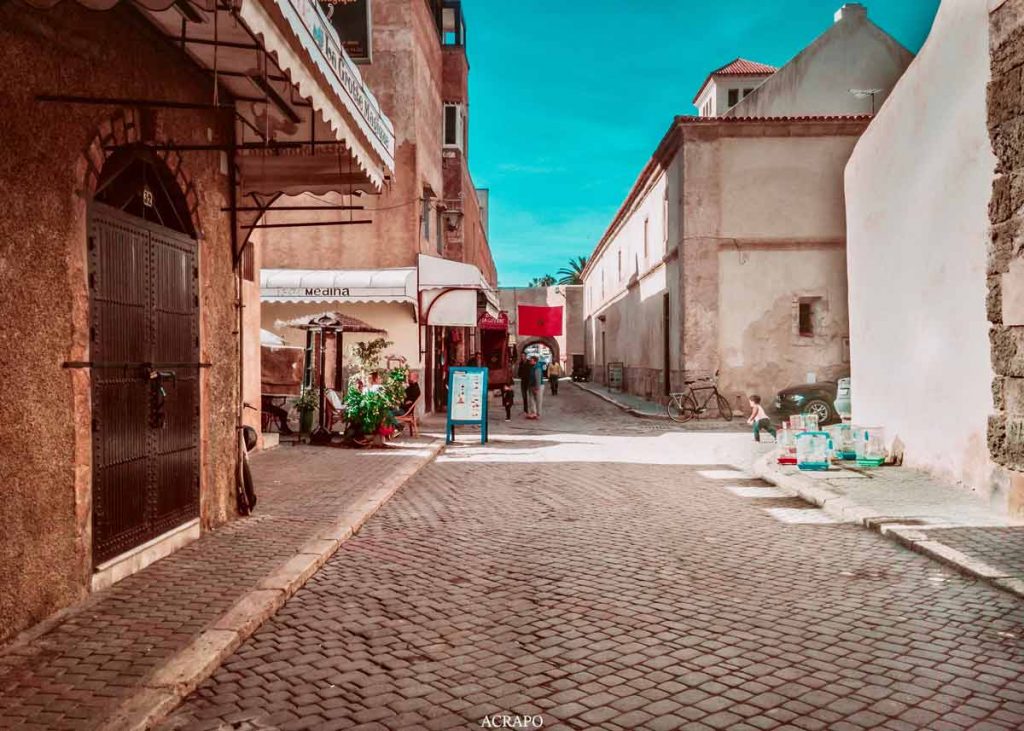
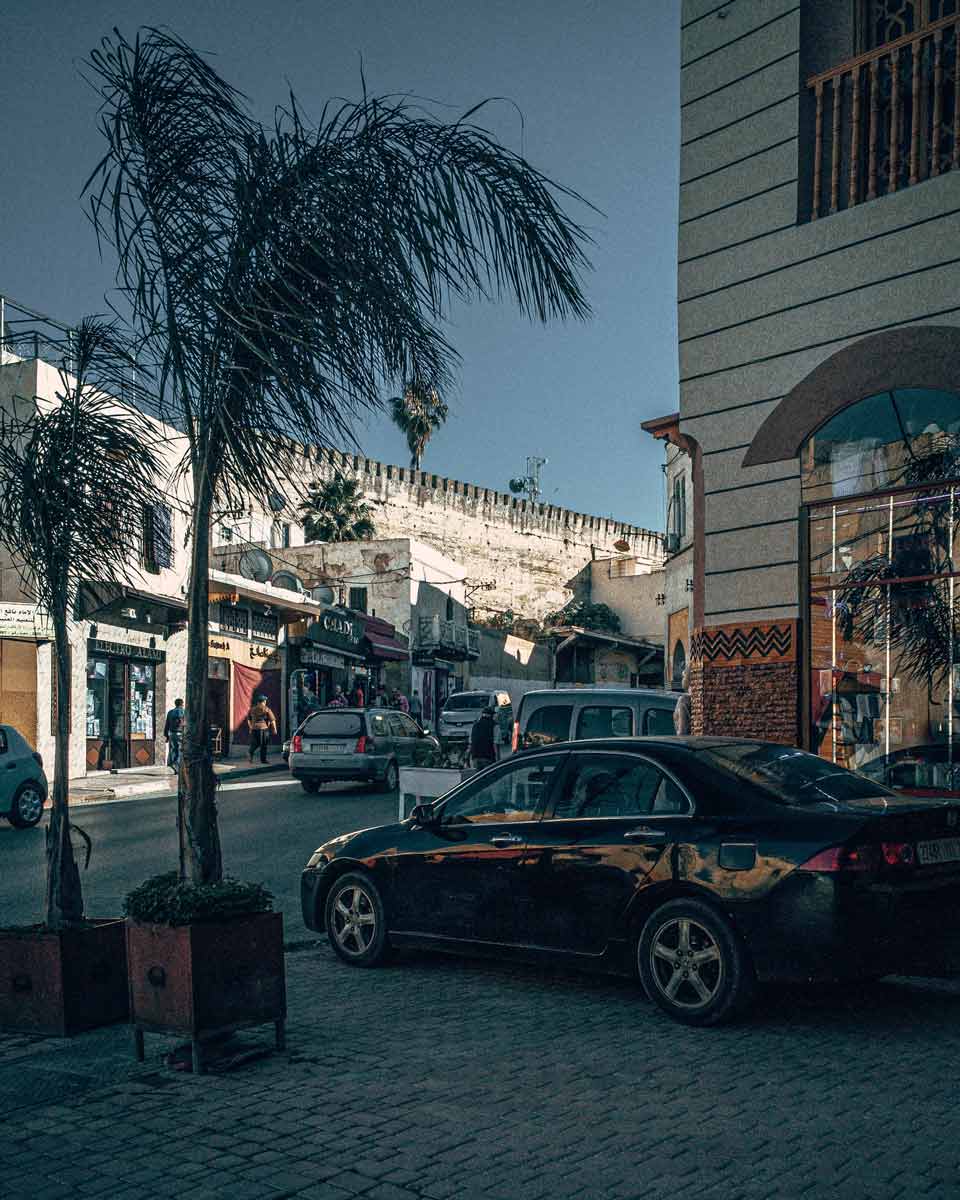
the country of morocco daily life

A linguistic mash-up of Arabic, Berber, and French influences Morocco is a North African country with a lot to offer in terms of memorable experiences. Morocco is home to a world of wonders, including storied old medinas, mint tea, ancient mosques, and delectable cuisine. If you’re having nightmares about staying safe while dreaming about the deserts of Morocco, don’t worry. These simple safety tips and useful tools will assist you in realizing your Moroccan dreams.

Following months of unrest and a travel warning issued by the US Consulate in 2017, travelers from all over the world might be wondering whether it is safe to visit Morocco. The good news is that Morocco’s safety status was upgraded to level 1 in early 2018, indicating that it is now safe to fly to the country and that visitors can exercise normal caution while there. If you’re still nervous about going to Morocco, here are some suggestions to help you have a safe and secure visit.

How Safe is Morocco?

Morocco is a safe place to visit in general. However, this does not rule out the risk of violence, and as with everywhere else in the world, you should exercise caution and be conscious of your surroundings at all times. Morocco’s tourism numbers have been steadily increasing year after year, and this trend is expected to continue. And, at the end of the day, rising tourism numbers generally mean that a country is safe to visit.
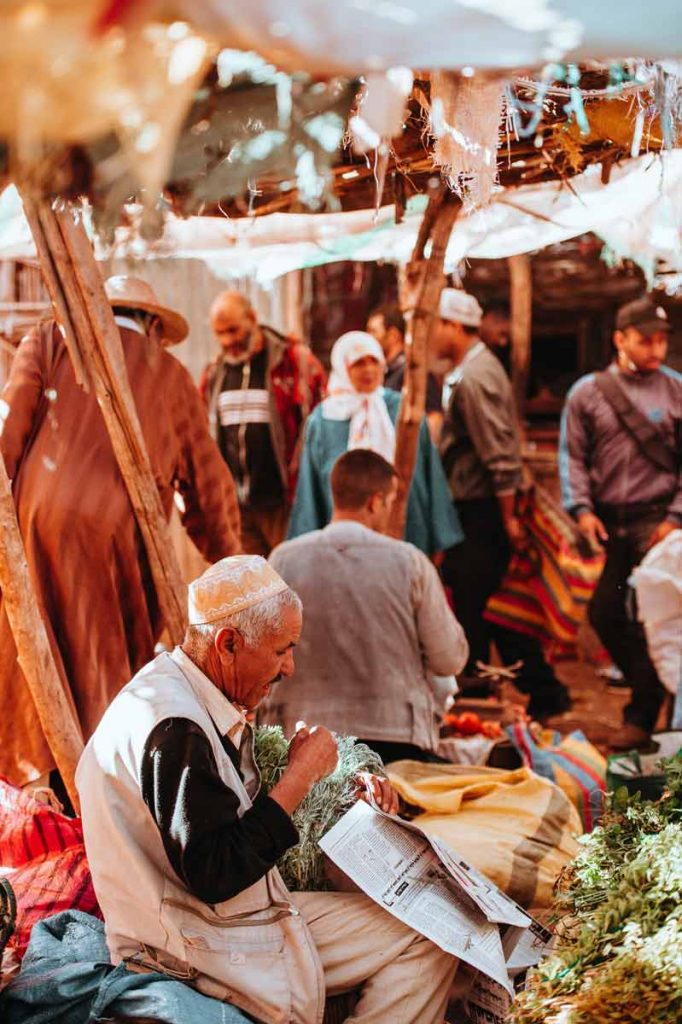
the country of morocco daily life
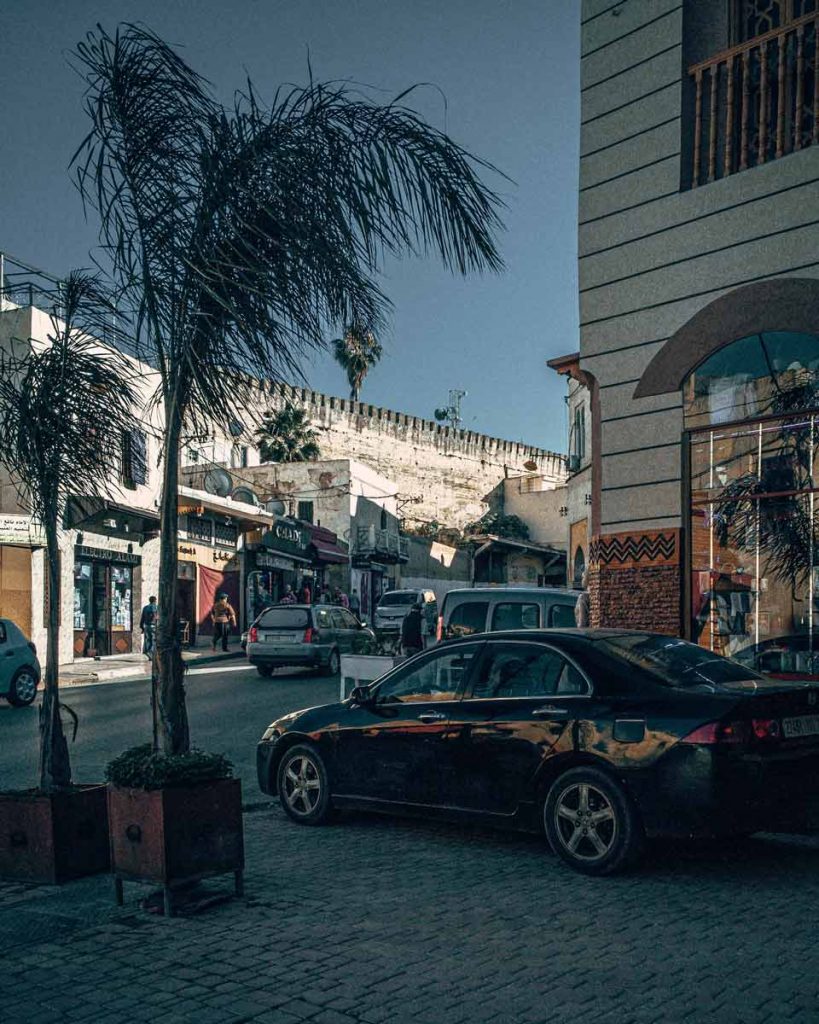
is morocco safe to travel

Is it true, however, that bad things happen in Morocco? Without a doubt. Pushy people, petty theft (which can be widespread in the major cities), and poor treatment of women are the most common complaints in Morocco.

While all of these problems are tragic, there are steps you can take to ensure your safety and a smooth trip to Morocco. Some people have complained about getting lost in Morocco’s winding streets because street names are constantly changing (from French and Spanish to Arabic), but google maps or maps.me can help you be able to complete the task.

#Is Morocco Safe to Travel? How safe?

Is Morocco Safe to Travel: Currency

Knowing the average prices of daily goods will help you plan your trip and avoid being taken advantage of while shopping in Morocco. The Dirham, the Moroccan currency, is currently worth around 0.11 USD.

#Is Morocco Safe to Travel? Currency?

Is Morocco Safe to Travel Right Now?

Yes, that is right. Of course, a little caution and common sense will go a long way, but most trips to this lovely country are usually a complete success. Morocco is, in reality, North Africa’s most politically stable region. To draw more visitors, the government has increased its infrastructure investment.

Because, in the end, more tourism equals more income. Faux guides, or unofficial guides who give their services in front of attractions, have been reported to be on the rise. While some of them do know a lot and speak many languages, you might also end up in the hands of a complete con artist. Fortunately, the tourist police have handled the situation admirably.

Political demonstrations are uncommon in Morocco, and when they do occur, they are usually not dangerous to tourists. You’ll be fine if you stay out of it and don’t join in the marches. A trip to Morocco right now should be pretty healthy and completely worth it, with so much culture and history to discover and a generally comfortable and welcoming environment.

#Is Morocco Safe to Travel?

Don’t Haggle

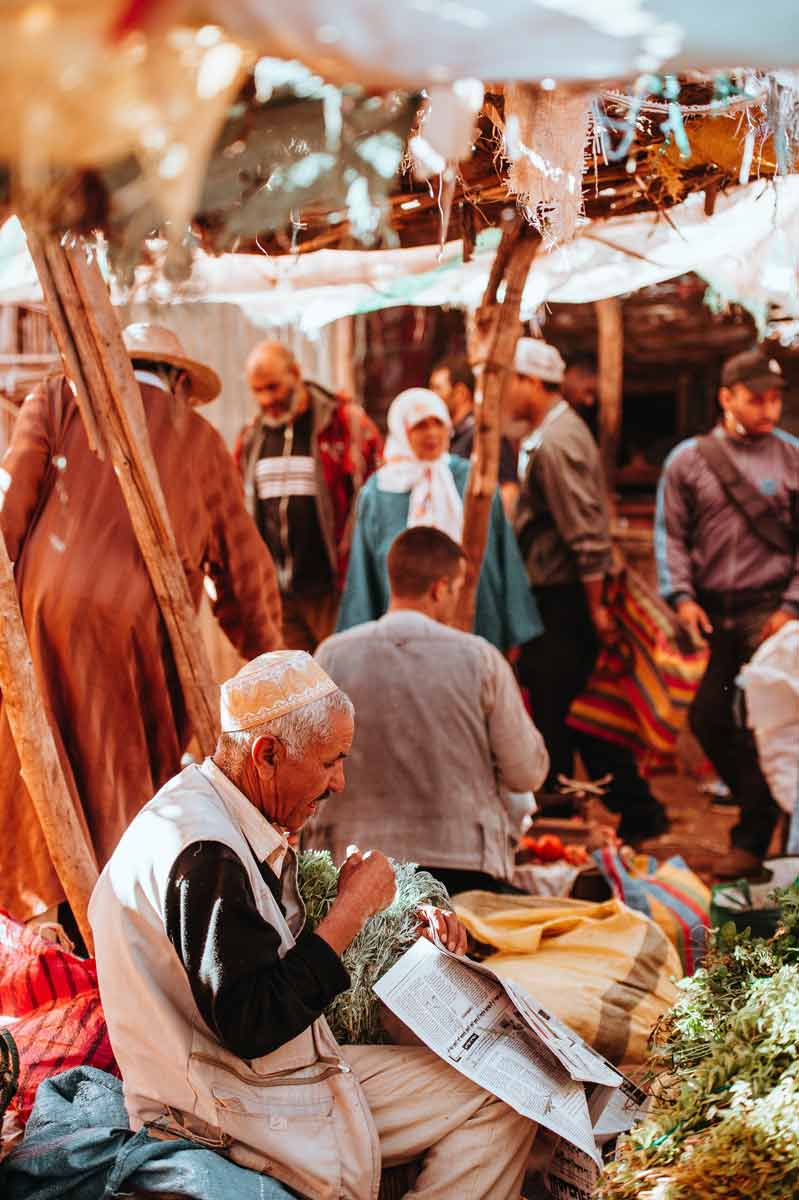
You’ll almost certainly come across some pushy salespeople and shop owners as you travel through the city’s medinas. They’ve been known to pursue passers-by, offering to take you somewhere special or attempting to sweep you into a back room. Never go to a place you don’t know with someone you haven’t researched beforehand, particularly if it’s far away from populated areas. If you ever feel unsafe, call the cops or run to the nearest riad, even if it’s not where you’re staying.

#Is Morocco Safe to Travel: Street scam

is morocco safe to travel _ safe places

Safest Places in Morocco

In Morocco, some areas are better than others. The best, as well as the not-so-safe, areas, are mentioned below to ensure a successful journey.

Marrakesh

Although it is not the capital, Marrakesh is Morocco’s most popular tourist destination, which is why it is considered to be one of the safest cities in the country. Tourists are welcome, and several establishments seem to be set up for them.

Marrakesh is well known for its amazing locations like the central market and souks, which are all based around Jemaa el-Fna Square – a feast for the senses where you can smell spices and hear traders shouting.

But there are a host of other attractions around the city that are a little less hectic, such as the Jardin Majorelle, Bahia Palace, and Koutoubia Mosque. Keep in mind that a large crowd will lead to issues such as pickpocketing and petty theft. Leave your valuables at home so you can enjoy the city without fear of being robbed!

#Is Morocco Safe to Travel: safe places 1

is it safe to travel morocco
is it safe to travel morocco desert and safe places

Essaouira

Essaouira is known as Africa’s Wind City, and there’s one thing it’s known for above all else: surfing! The small city is one of the best places in Morocco if you want protection on a budget, with plenty of surf camps, backpacker accommodation, and a chill atmosphere. From April to November is the perfect time to stay. That is when the best surfing conditions (both wind and regular) can be found. If you’re not coming to surf, however, coming out of season allows you to enjoy the medina and all of the attractions that this port town has to offer.

#Is Morocco Safe to Travel: safe places 2

Atlas Mountains/Sahara Desert

Take a closer look at the Atlas Mountains and the Sahara Desert if you’re a nature lover or outdoor enthusiast looking for some adventure. Both covering a large area of land, you’ll need a few days to enjoy some of Africa’s most tempting activities, such as camel trekking, overnight camping, and mountain hiking and biking.

Because there will be so few people around, you will be protected from pickpocketing and petty theft. But, because you will be in such a remote location, you will face natural dangers along the way. You’ll be perfectly safe here if you protect yourself from the light, follow your guide, and drink plenty of water.

is morocco safe to travel
is morocco safe to travel_ morocco safe for travel for couples

Places to Avoid in Morocco

If you want to have a healthy journey, there are places in almost every country that should be avoided rather than visited. Morocco is in the same boat. Although the crime rate is low in comparison to other African nations, there is a current threat of violent crime. If you want to explore the country on your own, you should ask locals for insider information and hire a tour guide just to be sure. Mentioned below are a few no-go zones to make it a little easier for you:

Casablanca

Casablanca, Morocco’s economic capital, is a beautiful city with a lot of problems. Due to drug trafficking and organized crime, this is Morocco’s most dangerous region. Although it isn’t a no-go area, you should be mindful of the situation and avoid empty side streets and suspicious characters.

#is it safe to travel to morocco: Not safe places 1?

Fez

This is probably Morocco’s most special, but stressful city. Though Fez has its charms and attractions, you’ll need a thick skin to push your way past the salesmen, con artists, and tour guides. Nonetheless, the city is indeed breathtakingly beautiful and boasts some incredible architecture and history. It is sometimes referred to as Morocco’s cultural capital.

#Is Morocco Safe to Travel: Not safe places 2?
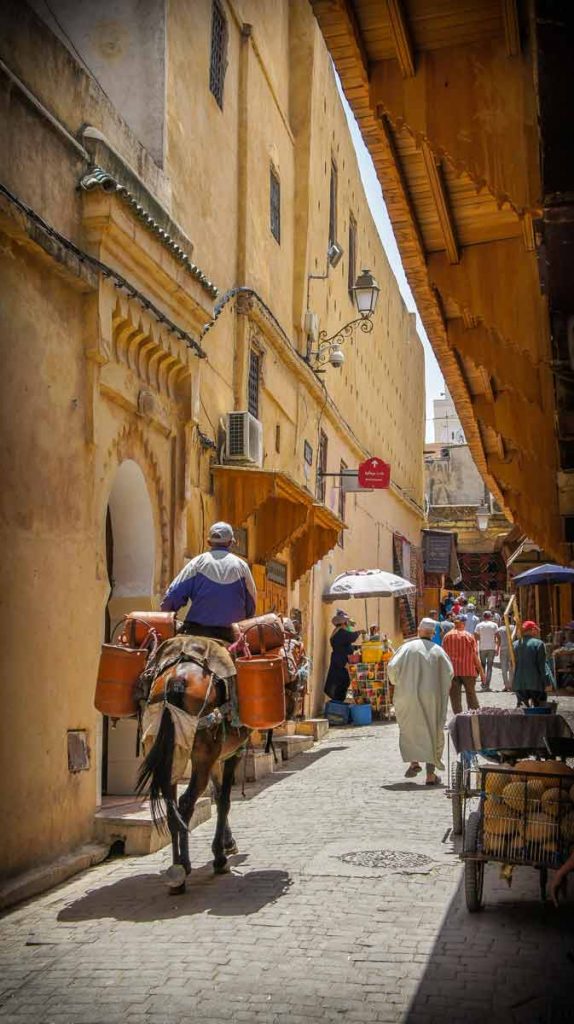
is morocco safe to travel

Top Safety Tips for Traveling to Morocco

Although we all accept that Morocco is generally secure, there are always precautions to take. You’ll be able to fly to Morocco with confidence if you follow these travel safety tips, and you’ll be able to spend more time traveling and less time worrying!

  • If you are approached and feel uneasy, don’t be afraid to say “no thank you” and walk away.
  • Check to see if you’ve packed everything you’ll need. Nothing is more aggravating than remembering you’ve forgotten half of your basics and having to dash to the nearest store. It’ll sabotage your budget and, more than likely, the start of your vacation.
  • Make a reservation with a professional guide and refuse to take tours from strangers. Faux guides are common near well-known attractions, but it is preferable to book your tour online or explore on your own.
  • Keep your valuables close at hand or tucked away. Pickpocketing is a significant issue in Morocco, especially in the larger cities. If you’re carrying money or valuables, make sure they’re well protected or invest in a money belt.
  • Carry small bills to avoid having to get out bigger bills.
  • This is a conservative country, so dress modestly. Adapting to the people around you is the best option. Keep an eye out for what the locals are wearing and dress accordingly. That way, you won’t be mistaken for a tourist and won’t offend anyone.
  • Make friends with other passengers. It’s always better in a community, whether it’s people you met at the hostel or on a tour. You will become a target if you walk alone.
  • If you wear something flashy, you’ll be more likely to be a victim of a con.
  • Before you get in the taxi, double-check the price. Some drivers would try to defraud you. If the fare seems excessive, get out and find another taxi.

#Is Morocco Safe to Travel: tips?
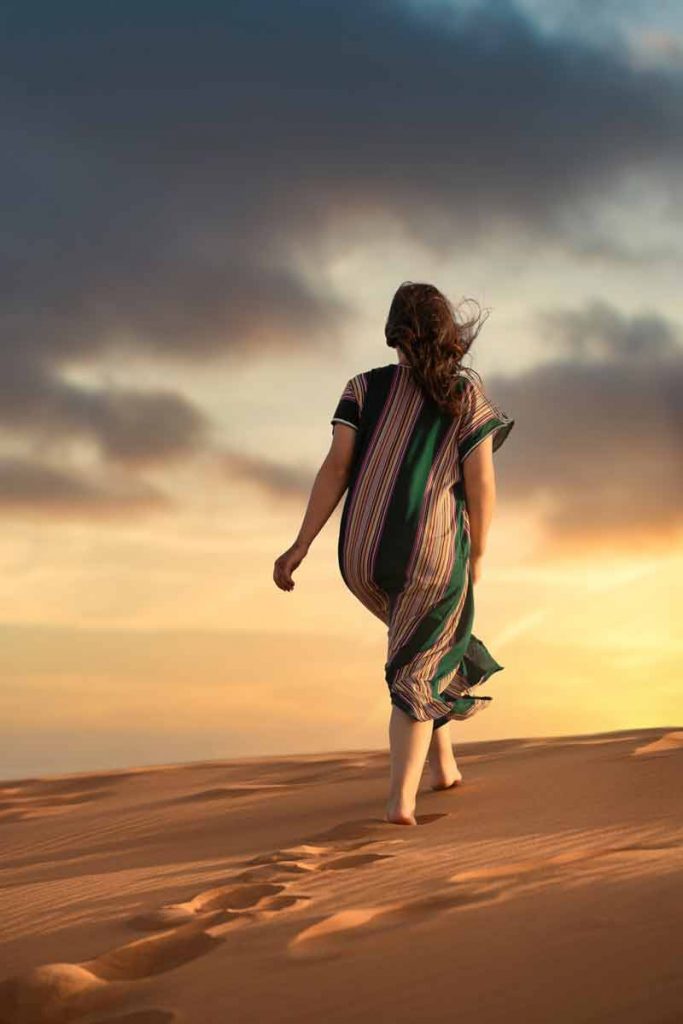
is it safe to travel morocco alone

Is Morocco Safe to Travel Alone?

Thousands of solo travelers visit Morocco each year to soak up the desert and culture of this incredible country. Meeting other solo travelers is simple thanks to a large number of hostels and inexpensive guesthouses available. That isn’t to say that traveling alone in Morocco is easy.

In general, traveling alone in Morocco is secure. However, something can happen anywhere in the world, so stay alert. It is not impossible to travel alone in this area, but you will need to learn a few things to have a good time on the road.

#Is Morocco Safe to Travel alone

Is Morocco Safe to Travel for Women?

Traveling as a woman – solo or otherwise – is often fraught with dangers, no matter where you go. Some countries have a greater impact than others. Having said that, traveling in Morocco as a woman is completely safe and possible! You’ll just have to be a little more cautious than in other nations. Unfortunately, some degree of publicity and mild abuse is to be expected. Keep an open mind and you’ll have a fantastic time. Traveling to Morocco as a woman can be stressful at times, but keep in mind why you’re there: to fully experience the country.

#Is Morocco Safe to Travel for women?
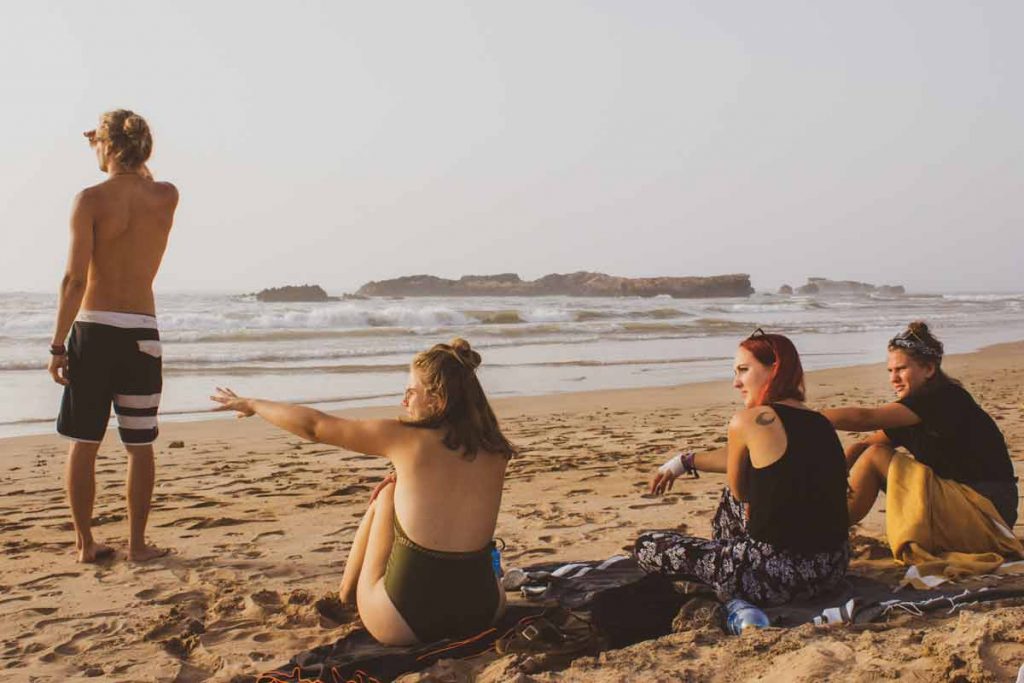
is it safe to travel morocco family

Is Morocco Safe to Travel for Families?

Yes, indeed. Morocco is a fantastic destination for families, and anyone traveling with children will have a blast! It’ll be a holiday you’ll never forget as a family. Moroccans are accustomed to big families, and traveling with children is a perfect way to meet locals who will be welcoming and accommodating to family groups. It’s a smart idea to book accommodation that is suitable for families.

Only make sure your kids are up to date with their vaccines, that you have basic drugs on hand (rehydration sachets, diarrhea tablets), and that they don’t drink tap water until you go. Also, avoid petting stray animals and allowing your children to spend too much time in the sun.

#Is Morocco Safe to Travel: families

Is Morocco Safe to Travel to Drive?

Although you can rent a car or a motorcycle in the area, we do not recommend it. Morocco’s city traffic is a complete mess. Potholes, congested traffic, and rude drivers abound on these highways. In 2017, road injuries were responsible for 3.6 percent of all deaths in Morocco (compare that to 0.39 percent in the UK).

best places to visit in morocco_Marrakech
is it safe to travel morocco at night

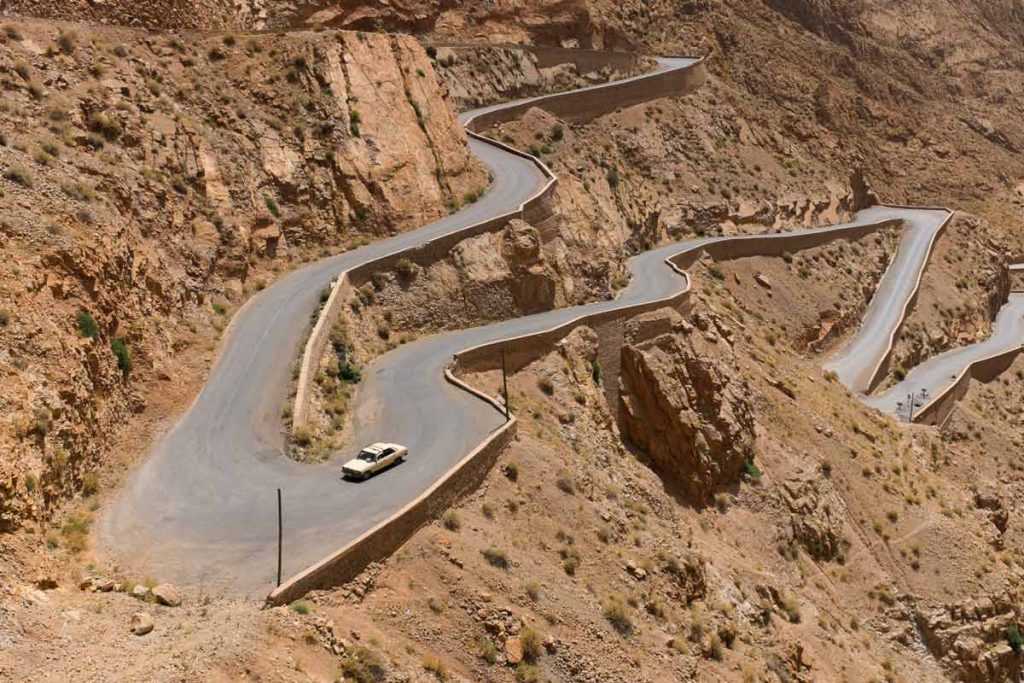
As a result, we can only recommend driving in Morocco’s larger cities to drivers who are extremely confident and/or experienced. However, if you want to get out of the capital, there are some fantastic road trips to be had. If you can find a reputable car rental company in Marrakesh, you can take a road trip along the Tizi N Tichka Pass, which is mostly empty and offers spectacular views of the countryside.

#Is Morocco Safe to Travel: drive

Drinking-Water in Morocco

While tap water in Morocco is generally safe to drink, it is always recommended that you avoid it. The water has been chlorinated and cleaned extensively. Morocco, on the other hand, is extremely hot, and you’ll need to stay hydrated. This can be accomplished by purchasing large bottles of water from supermarkets, StreetSide kiosks, and newsstands. Hotel rooms typically have water filters, and we strongly advise you to recycle bottles rather than purchasing new ones because plastic is the worst.

Take a good quality water bottle and water purification tablets with you if you’re going on a desert trek – or even if you’re just walking around a neighborhood. The water bottle can be used for something other than water, which is ideal if you need a little sugar to keep you going.

#Is Morocco Safe to Travel: water

best places to visit in morocco_tinghir
is it safe to travel morocco family_making friends

Bring a Friend

Traveling with a mate is much better. Make every effort to remain as a group as much as possible. Packing a phone and enabling an international plan can be costly; if you plan to stay for more than a week, consider buying a cheap prepaid mobile phone once you arrive so you still have a way to communicate with the rest of your party or someone at home who can assist in an emergency.

#Is Morocco Safe to Travel: group travel

Escape the City

If the hustle and bustle of Marrakech or Casablanca become too much for you, there are plenty of beautiful sights to see outside of the major cities. There are no limits to the off-the-beaten-path experiences you can have, from riding a camel across the Sahara to relaxing on the beaches of Essaouira, visiting small villages, or hiking the Atlas Mountains.

#Is Morocco Safe to Travel: away from city

Don’t Leave the House Alone After Dark.

Locals agree that walking through the medinas, or narrow alley-like corridors that run through the area, after dark is a bad idea. If necessary, have your driver or a security guard accompany you.

#Is Morocco Safe to Travel: after dark
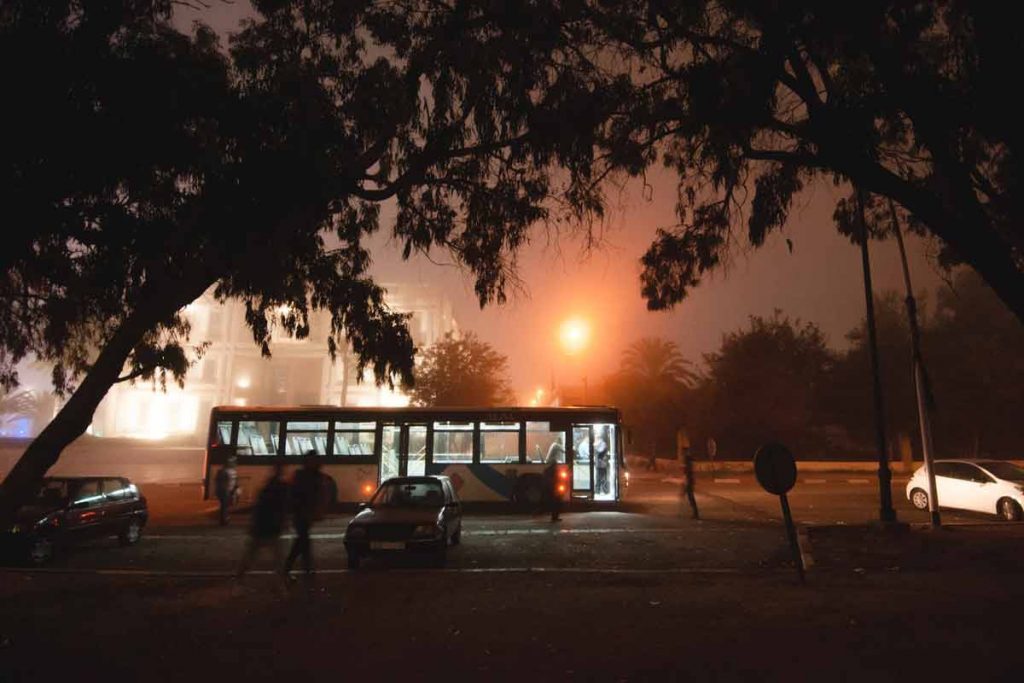
best places to visit in morocco_Agadir
is it safe to travel morocco transport

In the Transportation Sector

In Morocco, the key problem in terms of transportation is road safety on secondary roads and in cities. There are frequent traffic violations and risky habits, so you should exercise extreme caution.

#Is Morocco Safe to Travel: in transportation

Natural Hazards in Morocco

Rainfall can be heavy from November to March, causing flash flooding, particularly in the High Atlas. If you plan on visiting during this time, keep an eye on the local weather forecast.

#Is Morocco Safe to Travel: nature

Is Morocco Safe to Live in?

If you’re thinking about moving to Morocco, don’t be concerned: it’s a safe place to live and work. Every year, the number of foreign nationals residing in Morocco increases. It may be a cultural shock at first, and you may struggle – as with any transition to a foreign country – but Morocco is a very safe place to live.

An excellent suggestion? Avoid isolating yourself by integrating yourself into the local community. Place yourself in a location that will provide you with home comforts or at the very least European familiarity. Base yourself in Casablanca (where the majority of ex-pats live) or Rabat (where the best jobs can be found). Learning at least a portion of the language, such as Arabic or French, is important.

#Is Morocco Safe to Travel: to live in

Reference: morocco is it safe to travel?

13 Best Cities to Visit in Morocco

0
Best places to visit in morocco_Essaouira

Morocco, an elusive and beautiful country, has enticed foreign visitors for millennia and is still one of Africa’s most popular destinations. Here is a list of the best cities to visit in Morocco, which are built around laid-back beaches, soaring mountains, and busy souks.

1. Rabat

Morocco’s capital, Rabat, is well worth visiting, despite being overshadowed by Agadir, Casablanca, and Marrakech. It is one of the country’s four imperial towns, situated on the northwest coast and bordered by the Atlantic Ocean. Rabat is a lovely place to stroll around, with peaceful palm tree-lined boulevards and an atmospheric old medina. There are also fascinating historical sights and cultural landmarks strewn around. The main attraction is its well-preserved kasbah, which is surrounded by a vast Royal Palace and a stunning Art Deco cathedral.

This beautiful old mosque is surrounded by an idyllic Andalusian Garden and a splendid museum dedicated to the history of the sprawling site. Lots of exquisite architecture, as well as a lovely blue and white painted neighborhood, can be found within its solid stone walls. You can also get stunning views of Rabat, its huge public beach, and the ocean from the kasbah.

#best cities to visit morocco: Rabat

Best places to visit in morocco_Essaouira
best cities to visit morocco_Essaouira

2. Essaouira

Essaouira is a quiet coastal town with a distinct European flavor. It saw hippies, musicians, and travelers of the 1960s move into the city when it was under the French protectorate, which resulted in a fusion of cultures and architectural styles. As a result, it has become accustomed to foreigners and is now a popular tourist destination for those looking to spend some time walking through the medina. Essaouira has lovely sandy beaches, but sunbathing is difficult due to the powerful winds. Water-sports enthusiasts, on the other hand, recognize the value of the wind and congregate on Essaouira’s beaches during the summer months to hone their windsurfing skills.

The harbor and old city walls add to the city’s history and, with their narrow lanes and ancient streets, provide the ideal setting for getting lost and discovering new and fascinating secrets concealed within the walls.

#best cities to visit morocco: Essaouira

best places to visit in morocco_Ouarzazate
best cities to visit morocco_Ouarzazate

3. Ouarzazate

Ouarzazate, the gateway to the Sahara Desert, is located south of the High Atlas Mountains. The colossal Taourirt Kasbah, a 19th century fortified palace, dominates this tiny and dusty desert settlement. The palace offers breathtaking views of the red-hued mountains. It’s so distinctive that it’s been used in several films. There are many hotels and small, reasonably priced local restaurants to choose from in the area. The city’s location also makes day trips to nearby attractions like the Ait Benhaddou kasbah, which is in excellent condition.

best cities to visit morocco
best cities to visit morocco_Tetouan

4. Tetouan

Tetouan, which means “water springs” in Arabic, is a small city in the north of the country that sits at the foot of the Rif Mountains. The city was once the capital of Spanish Morocco and is now a significant port on the Mediterranean Sea. Its streets are lined with square, white-washed Spanish-style buildings, and broad boulevards; don’t miss the city’s wonderful medina, which will transport you back in time.

#best cities to visit morocco: Tetouan

El Jadida best cities to visit morocco

5. El Jadida

El Jadida, a lively port city, is a popular holiday destination for Moroccans. During the summer months, the long stretch of sandy beach here is packed with families spending some quality time together. The city itself isn’t especially interesting, but it can be visited on a day trip from Casablanca. Take a stroll along the 16th-century Portuguese Cistern’s ramparts and take in the sights.

#best cities to visit morocco: El Jadida

best places to visit in morocco_Marrakech
best cities to visit morocco_Marrakech

6. Marrakech

Marrakech is an eclectic meeting place of various cultures and the country’s most vibrant metropolis, being both African and Arab, eastern and western. Marrakech, one of Morocco’s four imperial towns, is located in the shadow of the Atlas Mountains.

The city’s landmark 12th-century Koutoubia Mosque, with a single minaret that can be seen for miles around, is perhaps most famous for its medieval medina, a UNESCO-protected labyrinth of alleys and markets. For others, getting lost is part of the pleasure of visiting Marrakech. If this describes you, embrace the chaos as you walk the souks of the medina in one of Morocco’s most beautiful cities.

Jemaa el-Fna square, Marrakech’s cultural core for 1,000 years, comes alive each evening at sunset. Locals and tourists alike flock to see the acrobats, magicians, fortune tellers, snake charmers, Gnaoua singers, and storytellers who put on a spectacular open-air show. A burgeoning contemporary cultural heartbeat complements the city’s Moorish roots and artistic heritage.

As a result, Marrakech has been named the African Capital of Culture for 2020. Throughout the year, museums and galleries such as the Museum of African Modern Art Al Maaden, the Museum of Photography, and the Yves Saint-Laurent Museum host activities. In the year 2020, there will be much more to explore in Marrakech’s cultural scene.

bestmeknes_ best places to visit in morocco
best cities to visit morocco_Meknes

7.  Meknes

Meknes, the smallest of Morocco’s four imperial cities, provides a fascinating glimpse into the megalomaniacal reign of Sultan Moulay Ismail. This picturesque hilltop city is nestled in the heart of Morocco’s premier wine-growing area, and it’s the ideal starting point for day trips to the nearby Roman ruins of Volubilis and the holy town of Moulay Idriss.

From 1672 to 1727, Moulay Ismail ruled Morocco from Meknes with an iron fist. The city prospered during this period because it was surrounded by fertile land and good trade routes. Ismail constructed a sophisticated defensive system that includes impressive fortifications that have stood the test of time. Meknes is an excellent choice for those looking to get off the beaten track in Morocco, with its UNESCO-declared medina to match Marrakech’s, the beautiful Bab Mansour gate, and the mausoleum of Moulay Ismail.

best places to visit in morocco_Fez
best cities to visit morocco_Fez

8. Fez

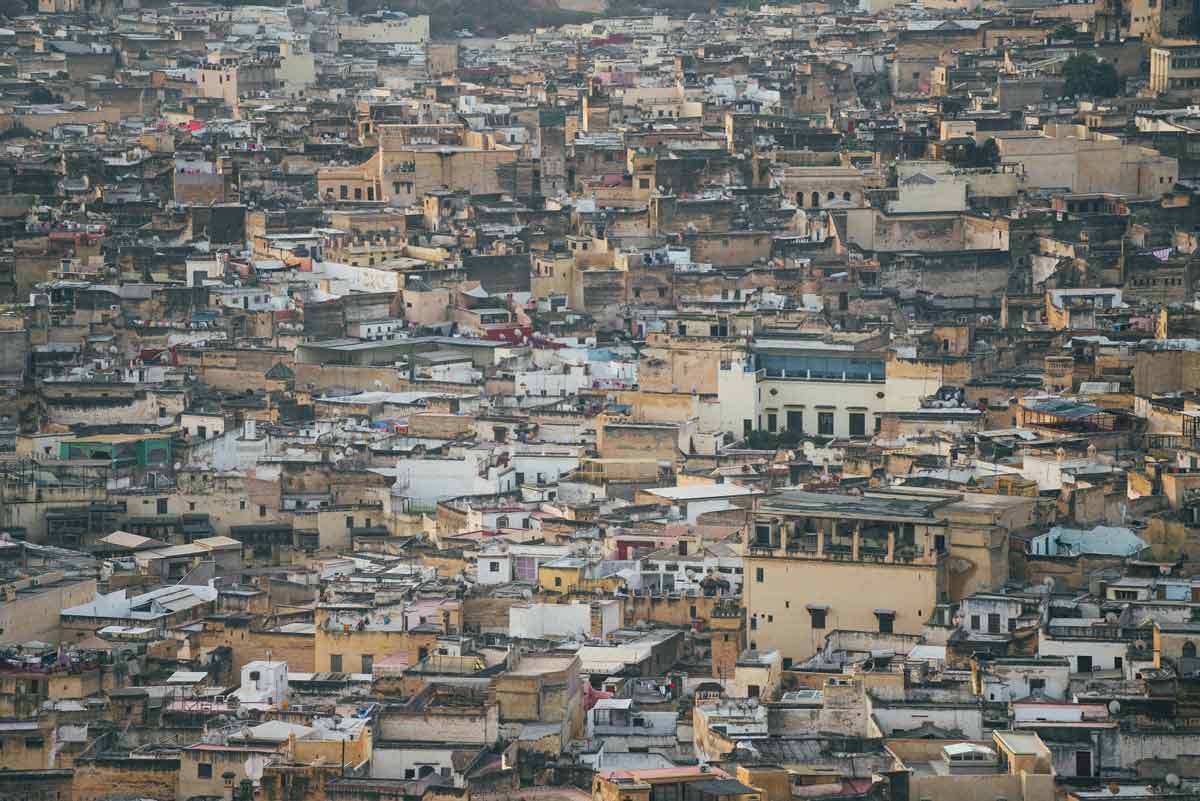
Fez is another of Morocco’s imperial cities and its former capital, and it is one of the oldest and most historic settlements in North Africa. Fez is also believed to be home to the world’s oldest university, which was established in AD 859, as well as one of the largest mosques outside of Mecca and Medina. This city is a cultural melting pot, with large Arab and Berber communities that have been augmented by refugees from Spain and Tunisia.

Travel back in time to El Bali’s Old City, a mystical maze of medieval markets, palaces, and mosques. Many of the crafts and trades that keep El Bali’s narrow streets afloat haven’t changed much in 1,000 years.

best places to visit in morocco_Chefchaouen
best cities to visit morocco_Chefchaouen

9.  Chefchaouen

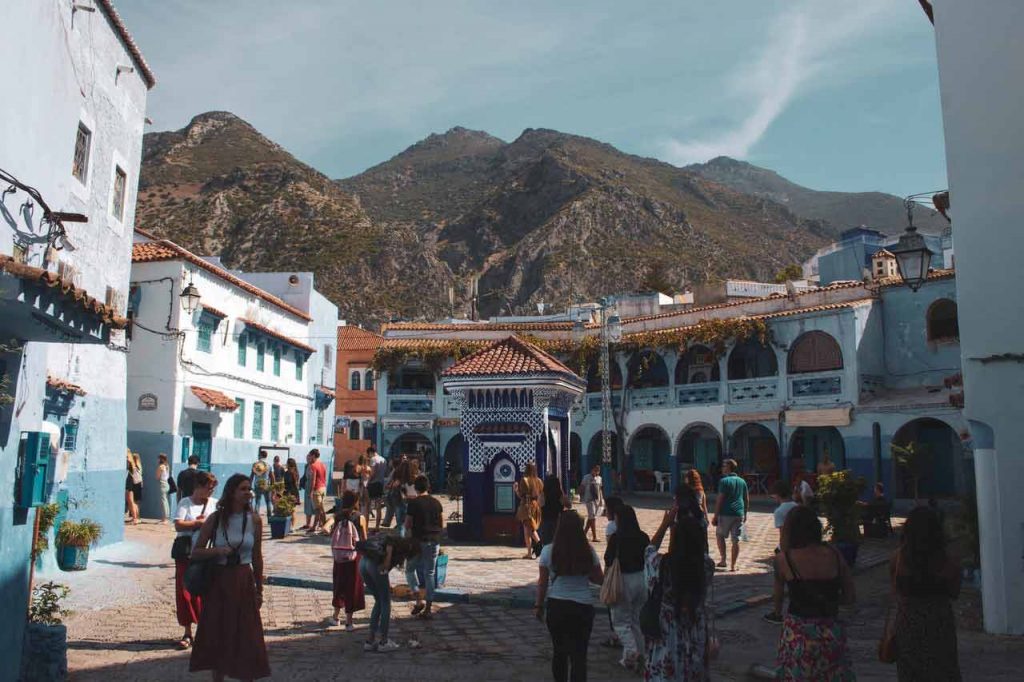
The blue-washed city of Chefchaouen, nestled among the peaks of the Rif Mountains, is a lively arts and crafts center with a peaceful atmosphere. Unlike the rest of the world, where Arabic and French are the most commonly spoken languages, many people here speak Spanish. There are a few hypotheses as to why Chefchaouen’s buildings are painted blue.

Some speculate that the movement started with an influx of Jewish immigrants fleeing the Spanish Inquisition; blue is the color of divinity in Judaism, and it is also the color of the sea and sky. Some people say that blue repels flies and mosquitos. Whatever the cause, this beautiful city encourages a slower pace of life and is undoubtedly one of Morocco’s best cities to visit.

best places to visit in morocco_Tangier
best cities to visit morocco_Tangier

10. Tangier

Tangier is one of Morocco’s most famous cities, and it has long attracted a diverse crowd ranging from artists and authors to foreign spies. Tangier is just 9 miles (14 kilometers) from Spain, which is located at the northernmost point of Morocco – and indeed Africa. For millennia, the city has been a vital crossroads in trading routes, with many cultures leaving their mark, particularly on the Medina. Tangier has recently attracted artists, writers, and musicians such as Henri Matisse, Jack Kerouac, and the Rolling Stones. Some of Morocco’s best beaches can be found in the area around Tangier.

best places to visit in morocco_casablanca
best cities to visit morocco_casablanca

11. Casablanca

Casablanca, another of Morocco’s iconic cities, was immortalized in Humphrey Bogart’s 1942 film of the same name. But don’t be fooled by the city’s on-screen picture of a sin city: Casablanca, Morocco’s economic hub and a fast-changing metropolis are one of the country’s most modern cities.

Casablanca’s burgeoning business market, as well as the city’s westernized middle class and cosmopolitan outlook, reminds one of the souths of France rather than the Maghreb. The city’s architecture is an odd but distinct mix of Parisian art deco and local Moroccan craftsmanship, which contrasts sharply with the city’s contemporary neighborhoods and districts. The ornately decorated Hasan II Mosque, the Place du 16 November, and the Place Mohammed V are only a few of Casablanca’s must-sees outside of the Medina.

best places to visit in morocco_Agadir
best cities to visit morocco_Agadir

12. Agadir

Agadir, a busy and bustling port area, is a holiday destination in and of itself. After a devastating earthquake in 1960 destroyed most of Agadir, especially its most historical parts, the city was rebuilt, but it is far less beautiful than Morocco’s many intricate old towns. Agadir, on the other hand, rose from the ashes to become a flourishing seaside resort with a laid-back vibe to match. The city’s laid-back beachfront promenade is ideal for strolling and taking in the sights like the locals. Drop by one of the food stalls for a bite to eat and a chat with some of the city’s friendly residents.

best places to visit morocco_rabat
best cities to visit morocco_rabat

13. Larache

This laid-back summer destination attracts a large number of domestic visitors during the summer months. The River Loukas winds its way through Larache, and nearby is the incredible ruins of Lixus, where the famed Gardens of the Hesperides are said to have once stood. Don’t be surprised if you come across tapas bars and Spanish churches in this city’s Spanish quarter.

#best cities to visit morocco: Larache

Resources: Top 3 cities to visit in a week

Atlas Mountains of Morocco

0
Atlas Mountains of Morocco field sheep

The Atlas Mountains are a series of mountain ranges in northwestern Africa that run roughly southwest to northeast and serve as the geologic backbone of the Maghrib (the Arab world’s western region) countries of Morocco, Algeria, and Tunisia. They stretch for more than 1,200 miles (2,000 kilometers) from the Moroccan port of Agadir in the southwest to Tunis, Tunisia’s capital.

Their thick rim rises to form a high sill that divides the Mediterranean basin to the north from the Sahara to the south, forming a barrier that slows but does not entirely preclude communication between the two regions. Both air masses and human migrations are filtered by the mountains.

The Atlas Mountains of Morocco, on the other hand, only allow movement in the east-west direction. These are the circumstances that give rise to the Atlas countries’ individuality and homogeneity at the same time. Although the Saharan region is more commonly thought of as the archetypal North African habitat, it is the well-watered mountains north of this vast desert that provide the foundation for most North African people’s livelihoods and a striking green or white backdrop for many North African cities.

Atlas Mountains of Morocco field sheep

With an elevation of 4,167 meters, Toubkal, located in central Morocco, is the highest peak in the range (13,671 ft). Berbers make up the majority of the population in the Atlas Mountains of Morocco. In some Berber languages, the words for the mountain are Adrar and Adras. These terms are thought to be cognates of Atlas, the toponym.

The mountains also shelter a variety of animals and plants, the majority of which are found in Africa but some of which can also be found in Europe. Many of these species are threatened with extinction, and a few have already gone extinct.

Where are the Atlas Mountains in Morocco?
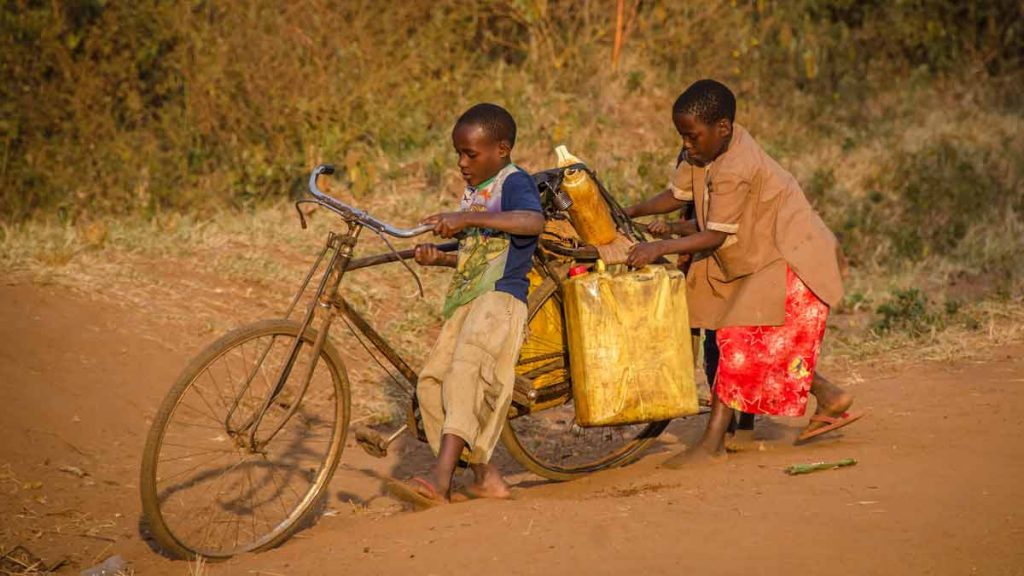
The range is divided into four distinct areas:

  • Anti-Atlas, High Atlas, and Middle Atlas (Morocco)
  • Tell Atlas (Morocco, Algeria, Tunisia)
  • Aurès Mountains (Algeria, Tunisia)
  • Saharan Atlas (Algeria)

The following are the Atlas Mountains of Morocco ranges:

Atlas Mountains of Morocco red rocks

Anti-Atlas

The Anti-Atlas extends from the Atlantic Ocean in the southwest of Morocco to the heights of Ouarzazate in the northeast, and further east to Tafilalt in the east (altogether a distance of approximately 500 kilometers or 310 miles).

It shares a southern border with the Sahara Desert. The Jbel Saghro range is the anti-Atlas’ easternmost point, and its northern border is flanked by parts of the High Atlas range. It contains the Djebel Siroua, a volcanic massif with the range’s highest peak at 3,304 meters. The Jebel Bani is a much smaller range that runs along the Anti-Atlas’ southern side.

High Atlas

The High Atlas mountain range in central Morocco climbs from the Atlantic coast in the west and extends east to the Moroccan-Algerian border. It has several peaks over 4,000 meters (2.5 miles), including Toubkal (4,167 meters (13,671 feet)), North Africa’s highest peak, and Ighil m’Goun (4,071 meters (13,356 feet), the range’s second main summit.

The range abruptly drops into the Atlantic and southwest, transitioning to the coast and the Anti-Atlas range. The range descends more gradually to the north, in the direction of Marrakesh. The Draa Valley, which opens southward on the Ouarzazate heights, cuts through the massif. Berbers, who live in small villages and cultivate the high plains of the Ourika Valley, make up the majority of the population.

Atlas Mountains of Morocco snow rocks

A hydroelectric dam near Barrage Cavagnac has formed the artificial lake Lalla Takerkoust. The lake is also a source of fish for the community’s fishermen.

Middle Atlas

The Middle Atlas is the northernmost of Morocco’s three major Atlas ranges, and it spans the entire country. The Moulouya and Oum Er-Rbia rivers separate the range from the High Atlas, and the Sebou River separates it from the Rif mountains.

The main coastal plains of Morocco, which are home to many of the country’s major cities, are to the west, while the high barren plateau that lies between the Saharan and Tells Atlas is to the east. The Jbel Bou Naceur is the range’s highest point (3340m).

The Middle Atlas receives more rainfall than the ranges to the south, making it an important water catchment area for the coastal plains and a biodiversity hotspot. It is home to the majority of the Barbary macaque population on the planet.

Tell Atlas

The Tell Atlas is a 1,500-kilometer (930-mile) long mountain chain in the Atlas mountain ranges that runs from Morocco through Algeria and Tunisia. It runs parallel to the Mediterranean coast and is the northernmost of two roughly parallel ranges that gradually approach each other in the east.

Atlas Mountains of Morocco snow rocks
Atlas Mountains of Morocco red rocks

The Saharan Atlas is the southernmost of the two ranges, and they meet in eastern Algeria. In Morocco, the western end of the Tell Atlas range is near the Middle Atlas range. The Hautes Plaines high plateau lies immediately to the south of the Tell Atlas, with lakes in the wet season and salt flats in the dry.

What are the Atlas Mountains of Morocco Famous for?

The Sahara Desert is separated from the Mediterranean and Atlantic coasts by the mountain range. It has several passes that connect the coast to the Sahara Desert. Toubkal, the highest peak in the range and North Africa, is found in Morocco. It stands at a height of 4,167 meters (13,671 feet).

Look down if you ever fly over Morocco’s High Atlas Range. You will be treated to a spectacular visual display that you will never forget. Massive layers of brightly colored rock crumpled up like paper. Sharp ridges weave their way across the desert, bobbing and weaving. Ancient volcanoes spewed swaths of black basalt. Layered outcrops of rock jutting from valleys at strange angles, resembling zebra stripes.

How High are the Atlas Mountains of Morocco?

The High Atlas Mountains of Morocco stretch hundreds of miles inland from Morocco’s Atlantic coast (near Agadir) to the Algerian border in a northeasterly direction. The range’s tallest mountains are found in the western section, with peaks rising above 4,000 meters (13,000 feet). Although the elevation drops in the central and eastern portions, the scenery remains stunning.

Atlas Mountains of Morocco how high
Atlas Mountains of Morocco

How the Atlas Mountains were Created

Geological processes have shaped the Atlas Mountains of Morocco over hundreds of millions of years. Many of the world’s continents were still bunched closely together after the breakup of the supercontinent Pangea during the early Jurassic Period (201 to 174 million years ago). This part of Morocco was part of the African plate, close to the Eurasian and North American plates’ boundaries. The crust thinned so much as the three plates separated that a tear opened up, forming a rift valley that eventually filled with ocean water.

Large blocks of Earth’s crust fell downward as the crust thinned and the rift opened up, forming broad valleys known as rift valleys (grabens). Horsts, which are elevated blocks at the edges of grabens, have become fault-block mountains. The collision of African and Eurasian tectonic plates drove these mountains even higher during a later phase of intensive mountain building in the Cenozoic (66 million years to present).

Interesting Facts About the Atlas Mountains

The Atlas Mountains of Morocco are a series of ranges separated by large areas of land known as plateaus, rather than a continuous chain of mountains. The Sahara Desert is separated from the Mediterranean and Atlantic coasts by the mountain range. It has several passes that connect the coast to the Sahara Desert.

Atlas Mountains of Morocco how high

Toubkal, the highest peak in the range and North Africa, is found in Morocco. It stands at a height of 4,167 meters (13,671 feet). Morocco’s mountain Ouanoukrim has the second and third highest peaks in the Atlas range. Timzguida, at 4,089 meters (13,415 feet), and Ras Ouanoukrim, at 4,083 meters, are the two summits (13,396 feet).

Small villages, rather than towns, make up the majority of the population in the Atlas region. The Berber People, a North African culture with thousands of years of history, are the most prominent and numerous of the Atlas populations.

Many of the plant and animal species found in the mountains are unique to Africa, and are often more similar to those found in Europe; many are endangered, and some have already become extinct.

The Atlas Mountains of Morocco were home to the North African Elephant until it became extinct in ancient Rome. The Atlas Bear, which is now extinct, once roamed the mountains. It was Africa’s only native bear. It was heavily pursued. The last one is thought to have been killed or died in the late 1800s. The Barbary lion, also known as the Atlas lion, is a subspecies of African lion that was once found in North Africa, including the Atlas Mountains, but is now extinct in the wild.

Natural resources abound in the Atlas. Among other resources, there are deposits of iron ore, lead ore, copper, silver, mercury, rock salt, phosphate, marble, anthracite coal, and natural gas.

Flora and Fauna of the Atlas Mountains

The Atlas cedar, evergreen oak, and many semi-evergreen oaks, such as the Algerian oak, are among the mountain flora.

The Barbary macaque, Barbary leopard, Barbary stag, Barbary sheep, Atlas Mountain badger, Cuvier’s gazelle, northern bald ibis, Algerian nuthatch, dipper, and Atlas Mountains of Morocco viper are some of the species that live in the region. The Atlas bear, North African elephant, North African aurochs, and bubal hartebeest were all once found in the Atlas Mountains of Morocco, but these subspecies are now extinct. Barbary lions are now extinct in the wild, but their descendants can be found in captivity.

References:

Rwanda on the Map

0
volcans national park rwanda flora

Rwanda is a landlocked country in east-central Africa that lies south of the Equator. Rwanda is known as le pays des mille collines (French: “land of a thousand hills”) because of its breathtaking scenery. Kigali, the country’s capital, is situated on the Ruganwa River in the country’s center. Where is Rwanda on the map? And what are the main districts and cities in the country?

Rwanda, like its southern neighbor Burundi, is a small country with one of the highest population densities in Sub-Saharan Africa. Burundi and Rwanda both have a long history of monarchical rule. Unlike what happened in Burundi; however, the Rwandan kingship was overthrown by a Hutu-led uprising that took place before the country’s independence in 1962.

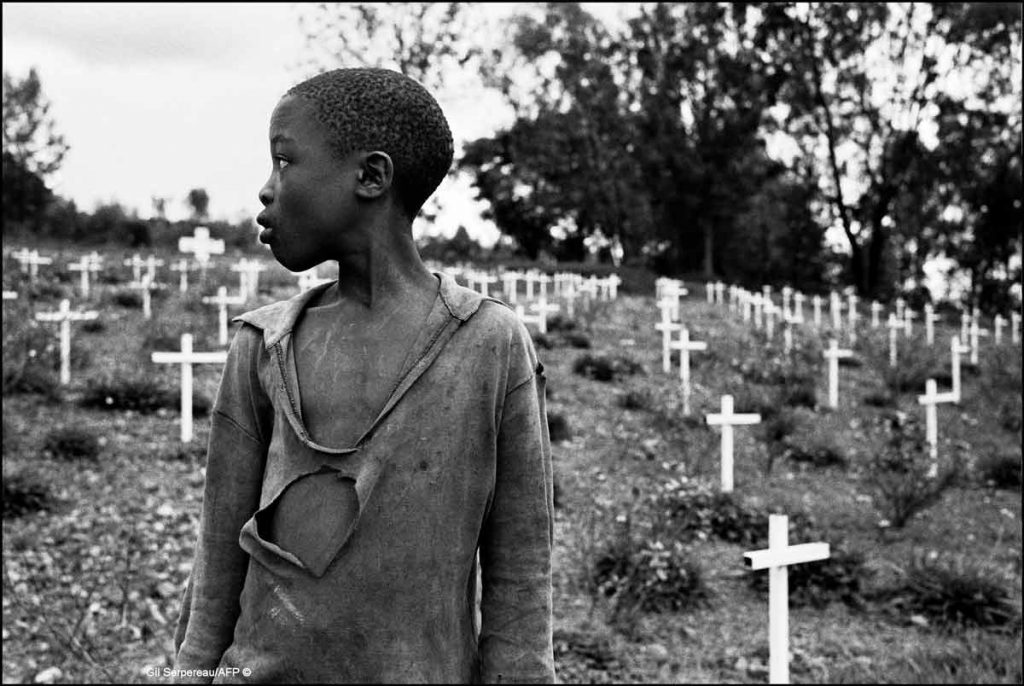
In 1994, ethnic tensions between the majority Hutu and minority Tutsi factions reached an all-time high. Rwanda’s economy and social fabric were in shambles at the time due to civil war and genocide. Reconstruction and ethnic reconciliation characterized the years that followed.

Rwanda, with its majestic mountains, undulating hills, enthralling customs, and some of the world’s rarest animal species, is shaking off the memories of its tumultuous past and quickly becoming one of Africa’s must-visit nations.

Rwanda on the Map with Districts

Rwanda’s five provinces are grouped into 30 districts. Each district is divided into sectors, which are further subdivided into cells, which are then further subdivided into villages. Rwanda was divided into prefectures, subprefectures (also known as “districts”), and 154 communes before 2002. Communes were phased out in 2002 in favor of two types of divisions: districts and municipalities. The number of municipalities was cut from 106 to 30 in 2006.

Top Populus Districts in Rwanda

Rwanda on the Map: Gasabo District

Gasabo is a neighborhood in Kigali, Rwanda’s capital. Gasabo’s headquarters are in the kimironko Sector. Large swaths of the city, including Kacyiru, Remera, Nyarutarama, and Kimihurura, are included in the district. It is the site of the Gisozi Genocide Memorial Site, which holds the graves of nearly 300,000 Rwandan genocide victims. Aside from the cemetery, the memorial has a genocide exhibition area and library, as well as plans to build a teaching center on the genocide’s history.

#Rwanda on the Map: Gasabo District

Rwanda on the Map: Nyagatare District

Nyagatare is Rwanda’s second-largest and most populous district. It is situated in Rwanda’s Eastern Province, in the country’s northeastern corner. Nyagatare City, the former capital of the now-defunct Umutara province, serves as the country’s capital. Nyagatare District is bordered on the north by Uganda, on the east by Tanzania, on the south by Gatsibo District of the Eastern Province, and on the west by the Gicumbi District of the Northern Province.

Nyagatare is Rwanda’s largest district, covering 1741 square kilometers. Nyagatare, with a population of 466,944 people in 2012, is Rwanda’s second most populous district, trailing only Kigali City’s Gasabo District, which has 530,907 people. This represents an increase of 83 percent since 2002 when the population was only 255,104. The population explosion is due to a large-scale migration of people from other parts of the country in search of land.

#Rwanda on the Map: Nyagatare District

Rwanda on the Map: Gatsibo District

Gatsibo is a municipality in Rwanda’s Eastern Province. Kabarore is the capital. It is located in the Gatsibo and Kageyo sectors. It takes about 1 hour and 50 minutes to get there from Kigali. Between Kayonza and Nyagatare, the district encompasses areas in Rwanda’s north-east. The German post of Gatsibo, as well as the present-day Gabiro military camp, were both located here. The district’s eastern half is in Akagera National Park, with the Kagera River forming the district’s Tanzanian boundary.

#Rwanda on the Map: Gatsibo District

Rwanda on the Map: Rusizi District

Rusizi is a district in Rwanda’s Western Province. Its capital is Cyangugu, Rwanda’s largest city in the south-west, and the district encompasses much of the former Cyangugu Province. The district is located near Lake Kivu’s southern end, where it empties into the Rusizi River (after which the district is named).

Cyangugu, Rusizi’s capital, is one of Lake Kivu’s three major Rwandan lake ports (along with Kibuye and Gisenyi), and it is adjacent to the much bigger Congolese city of Bukavu. The district also includes the western half of Nyungwe Forest, a popular tourist destination that is one of Rwanda’s last surviving forest areas, home to chimps and a variety of other primates.

#Rwanda on the Map: Rusizi District

Rwanda on the Map: Rubavu District

Rubavu District is one of the country district’s seven districts in Rwanda’s Western Province. Gisenyi, the capital, is a large beach resort and border city. It covers a total area of 388.3 km2. The district is located along the shores of Lake Kivu, near the city of Gisenyi, and just across the Congolese border from Goma.

It is bordered on the east by Nyabihu District, on the west and north by the Democratic Republic of Congo, and on the south by Rutsiro District. It is 154.7 kilometers from Kigali, Rwanda’s capital, and takes 2 hours and 53 minutes to drive there.

volcans national park rwanda flora

The district’s geographic location, as well as associated features such as Lake Kivu, contribute to its status as a business and tourism hub (especially through cross-border trade with DRC). The Rubavu District is divided into 12 administrative areas, 80 Cells, and 525 villages. Rainfall in Rubavu District varies between 1200 and 1500 mm per year, depending on the geography of the district.

The land in the district’s northwest has very rich soil, but it is shallow due to volcanic ash and lava decomposition, while the land in the district’s southeast has deep soils, but it is poor, often acidic, sandy clay, and leached by high erosion, and it is also close to Mount Nyiragongo, an active volcano.

#Rwanda on the Map: Rubavu District

Cities of Rwanda on the Map

1- Rwanda on the Map: Kigali

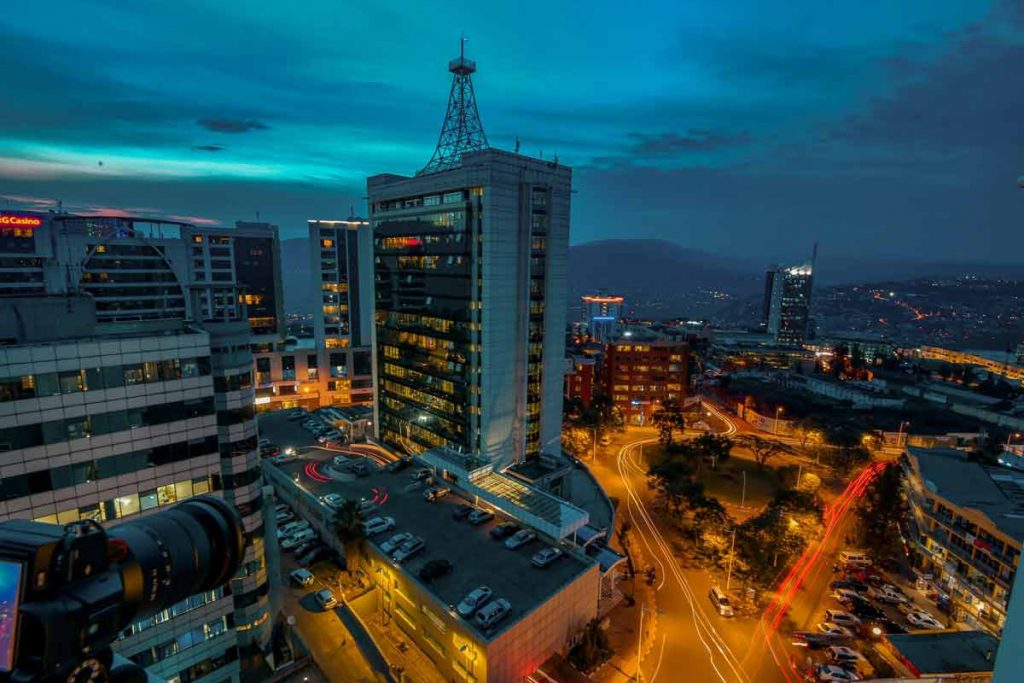
Kigali is centrally located in Rwanda, extending across several hills and valleys with excellent road connections to the rest of the country. With just over one million residents, the verdant capital city is pleasantly low-key but dynamic and progressive. First-time visitors to the bustling and vibrant center often comment on how clean the streets are, which is something that every community in the country takes pride in.

Kigali is a city that is just a few years old. It was established as an administrative outpost in 1907, and when the country gained independence in 1962, it became the country’s capital, drawing attention away from Huye. Outsiders are usually left to their own devices unless they need help, in which case they will be welcomed with warm hospitality. The city’s broad tree-lined boulevards and immaculate squares are safe to walk.

Rwanda cities -

There’s a burgeoning art scene here, as well as a growing number of places to eat and drink, many of which have lovely panoramic views. Local artisans and food vendors have a dedicated space to display and trade their wares at the Kigali Cultural Village. Kigali is rapidly expanding, with new shopping malls, office buildings, and a world-class convention center built in the style of an old-fashioned King’s Palace atop one of the many hills, which lights up the night sky.

Nyarugenge Hill is home to the central business district, while Kacyiru Hill is home to the ministries and administrative quarter. In one of the major valleys, Nyarutarama Lake, also known as Lover’s Lake, borders an 18-hole golf course. The path around the lake is surprisingly quiet, and it makes for a great urban nature walk, with the bonus of seeing some of Rwanda’s amazing birds.

A trip to Rwanda would be incomplete without a stop at the Kigali Genocide Memorial, which honors the memory of the more than one million Rwandans killed in the 1994 genocide through education and peacebuilding. The three permanent exhibitions and burial gardens serve as a strong educational tool for visitors as well as a significant tribute to those who have died.

#Rwanda on the Map: Kigali

2- Rwanda on the Map: Rubavu

Rubavu, a waterfront village on Lake Kivu’s shores, is an hour from the Volcanoes National Park and makes a wonderful stopover on the way to or from Nyungwe, or a relaxing stop after gorilla tracking. Rubavu, like other Lake Kivu destinations, has red sand beaches, warm, clear water, and a laid-back tropical vibe. It’s a wonderful place to relax, take in the peaceful atmosphere, watch the birds, and participate in a variety of watersports.

In the interior, old colonial buildings stand alongside palm-lined avenues, surrounded by banks, hotels, and offices. The Congo Nile Trail begins in the city and runs 227 kilometers south to Rusizi. With endless lake views, friendly hamlets, fishermen at work, and women dressed in striking prints going about their daily lives, the trail can be enjoyed on foot or by mountain bike. The area around Rubavu has something for everyone, with many tea and coffee plantations, as well as bird and primates to see in the new Gishwati-Mukura National Park.

#Rwanda on the Map: Rubavu

3- Rwanda on the Map: Karongi

Karongi is perhaps Rwanda’s most popular beach getaway for families who live elsewhere in the country. With its majestic vistas, tranquil climate, and easy access from Kigali, it’s easy to see why. The sparkling lake is framed by pine and eucalyptus-covered hillsides, with accommodations to suit all budgets. The sound of local fishermen singing carries across the water at dawn and dusk as they paddle in unison.

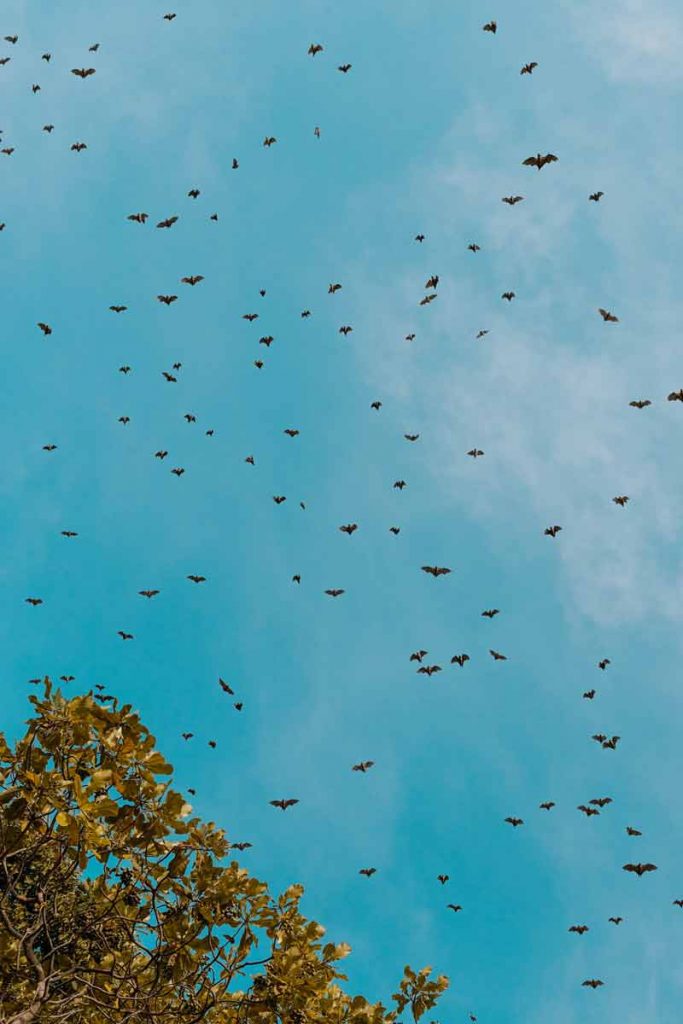
This is a place where busy minds can fully unwind, occasionally lifting their heads from a good book to notice the birds or the shifting colors on the lake as the sun sets over the horizon. Kayaks are available for rent at many hotels for those who want to stay active. Small groups are transported by boat to Napoleon’s Island, which is home to a colony of fruit bats, or to one of Amahoro Island’s restaurants. Head out night fishing with the locals or go sunset kayaking with them for an authentic taste of Rwandan life.

The Mukura Forest, located northwest of Karongi, is a haven for birdwatchers, with over 150 species recorded, including 17 endemics to the Albertine Rift. Mukura is a true montane rainforest, with an average altitude of 2,600m. It is a term used to describe forests in mountainous areas of the tropical belt. In 2015, the area was designated as a National Park.

#Rwanda on the Map: Karongi

4- Rwanda on the Map: Musanze

Musanze’s strategic location in the Virunga Massif’s foothills is attractive to tourism, industry, and agriculture, with particularly fertile land in the surrounding area. It is poised to become one of Rwanda’s major cities.

The city, which sits at an elevation of 1,850 meters, is an ideal location for gorilla monitoring, as the Kinigi headquarters are only 13 kilometers away. There are several boutique lodges on the outskirts of the Volcanoes National Park that offer spectacular views and a more rural setting for those who want to stay closer to the park’s edge.

Musanze is a bustling city with a diverse dining scene, ATMs for cash withdrawals, a lively nightlife, markets, and artisanal trades. A guided tour of the underground caves, bicycle tours, and the opportunity to meet the Rwandan cycling team at the Africa Rising Cycling Centre, the Buhanga Eco-Park, and the lesser-known lakes of Karago, Burera, and Ruhondo are all available from Musanze.

#Rwanda on the Map: Musanze

5- Rwanda on the Map: Nyanza

Nyanza is Rwanda’s eighth-largest city and the administrative capital of the Southern Province. The region’s major draw is its cultural heritage, which is well worth a stopover on the way to Nyungwe National Park.

The King’s Palace, a beautifully-crafted thatched dwelling shaped like a beehive and a rebuilding of the traditional royal residence, is well worth a visit. A few long-horned Ankole cattle, descended from the king’s herd, live in the back, where their keepers carefully tend to them and sing to them.

Rwandan kings used to be very mobile, moving between several different residences all over the country. However, by the late nineteenth century, the increasing colonial presence threatened to undermine the crown’s authority. To combat this, Mwami (King) Musinga Yuhi V established Nyanza as Rwanda’s first permanent royal capital in 1899, and it remained so until the country became a republic in 1962.

The Belgians were so impressed by the royal court that they decided to exert control through the existing power structure rather than intruding on the city. Nyanza is firmly on the map of cultural heritage, thanks to Western accounts full of color, pomp, and ceremony that mix with Rwandan oral tradition.

While the royal court has long since dispersed and the hillsides of Nyanza are no longer covered in roundhouses, the area remains an important cultural center. The Ethnographic Museum in neighboring Huye is another attraction.

#Rwanda on the Map: Nyanza

6- Rwanda on the Map: Rusizi

A small village on the Congolese border with views of Bukavu, the Congolese capital. Nyungwe National Park is about an hour’s drive away, and Rusizi is the nearest village. Self-drive visitors to the National Park will appreciate the low-cost accommodations available here.

#Rwanda on the Map: Rusizi

7- Rwanda on the Map: Huye

Huye, which is peaceful and compact, was founded in the early colonial period, as evidenced by the city’s architecture. For a time, it was known as Astrida, after King Leopold III of Belgium’s late wife. The area has long been a power center, although much of its history has been passed down through the generations solely through oral tradition. Huye is now a hub of academic activity, with the National University of Rwanda, the National Institute of Scientific Research, and several training schools and universities.

It is also notable for its religious significance, with colossal cathedrals and churches where congregations sing with fervent vigor and passion. The outstanding Ethnographic Museum, also known as the National Museum, houses what is arguably Africa’s best ethnographic collection. Traditional artifacts and antique monochrome photos on display provide insight into Rwanda’s pre-colonial period as well as the country’s transition to modernity.

In 1933, an arboretum on Ruhande Hill was created, with a mix of exotic and indigenous species. The Queen’s Commonwealth Canopy project recently dedicated the 200-hectare forest, which was selected because it is a research forest and a “gene bank” of Rwandan forests, which are vital to the country’s conservation. Nearby, the King’s Palace in Nyanza, with its replica royal hut and holy Inyambo (Ankole) cows in the field behind it, brings the old ways to life.

#Rwanda on the Map: Huye

8- Rwanda on the Map: Kibeho

Since the Virgin Mary appeared on November 28, 1981, Kibeho Parish has been a worldwide pilgrimage destination for Roman Catholics. Kibeho Church is the focal point, where the faithful receive Holy Communion. Today, pilgrims visit the site throughout the year, with two main dates dominating the calendar: Assumption Day (15 August) and the anniversary of the Virgin Mary’s appearance on November 28th.

Kibeho Church receives between 25,000 and 30,000 visitors during peak season. Pilgrims and religious visitors come from all over the world, including the United States, Poland, the Czech Republic, Slovakia, France, Italy, and India. Kibeho receives about 100 religious’ visitors per week during the low season, mainly from Rwanda, Uganda, the Democratic Republic of Congo, and Tanzania.

#Rwanda on the Map: Kibeho

9- Rwanda on the Map: Ngororero

Even though Ngororero does not appear in many guidebooks, this small Rwandan village exudes a lovely charm and has historical importance that should not be overlooked. Ngororero is conveniently located on the road from Musanze to Muhanga, at an altitude of 1760km.

The small district is surrounded by picturesque hills and has become a cultural and historical site; 14,500 Tutsis were burned alive in the former MRND palace here in 1994, making it one of the most important genocide memorials outside of Kigali. Furthermore, the hilltop of Umukore, located about 12 kilometers from the town’s marketplace, was once the royal residence of Mwami Kigeli IV, one of Rwanda’s most powerful kings.

The explorer Gustav Adolf von Götzen, who would later become the German governor of East Africa, was hosted by the King here, and this was the first official meeting between a European and a Rwandan king. Today, the town is best known for its massive and bustling multi-level market, which is open most days of the week.

#Rwanda on the Map: Ngororero

Reference:  Political Map of Rwanda

The Country of Morocco

0
best places to visit in morocco_Fez

Despite rapid modernization and a growing standard of living, the country retains much of its ancient architecture and even more traditional customs. Casablanca, Morocco’s largest city and major Atlantic Ocean port, is an industrial and commercial hub. Rabat, the capital, is situated on the Atlantic coast to the north. Tangier, on the Strait of Gibraltar, Agadir, on the Atlantic, and Al-Hocema, on the Mediterranean Sea, are among the other port cities.

Fès is known for having some of the best souks (open-air markets) in all of North Africa. The country of Morocco, scenic and fertile, deserves the praise of a native son, medieval traveler Ibn Baah, who wrote, “It is the best of nations, for in it fruits are abundant, and running water and nourishing food are never exhausted.”

Location of The Country of Morocco

Morocco is a mountainous country in western North Africa that borders Spain across the Gibraltar Strait. The country of Morocco is bordered on the east and southeast by Algeria, on the south by Western Sahara, on the west by the Atlantic Ocean, and on the north by the Mediterranean Sea. It is the only African country with access to both the Atlantic and Mediterranean Seas from its coast. Its area is slightly greater than the state of California in the United States, excluding Moroccan-controlled Western Sahara. Ceuta and Melilla, two small Spanish enclaves, are located on the country’s northern coast.

History of The country of Morocco

Human habitation in Morocco dates back to the Lower Paleolithic, with Jebel Irhoud being the earliest known site. The country of Morocco, including Taforalt, became part of Iberomaurusian culture much later. It spans the formation of Mauretania and other ancient Berber kingdoms, the Idrisid dynasty’s establishment of the Moroccan state, followed by other Islamic dynasties, and the colonial and independence eras.

best places to visit in morocco_Fez
best places to visit in morocco_Fez-

Hominids lived in the region at least 400,000 years ago, according to archeological evidence. Morocco’s recorded history begins with the Phoenician colonization of the Moroccan coast between the eighth and sixth centuries BCE, even though the region had been populated by indigenous Berbers for over two thousand years prior. The city-state of Carthage extended its hegemony over the coastal regions in the 5th century BCE.

They remained there until the late 3rd century BCE, while indigenous monarchs ruled the hinterland. The territory was ruled by indigenous Berber monarchs from the 3rd century BCE until 40 CE when it was annexed by the Roman Empire. It was overrun by Vandals in the mid-fifth century AD, before being reclaimed by the Byzantine Empire in the sixth century.

The region was conquered by Muslims in the early eighth century AD, but after the Berber Revolt of 740, it seceded from the Umayyad Caliphate. The Idrisid dynasty founded the Moroccan state half a century later. Morocco dominated the Maghreb and Muslim Spain under the Almoravid and Almohad dynasties. From 1549 to 1659, the Saadi dynasty ruled Morocco, followed by the Alaouites from 1667 onwards, who have ruled Morocco ever since.

best places to visit in morocco_shara desert -
the country of morocco_climate

The country of Morocco: Climate

North of Western Sahara, most of Morocco, especially along the coasts, has a typical Mediterranean climate, with mild wet winters and hot dry summers. The rainy season lasts from October to April on average. Although torrential downpours can cause devastating flooding, several factors work together to reduce the country’s rainfall.

The country of Morocco is located on the southern edge of the mid-latitude frontal storm system that passes through the North Atlantic regularly. As a result, rainfall is generally low and decreases steadily from north to south.

Furthermore, during the rainy season, high-pressure ridges form offshore, turning storms to the north. When these ridges persist for an extended period, drought occurs. The cold Canary Current off the western coasts also stabilizes the atmosphere and reduces the likelihood of precipitation.

Average annual precipitation in the broad coastal lowlands decreases gradually, from about 32 inches (800 mm) on the northern Gharb plain to less than 8 inches (200 mm) in the Sous valley. Semiarid conditions rapidly fade into the desert further south, beyond the Anti-Atlas. However, elevation has a significant impact on this prevailing pattern, with mountains receiving considerably more precipitation.

Morocco is a country of hot climate.

best places to visit in morocco_tinghir
the country of morocco_Tinghir

The central Rif, for example, receives more than 80 inches (2,030 mm) of rain per year, and the High Atlas, which is much further south, receives about 30 inches (760 mm). Snow is widespread at elevations of around 6,500 feet (2,000 meters), and the snowpack lasts until late spring or early summer in the highest elevations. Morocco’s mountains produce a substantial rain shadow directly east of the mountains, where desert conditions begin abruptly in the lee of the prevailing winds.

Summer heat is lowered in the lowlands near the coast by cool onshore breezes. Summer temperatures in coastal cities range from 64 to 82 degrees Fahrenheit (18 to 28 degrees Celsius). Daily highs in the interior, on the other hand, regularly reach 95 degrees Fahrenheit (35 degrees Celsius). The Sharq (chergui), a hot, dusty wind from the Sahara, can sweep over the mountains and into the lowlands in late spring or summer, even penetrating coastal cities.

Temperatures soar to 105 degrees Fahrenheit (41 degrees Celsius) or higher. If crops have not been harvested, the Sharq’s desiccating effects may cause significant damage. In the winter, the coastal areas’ temperatures are moderated by the influence of the sea. The average daily winter temperature ranges from 46 to 63 degrees Fahrenheit (8 to 17 degrees Celsius). Away from the coast, temperatures plummet, with temperatures rarely falling below freezing.

the country of morocco ethinic_morocco girl

Morocco is a country of Ethnic Groups

Moroccans and Imazighen, or a combination of the two, make up the majority of the population. Imazighen live in large numbers in the country’s mountainous regions, which provide them with long periods of shelter where they can retain their language and culture. Some members of the population are descended from Spanish Reconquista refugees who fled the Iberian Peninsula during the 15th-century Christian reconquest.

Sub-Saharan Africans were introduced to Morocco by trade and slavery, and their descendants now live primarily in the southern oases and larger cities. Until the mid-twentieth century, when many Jews felt obliged to leave the country in the aftermath of Israel’s founding and the start of the Arab-Israeli conflict, the majority emigrated to Israel, Europe, and South and North America.

Morocco Language

Two-thirds of the population speaks Arabic, which is one of Morocco’s national and official languages, and Modern Standard Arabic is taught in schools. Tamazight, the Amazigh language, became an official language in 2011. It is spoken by approximately one-third of the population, having been preserved in Amazigh enclaves. Tamazight is taught in schools, and many Imazighen also speaks Arabic. Spanish is widely spoken, and French is an important secondary language. English is now becoming more widely used.

The Rif people (also known as Riffi or Riffians) of the Rif Mountains, the people of the Middle Atlas, and the people of the High Atlas and the Sous valley are the three ethnolinguistic groups that speak Tamazight. While there are differences between these dialects, they are all understandable to one another.

#Morocco is a country of Arabic language.

the country of morocco culture

The country of Morocco: Culture

Morocco has long been a crossroads between Europe, Sub-Saharan Africa, and the Middle East, with a varied cultural and ethnic population passing through and leaving their imprint. Beginning in the eighth century, waves of Arab conquerors and travelers arrived, bringing with them the Islamic faith as well as the strong influence of the Arabic language and culture.

The arrival of countless Jewish and Muslim refugees from the Spanish Reconquista in the 16th century imbued Moroccan culture with an Andalusian flavor, and beginning in the 19th century, the influence of French culture grew in all parts of North Africa, along with French political power. The persistence of French culture, as well as the French language, has had a strong influence on Morocco. Some Moroccans have rekindled their interest in Amazigh culture, with civic organizations forming to promote the study of Tamazight literature and oral traditions.

Religion in Morocco

The official state religion is Islam, and the vast majority of Moroccans follow the Mlik rite of Sunni Islam. Since the 17th century, the royal house, the Alawite dynasty, has ruled, claiming legitimacy through descent from the Prophet Muhammad. Moroccan Muslims hold the royal family in high regard because of their prophetic lineage.

Sufism has followers, as it does in many Islamic countries, and popular religion, such as saint veneration and tomb visits, is widely practiced. Moroccan law guarantees religious freedom, but there are few non-Muslims in the country. There is no indigenous Christian population in the country, and the Jewish community has shrunk to a few thousand people.

the country of morocco daily life

Daily life & Social Customs of Moroccan’s

For the most part, Moroccans’ social lives are still centered on their homes and families. For men, the sidewalk café is a favorite hangout spot, and watching a football (soccer) match on television in the neighborhood café is a popular pastime.

Cinemas, restaurants, and shopping in contemporary boutiques or the souk, an open-air market where vendors sell a wide range of local arts and crafts items alongside foods and imported goods, are all available in big cities like Casablanca. Morocco’s long coastline is home to a plethora of beautiful beaches, some of which are private and off-limits, but many of which are open to the public and within easy reach of the capital. Families often spend their weekends at the beach, swimming, picnicking, and playing sports.

Morocco is a country of sparking daily life.

The country of Morocco: Flag

Morocco’s flag is a red background with a green emerald pentagram. The color red has a long history in the country of Morocco, as it signifies descent from the royal Alaouite dynasty. This ruling house was linked to the Islamic prophet Muhammad through Fatimah, Ali’s fourth Muslim Caliph’s wife. Red is also the color that was used by the sharifs of Mecca and the imams of Yemen. Morocco’s flags were plain red from the 17th century onwards when the Alaouite dynasty ruled the country.

the country of morocco flag street
the country of morocco flag

Resident General Hubert Lyautey had Sultan Yusef sign a dhahir on November 17, 1915, which made Morocco’s flag red with a green interlaced pentangle. Love, Truth, Peace, Freedom, and Justice are represented by the five points of the star. The red flag with the seal in the center was used in the country of Morocco while it was under French and Spanish rule, but only inland. It was not allowed to be used at sea. It once again became the national flag, when independence was restored in 1956.

The Moroccan flag’s red background represents hardiness, courage, strength, and valor, while the green represents love, joy, wisdom, peace, and hope; it is also the Islamic flag’s color, and the pentagram represents Solomon’s seal. The pillars of Islam are also represented by the five branches.

Economy of Morocco

Morocco’s economy, like that of many other former African colonies, is still heavily reliant on raw material exports. Modern sectors, such as tourism and telecommunications, are becoming increasingly important to the economy. Even though it employs only about one-third of the country’s workforce, the modern sector accounts for more than two-thirds of the country’s GDP.

the country of morocco market

The Moroccan government has been pursuing robust privatization and economic reform program since the mid-1980s, aided by major international lenders such as the World Bank and the International Monetary Fund. Selling state-owned enterprises, devaluing the currency, and changing pricing policies have all been implemented to stimulate local production.

The Moroccan government established a loan fund in 1999 to encourage small business growth and competition. Morocco’s sandy beaches, sunshine, diverse habitats, and rich cultural heritage provide it with exceptional tourism potential, which the government has been working hard to develop.

Morocco is a country of various markets.

Constitutional Framework of The country of Morocco

The country of Morocco has two legislative houses and is a constitutional monarchy. Morocco’s political power is divided between the hereditary monarch and an elected bicameral parliament consisting of the House of Councilors and the House of Representatives, according to the 2011 constitution. The cabinet, which makes up the executive branch, is headed by a prime minister.

Despite the existence of a constitution, legislature, and several active political groups, the king retains broad political power, promulgating laws, selecting the prime minister from the largest party in parliament, and approving government appointments. He has complete control over religious matters, the military, and national security policy.

best places to visit in morocco_casablanca
the country of morocco_casablanca

The monarch’s omnipotent power in politics has been the subject of heated debate and criticism. Political reforms to strengthen representative institutions, reinforce the power of the parliament and cabinet, increase political participation, and restrict the king’s ability to influence political affairs have been introduced since the mid-1990s, under pressure from both domestic and international opposition groups.

Moroccan voters approved a new constitution proposed by King Muhammad VI in July 2011. The new constitution gave parliament and the prime minister more powers but gave the king broad authority over all branches of government. Also, the constitution included a new section promoting cultural pluralism in The country of Morocco, as well as recognition of the Tamazight language as an official language.

Local Government in the Country of Morocco

Morocco is split into different levels of government at the local level, all of which are directly under the Ministry of the Interior. The king appoints governors to each of the 16 regions, which are further divided into several dozen provinces and urban prefectures. Rural qaawt (districts) and municipalities, governed by chefs de Cercle, lie beneath this second-order subdivision.

Rural communes and autonomous urban centers, governed by qids (caids) and pashas, respectively, make up the fourth level. Lower-level officials are nominated by the governors or the Ministry of the Interior. Each level has democratically elected bodies whose main purpose is to assist in the determination of local issues and priorities, such as launching development projects and determining budget expenses. Government policy was shifting toward allowing more local decision-making at the end of the 1990s.

best places to visit in morocco_shara desert -
morocco is a country of tourism

Tourism in Morocco

One of the most important sectors of the Moroccan economy is tourism. It has a well-developed tourism industry that is centered on the country’s coast, culture, and history. In 2019, more than 13 million visitors visited the country of Morocco. After the phosphate industry, tourism is Morocco’s second-largest source of foreign exchange.

The Moroccan government is heavily investing in tourism development; in 2010, it launched Vision 2020, which aims to make Morocco one of the top 20 tourist destinations in the world by 2020, to double annual international arrivals to 20 million, with tourism accounting for 20% of GDP.

Plant Life in Morocco

Morocco’s vegetation, outside of desert areas, is similar to that of the Iberian Peninsula. In the more humid mountainous areas, extensive forests can still be found, with cork oak, evergreen oak, and deciduous oak on the lower slopes and fir and cedar at higher elevations, especially in the Middle Atlas.

Open forests of thuja, juniper, and Aleppo (Pinus halepensis) as well as marine pine are widespread in drier mountain areas. The Mamora Forest, which is located east of Rabat, is a large cork oak forest. French authorities introduced Eucalyptus, a native of Australia, for reforestation during the colonial period.

Is Morocco a Safe Country?

Following months of unrest and a travel advisory issued by the US Consulate in 2017, travelers from all over the world may be asking if it is safe to visit the country of Morocco. The good news is that Morocco’s safety status was upgraded to level 1 in early 2018, indicating that it is now safe to travel to the country and that visitors should exercise normal caution while there.

Morocco is a country of safe travel.

What is The Country of Morocco Famous for?

The country of Morocco is regarded as one of the most tolerant Arab countries. It is a relatively safe, peaceful, and stable country. Moroccans, both Arabic and Berber, are known for their warm hospitality and outgoing personalities.

Reference: The country of Morocco. Morocco is a country of destination.

The Country of Rwanda

0
Rwanda cities

The Country of Rwanda is believed to have been occupied by humans shortly after the last ice age ended. The people had organized themselves into several kingdoms by the 16th century. Mwami (king) Rwabugiri of the Kingdom of Rwanda led a decades-long campaign of military conquest and administrative consolidation that saw the kingdom gain control of the majority of what is now The Country of Rwanda. Germany and Belgium, colonial powers, allied with the Rwandan court.

Belgium granted national independence in 1962 as a result of a convergence of anti-colonial and anti-Tutsi sentiment. Under President Grégoire Kayibanda, direct elections resulted in a representative government dominated by the majority of Hutu.

When Juvénal Habyarimana, a Hutu, seized power in 1973, unresolved ethnic and political tensions were exacerbated. The Rwandan Civil War began in 1990 when the Rwandan Patriotic Front (RPF), a rebel group made up of 10,000 Tutsi refugees from previous decades of unrest, invaded the country. As the war progressed, ethnic tensions increased as the Hutu feared losing their gains.

The assassination of Habyarimana triggered the 1994 genocide, which resulted in the deaths of hundreds of thousands of Tutsis and moderate Hutus, including Prime Minister Agathe Uwilingiyimana. Thousands of Hutus were imprisoned pending the establishment of the Gacaca courts after the Tutsi RPF invaded The Country of Rwanda.

Millions of Hutu fled as refugees, contributing to large Hutu refugee camps in the neighboring Democratic Republic of Congo, where refugees from other countries were already present. These were dissolved in 1996 by an RPF-backed invasion that overthrew the new Congolese president following the First Congo War. The Second Congo War began with a second invasion to replace the new Congolese president, becoming the deadliest war since World War II and involving many African countries, including Rwanda, for many years.

The Country of Rwanda Map

Rwanda is bordered to the north by Uganda, Tanzania to the east, Burundi to the south, and the Democratic Republic of the Congo (Kinshasa) and Lake Kivu to the west.

The Country of Rwanda Economy

Rwanda’s economy has rapidly industrialized as a result of effective government policy. The Country of Rwanda has experienced an economic boom since the early 2000s, which has improved the living standards of many Rwandans. The government’s progressive visions have acted as a catalyst for the economy’s rapid transformation. Rwandan President Paul Kagame has stated his desire to turn Rwanda into the “Singapore of Africa” by adopting the Singapore economic model.

Rwanda cities
Rwanda in which country Development challenges

Development Challenges in Rwanda

Rwanda’s public-sector-led development model has flaws, as the country’s public debt has skyrocketed in recent years. Rwanda’s growth model is heavily reliant on large public investments (12.3 percent of GDP in 2019), resulting in significant fiscal deficits funded primarily through external borrowing.

As a result, the debt-to-GDP ratio in 2019 increased to 56.7 percent (from 19.4 percent in 2010). Grants, concessional and non-concessional borrowing were all key sources of external funding for public investments. The private sector will play a larger role in ensuring economic growth in the future. Private investment is hampered by a lack of domestic savings, a lack of skills, and the high cost of energy.

Stronger private sector dynamism will aid in maintaining high investment rates and accelerating growth. Domestic savings promotion is seen as crucial. Inclusive growth is also a significant challenge. The momentum for poverty reduction has slowed in recent years, highlighting the need for a medium-term public investment strategy to ensure a more effective allocation of resources to projects that are crucial for broad-based and inclusive economic recovery following the pandemic.

volcans national park rwanda flora
rwanda in which country volcans national park found

The Country of Rwanda Climate

Temperatures in The Country of Rwanda are mild year-round, averaging 70 degrees Fahrenheit (21 degrees Celsius) in Kigali, for example, in the interior highlands. However, there are major differences between the northwest area of the volcanoes, where heavy rains are accompanied by lower average temperatures, and the warmer and drier interior highlands. The latter receives about 45 inches (1,140 millimeters) of annual rainfall, which is concentrated in two rainy seasons (roughly February to May and October to December).

Ethnic Groups in Rwanda

The largest ethnic groups in The Country of Rwanda, like Burundi, are Hutu and Tutsi, who account for more than four-fifths and one-seventh of the total population, respectively. The Twa are hunter-gatherer people who make up less than 1% of the population.

A small group of Europeans (mostly missionaries, workers of relief and development programs, and entrepreneurs), a small group of Asian traders, and Africans from Tanzania, Uganda, the Democratic Republic of the Congo, and elsewhere are among the other minorities.

what was the cause of the rwanda genocide
Rwanda in which country genocide happen

The Tutsi, with a strong pastoralist tradition, gained social, economic, and political ascendancy over the Hutu, who were mainly agriculturalists, as evidenced by the system of patron-client connections through which the Tutsi, with a strong pastoralist tradition, gained social, economic, and political ascendancy over the Hutu, who were primarily agriculturalists.

The once-distinct pastoral and agricultural systems have become increasingly intertwined, and nearly all farm households now produce crops and livestock at the same time. Approximately 150,000 to 300,000 Tutsi were forced out of the country during the Hutu revolution, which began in late 1959, reducing the former ruling aristocracy to an even smaller minority. Many Tutsis have returned to Rwanda after the 1994 genocide to recover their heritage.

Languages in the Country of Rwanda

The Country of Rwanda has three official languages: Kinyarwanda (the official language of Rwanda), English, and French. Rwanda is a Bantu language spoken by almost everyone in Rwanda. It is part of the Benue-Congo branch of the Niger-Congo language family. It is closely related to Rundi, a language spoken in Burundi’s neighboring country.

Although English was designated as the language of educational instruction in 2008, English and French have historically been spoken by only a small percentage of the population. Swahili is commonly spoken in the cities and is still the main language used by Africans from neighboring countries.

Religion in The Country of Rwanda

Rwanda is one of the countries in Africa where Christianity has had a significant impact. The Hutu revolution took a lot of its egalitarian inspiration from the teachings of the European clergy, and Catholic seminaries were used to recruit Hutu leaders. More than two-fifths of the population is Roman Catholic, one-third is Protestant, and one-tenth is Adventist. Muslims, nonreligious people, and members of Christian schismatic religious communities make up less than a tenth of the population.

food in rwanda
rwanda in which country food

Cultural Life in Rwanda

Good Friday, Easter and Christmas are among the holidays celebrated in Rwanda by the majority Christian population. On August 15, the Roman Catholic community celebrates the Feast of the Assumption. The Muslim community commemorates ʿĪd al-Fiṭr, which marks the end of Ramadan, and ʿĪd al-Aḍḥā, which commemorates the completion of the hajj. Genocide Memorial Day, which is observed on April 7, and Independence Day, which is observed on July 1, are two other holidays.

The Arts

Dances, praise songs, and dynastic poems made up a large part of Rwanda’s traditional cultural heritage to strengthen the Tutsi kingship. Since the country’s independence in 1962, a new set of traditions has emerged, highlighting a distinct cultural stream linked to Hutu ancestry. Regional dances, such as the well-known northern hoe dance, have a prominent place in the country’s cultural repertoire. Basketry, ceramics, and ironwork are examples of traditional crafts that provide a sense of continuity with the past.

Social Context in the Country of Rwanda

Rwanda’s rapid economic growth coincided with significant improvements in living standards, including a two-thirds reduction in child mortality and nearly universal primary school enrollment. Access to services and human development indicators have improved significantly as a result of a strong emphasis on homegrown policies and initiatives.

what was the cause of the rwanda genocide
what caused rwanda genocide_ the country of rwanda in which country

Political Context of The Country of Rwanda

Since the 1994 Tutsi genocide, the Country of Rwanda has maintained political stability. Women won 64 percent of the seats in parliament in September 2018, the Rwandan Patriotic Front kept its absolute majority in the Chamber of Deputies, and two opposition parties, the Democratic Green Party of Rwanda and the Social Party Imberakuri, won two seats each for the first time.

Following a constitutional amendment in December 2015 that allowed him to serve a third term, President Paul Kagame was re-elected to a seven-year term in August 2018.

What is Rwanda known for?

Although Rwanda’s endangered mountain gorilla population attracts the majority of visitors, the country has much more to offer. Africa’s Big Five, a plethora of primates, and hundreds of bird species can be found in sparkling lakes, volcanoes, and diverse national parks such as Nyungwe National Park and Akagera National Park. Kigali, Rwanda’s capital, is also rapidly developing as a creative foodie hotspot that should not be overlooked. Come for the gorillas, but stay for the rest of this small country’s attractions.

Is Rwanda a safe country?

The Country of Rwanda was named one of the safest nations in the world in 2017. Even though Rwanda’s proximity to the Democratic Republic of the Congo, which is far less peaceful, has led it to fall in the rankings, 83 percent of people say they feel safe walking alone at night. Kigali, the capital city of Rwanda, is still regarded as Africa’s safest capital city and is a popular destination for solo travelers.

Locals are welcoming, friendly, and hospitable, and crime is comparatively low, with visitors sometimes experiencing petty crime. Pickpockets can be found in crowded places like markets, and rental cars can be broken into for valuables. Travelers are rarely victims of violent crimes. Out of respect for the local culture, women passengers are encouraged to dress modestly.

What is the Biggest Problem in Rwanda?

In the Country of Rwanda, the ruling Rwandan Patriotic Front (RPF) maintained complete control over political space in 2019. Those who criticize the government or the RPF are routinely threatened by President Paul Kagame and other senior government officials.

Several members of the opposition and one journalist vanished or were discovered dead in mysterious circumstances. Even though the Rwanda Investigation Bureau (RIB) claimed to have opened investigations into the cases, the results were rarely shared. Security forces allegedly killed 19 people suspected of being involved in an attack in Musanze District in October.

According to reliable sources, arbitrary detention, ill-treatment, and torture continued in both official and unofficial detention facilities. Human Rights Watch continued to document the arbitrary detention and mistreatment of Kigali’s street children.

Reference: Rwanda in which country, culture and People

The Country of Uganda

0
the country of uganda_weather

The Country of Uganda is a small one in the east of Africa. The Country of Uganda history includes the history of the people who lived in the present-day territory of Uganda before the establishment of the Republic of Uganda, as well as the history of the country after it was founded. Humans have lived in Uganda for at least 50,000 years, according to Paleolithic evidence. People who most likely spoke Bantu languages gradually cleared Uganda’s forests for agriculture.

The Country of Uganda became a protectorate of the British Empire in 1894, and Uganda gained independence from the UK in 1962. Idi Amin deposed Milton Obote in 1971 to become Uganda’s dictator, a position he would hold until the Uganda-Tanzania War ousted him in 1979. Yoweri Museveni became Uganda’s president in 1986, following a succession of other governments.

Is Uganda a Country and Uganda Map?

Uganda is a country in East Africa. Uganda, the size of the United Kingdom, is home to thousands of ethnic groups. The English language and Christianity help to bring these disparate peoples together in Kampala, Uganda’s cosmopolitan capital, which boasts dozens of small parks and public gardens, as well as a scenic promenade along the shores of Lake Victoria, Africa’s largest freshwater lake. The Swahili language binds the country to Kenya and Tanzania, its East African neighbors.

“Uganda is a fantastical country. Sir Winston Churchill, who visited the country during its years under British rule and dubbed it “the pearl of Africa,” wrote, “You climb a railway instead of a beanstalk, and at the end, there is a glorious new world.” Uganda is home to a diverse range of habitats, from the high volcanic mountains of the country’s eastern and western borders to the Albert Nile River’s densely forested swamps and the rainforests of the country’s central plateau. Ugandan coffee has become a mainstay of the agricultural economy and a favorite of connoisseurs around the world thanks to the fertile land.

Where is the Country of Uganda?

The Country of Uganda is in eastern Africa, west of Kenya, south of South Sudan, east of the DRC, and north of Rwanda and Tanzania. It is located in the Great Lakes region and is surrounded by three of the Great Lakes: Lake Edward, Lake Albert, and Lake Victoria.

the country of uganda_weather

Uganda Weather

Uganda’s tropical climate is influenced by elevation and, to a lesser extent, the presence of lakes. Northeasterly and southwesterly air currents are the main air currents. Due to Uganda’s equatorial location, the sun’s declination at midday is nearly constant, and the length of daylight is almost always 12 hours. All of these factors, combined with a fairly constant cloud cover, guarantee a pleasant climate all year.

The majority of the country of uganda receives sufficient rainfall, with annual amounts ranging from less than 20 inches (500 mm) in the northeast to 80 inches (2,000 mm) in the Sese Islands of Lake Victoria. Two wet seasons (April to May and October to November) are separated by dry periods in the south, though tropical thunderstorms do occur on occasion. A wet season occurs in the north from April to October, followed by a dry season from November to March.

volcans national park rwanda gorilla
the country of uganda: tourism

The Country of Uganda Tourism

A multicultural country in East Africa with a varied landscape that includes the snowcapped Rwenzori Mountains and the massive Lake Victoria, which serves as the main source of the Nile River. Chimpanzees, gorillas, the popular Big 5 of the 10 Savannah parks, and 1000+ rare bird species are among the abundant wildlife. Bwindi Impenetrable Forest National Park is known for its mountain gorillas, while Kidepo Valley National Park is a top destination for wild game driving in Africa.

The Rwenzoris, Africa’s tallest mountain range, extend across western Uganda, shrouded in mist and teeming with glaciers, waterfalls, and alpine lakes, and are the source of the Nile river. Uganda’s mountain gorillas call these ‘mountains of the moon’ home, and tracking them through this magnificent habitat is one of the country’s most iconic experiences.

the country of uganda_ security

Is Uganda a Safe Country?

While Uganda is generally regarded as a safe, secure, and politically stable country in the region, its vast and porous borders are poorly policed, allowing for a steady flow of illegal trade and immigration.

In the eastern DRC, rebel groups operate openly, posing a threat to Uganda’s western border region. The northern border with Southern Sudan has a low-security presence and is currently unstable, which could draw Uganda into a regional conflict, but it is unlikely to spill over into Uganda. The eastern border with Kenya is also difficult to police, but there is a coherent police presence on major roads and border crossings.

The country of uganda , for the most part, does not have any significant organized crime elements operating within its borders. Human smuggling gangs operate in Uganda, supplying forged documents to illegal immigrants hoping to enter the European Union, but the volume is likely small. Because Uganda lacks any anti-money laundering legislation, organizations could easily operate with little risk of exposure due to the country’s lenient financial regulatory framework, but none has emerged so far.

the country of uganda_ ethinic group
the country of uganda_ ethnic group

Uganda Ethnic Groups

Even though the country of Uganda is home to a diverse range of ethnic groups, it is commonly divided into the “Nilotic North” and the “Bantu South.” The Bantu language is spoken by the majority of Ugandans. The Ganda are the largest ethnic group in the country, accounting for about one-sixth of the total population.

The Soga, Gwere, Gisu, Nyole, Samia, Toro, Nyoro, Kiga, Nyankole, Amba, and Konjo are other Bantu speakers. Until the mid-1990s, Uganda had a sizeable population of Rwandan (Banyarwanda) speakers who had fled Rwanda in the late 1960s and early 1970s.

What Language does Uganda speak?

The country of uganda has at least 32 official languages, but English, Swahili, and Ganda are the most widely spoken. English is the language of education and government, and although only a small percentage of the population is fluent in the language, it is nearly impossible to obtain high office, prestige, or economic and political power without it.

Although Ugandans’ command of Swahili is significantly lower than that of Tanzania, Kenya, and even the eastern Democratic Republic of the Congo, it was selected as another official national language because of its potential to facilitate regional integration. Furthermore, a large percentage of Ugandans dislike Swahili, believing it to be the language of previous dictators and armies.

Uganda’s indigenous languages are intertwined with the country’s various ethnic groups. Radio Uganda broadcasts in over 20 indigenous languages, including Alur, Ganda, Lugbara, Masaba, Rwanda, Nyankole, Nyole, Soga, and Teso, in addition to English, French, and Swahili (Iteso). The majority of Ugandans are multilingual.

the country of uganda_ culture

Cultural Life in Uganda

Cultural diversity has resulted in a wide range of lifestyles and interests among Ugandans, ranging from the Ganda culture in the south to the Acholi and Lango cultures in the north, as well as the influence of past and present South Asians. The country has a long and illustrious theatrical tradition, ranging from the vibrant National Theatre in Kampala to hundreds of small, regional theater companies.

From gender relations to sexually transmitted diseases, the theatre has played an important role in educating and informing the public. The small video booth, which can be found in large numbers across cities and small rural trade centers, is another popular and widespread form of entertainment.

A video booth, which can run on a vehicle battery, allows people, mostly young people, to watch a variety of films; however, the booths often show short informative films provided by government agencies on occasion. Television is widely available in cities and some smaller rural communities, where it is common to see a large group of people gathered in front of a single set.

Uganda Economy

The economy is primarily agricultural, and it employs about four-fifths of the workforce. The moderate climate of Uganda is ideal for the production of both livestock and crops. Due to the effects of the COVID-19 (coronavirus) pandemic, Uganda’s actual gross domestic product (GDP) rose at 2.9 percent in FY20, less than half of the 6.8 percent recorded in FY19. In FY21, GDP is expected to expand at a similar pace.

Due to a domestic lockdown that lasted more than four months, border closures for all but essential freight, and the spillover impacts of disruptions to global demand and supply chains, economic activity stalled in the second half of FY20. As a result, public investment fell sharply and private consumption slowed, wreaking havoc on the industrial and service sectors, especially the informal service sector.

Real GDP growth is expected to slow by up to 1% in 2020, compared to 7.5 percent in 2019, and real per capita GDP growth is expected to slow by about 4.5 percent. Even if GDP growth picks up significantly by 2022, per capita GDP is likely to remain well below pre-COVID levels.

 uganda in which country economy
uganda in which country economy

Is Uganda a Poor or Rich Country?

The country of Uganda is one of the poorest countries in the world, with an average GDP per capita of $794 in 2019. The vast majority of Ugandans are small-scale farmers who cultivate subsistence agriculture or cash crops such as coffee and tea on small plots of land.

How expensive is Uganda?

For one person, a one-week holiday in the country of Uganda costs around 340 dollars. As a result, a one-week trip to Uganda for two people costs around 680 dollars. In Uganda, a two-week holiday for two people costs 1360 dollars.

What is the Main Food in Uganda?

Matoke is a staple meal in Uganda (cooking bananas). Cassava (manioc), sweet potatoes, white potatoes, yams, beans, peas, groundnuts (peanuts), cabbage, onions, pumpkins, and tomatoes are among the other food crops. Oranges, pawpaws (papayas), lemons, and pineapples are among the fruits harvested.

20 Best Places to Visit in Morocco

0
bestmeknes_ best places to visit in morocco

Some people travel to relax, while others travel to discover. If you believe you fall into the latter category without hesitation, then it’s time to add Morocco to your bucket list! Aside from some of the best places to visit in Morocco, the country also introduces you to a culture and way of life that you can only find in a few places today. If you’re planning a trip to Morocco anytime soon, don’t forget to stop by these lovely famous places in the country. All of these locations are unquestionably the best places to visit in Morocco!

The best time to visit morocco: If you want to travel and experience the true beauty of Morocco’s tourist attractions, any time between March and May is a good time to visit.

Here are the 20 Best Places to Visit in Morocco.

The past is always present in this vibrant country, whether sampling cuisine at a local souq or relaxing in the sun in a white-washed seaside town.

bestmeknes_ best places to visit in morocco
best places to visit in morocco_Meknes

1.      Meknes

Despite its age and architecture, Meknes is one of Morocco’s top tourist destinations. It is a 9th-century medina and one of Morocco’s former capitals, situated in the north of the country. While you may not think it’s as nice as some of Morocco’s other cities to visit, the royal palace and other major historical sites are excellent places to learn about the country’s culture. Don’t miss its charming attractions, which is why it’s so popular with tourists seeking exotic Arabian experiences.

The Best Way to Get There: To get to Meknes in comfort, take a local train or hire a taxi.

best places to visit in morocco_ sahara desert

2.      Sahara Desert

The desert is a must-see for anyone visiting Morocco. Every experience in the desert is captivating and memorable, from watching a beautiful sunset over the dunes to staring at a sky full of bright stars. Make sure you save a few days out of all the best places to visit in Morocco for a trip to the Sahara Desert, one of the best places to visit in Morocco!

The Best Way to Get There: The most prevalent mode of public transportation from Marrakech to Merzouga. To get here, take a cab or taxi, or take the bus.

#best place to visit morocco: sahara Desert

best places to visit in morocco   high atlas
best places to visit in morocco_ high atlas

3.      High Atlas

The High Atlas, North Africa’s highest mountain range, is also known as the “mountain of mountains.” Trekkers will love this place, particularly from spring to autumn. It stretches for about 1000 kilometers across Morocco, and its saw-toothed Jurassic peaks act as a weather barrier. This is one of the most beautiful places to visit in Morocco, and it will take your breath away! Put on your hiking boots and embark on a trip you’ll never forget!

The Best Way to Get There: To get here, take a bus or a taxi.

Best places to visit in morocco_Essaouira
best place to visit in morocco_Essaouira

4.      Essaouira (Mogador)

Essaouira is a popular tourist destination in Morocco. Not only because it’s a wonderful place to get away from the heat and monotony of big city life, but also because it’s where Season 3 of Game of Thrones was filmed! This seaside village was a popular beach hangout for celebrities like Jimi Hendrix and Bob Marley in the 1960s, which adds to its popularity. You never know, you could run into one of your favorite celebrities while visiting Essaouira! If not, don’t miss the Gnaoua, one of the world’s most vibrant beach festivals.

The Best Way to Get There: Because there is no train station in Essaouira, you must travel by bus.

best places to visit in morocco_Chefchaouen

5.      Chefchaouen

Chefchaouen, also known as the blue city, is a small town in a vast landscape set amidst the Rif Mountains. This is one of the most popular Moroccan towns to visit for solo travelers who want to explore the town’s famous blue and white painted houses. The people are also extremely friendly, so you will undoubtedly enjoy some delightful hospitality, making this one of the best places to visit in Morocco. Don’t miss a visit to the secluded and peaceful Ras El Maa, one of Morocco’s most intriguing and hidden gems.

The Best Way to Get There: Take a flight from Marrakech to Tangier, Tetouan, Fes, or, if time is of the essence, Casablanca. Take a taxi from the airport to the CTM bus stop.

#best places to visit in morocco: Chefchaouen

6.      Rose Valley

Rose Valley is one of the most beautiful spots in Morocco for those seeking less traveled paths. Rose Valley is truly a sight to behold, with its different shades of green, pristine blue waters, snow-capped Atlas Mountains, and vast patches of olive and fig trees forming its landscape. This valley got its name from the enormous pink rose gardens that cover the Moroccan floors, making it a haven for adventurers. In May, the sweet and overwhelming scent, pink views if you visit in the right month, and oil factories all come together to create an unforgettable experience in this valley. It is easy to lose track of time while admiring the beauty that this location has to offer.

The Best Way to Get There: Join the trekking tour that begins in Marrakech and ends in this city.

 best places to visit morocco_rabat
best places to visit morocco_rabat

7.      Rabat

Rabat, the country’s capital and one of the top Morocco tourist attractions, is located on the coast. The pleasant weather all year and the peaceful Moroccan beaches are just two of the reasons for its popularity. It is one of the best places in Morocco because of its exquisite experiences! The city is divided into two sections: a new section with broad boulevards and outdoor cafes, and an old town or medina with fortified walls. With so much to offer visitors of all ages and nationalities, you must not leave this location off your travel itinerary!

The Best Way to Get There: To get here, take a train to Rabat Ville Train Station and then hire a taxi.

#best places to visit in morocco: Rabat

best places to visit in morocco_casablanca

8.      Casablanca

While Casablanca may not be as atmospheric as the other cities, it is without a doubt one of the best places to visit in Morocco and the epitome of modernity. The city’s beautiful Moresque buildings, which combine French-colonial architecture with traditional Moroccan design, are the best thing to see. It is unquestionably one of the best places to visit in Morocco due to its fantastic food and architecture.

The Best Way to Get There: The most comfortable way to get here is by train. The stations are easy to navigate, and the time of departure/arrival is displayed on the boards.

best places to visit in morocco_Ouarzazate

9.      Ouarzazate

If you’ve always admired Hollywood’s arid desert scenes, you’ll be pleased to learn that some of your favorite dessert classics may have been shot in Morocco at some point during their production. Since the 1960s, Morocco has welcomed Hollywood directors, with Ouarzazate serving as the epicenter. If you enjoy photographing wonderful moments, this is undoubtedly one of the best places in Morocco for you! So now you know why this city is one of Morocco’s top tourist destinations! With all of its Arabian beauty that attracts visitors from all over the world, it will undoubtedly provide you with some fantastic backdrops for your photographs.

The Best Way to Get There: The country’s bus network serves Ouarzazate well, with buses arriving at least once a day from Agadir.

best places to visit in morocco_Asilah

10.  Asilah

Seaside Asilah, on Morocco’s North Atlantic coast, is a popular summer destination for both tourists and locals. Aside from the sandy beaches, the city walls are covered in colorful murals, making this city one of the best places to visit in Morocco! This is just one of the many reasons why a Moroccan honeymoon should be on your bucket list! If you visit in August, don’t miss the town’s vibrant annual Arts Festival, which is every youngster’s favorite city in Morocco at this time of year!

The Best Way to Get There: Tangier is connected to Rabat, Casablanca, Marrakech, Meknes, and Fez by a rail line that runs through Asilah. To get here, take a train from any of the above-mentioned locations.

best places to visit in morocco_Marrakech

11.  Marrakech

Marrakech, located north of the Atlas Mountains’ foothills, is a bustling city with a large medina and one of Morocco’s most popular tourist destinations. There’s a lot to do and see here, from Djemma El-central Fna’s square to the El Badi Palace and the bustling souks or bazaars! One of the best things to do in Morocco is go shopping, and Marrakech is the best place to do it. Marrakech, along with Agadir, is regarded as Morocco’s safest city to visit.

The Best Way to Get There: The city is well-connected to the rest of the world, with numerous major airports serving Marrakesh Menara.

#best places in morocco to visit: Marrakech

best places to visit in morocco_tinghir
best places to visit in morocco_Tinghir

12.  Tinghir

Tinghir is Morocco’s crown jewel, nestled between the High Atlas Mountains and the stunning Sahara Desert. It sits snugly in the center of the Todra Valley and is arguably one of the best places to visit in Morocco for couples. Tinghir, unlike other places in the country, is an old French town that has been transformed into a sprawling city that entertains tourists with magnificent flower gardens, Kasbahs, and rustic narrow streets. It is also every hiker’s favorite city in Morocco because it offers excellent views of the entire city and surrounding hills after a hike up to the ruins of the 18th century Glaoui Palace, which sits at a significant elevation.

The Best Way to Get There: You can take a taxi from Dades Gorge or Merzouga to get there because it is close to the famous attractions.

best places to visit in morocco_Agadir

13.  Agadir

Agadir has finally managed to rise from the ashes after much of it was destroyed in the 1960 earthquake, including many of its heritage sites. It is now a flourishing seaside resort town with a wonderful waterfront and a laid-back vibe in every direction, which is why this lovely town is known as Morocco’s best place for couples. This busy and bustling port city has turned into one of Morocco’s top places to visit, proudly displaying its battle scars. There is a lot one can do during a trip to Agadir in Morocco, from strolling through its charming streets to basking in the sun on its beaches to gorging on Moroccan delicacies at the various food stalls.

The Best Way to Get There: Take a train to Marrakech and then take a taxi to this location.

best places to visit in morocco_Fez

14.  Fez

Fez, one of Morocco’s most interesting attractions, has everything you’d expect from a 1,200year-old Maghreb city in the Middle Eastern deserts. Fès el-Bali, which happens to be the historic heart of this city with a deep and mysterious labyrinth of lanes and staircases set amidst colorful tanneries and cottages, is one of the most exciting places in Morocco. The elegant boulevards of Ville Nouvelle, where the French built beautiful palm-fringed avenues and refreshing fountains alongside luxury hotels and Parisian-style streets, are another major draw.

How to Get There: The closest airport to Fez is Fes-Saiss Airport. If you’re going by train, get off at the Fès-Ville railway station.

best places to visit in morocco_Tangier

15.  Tangier

Tangier, out of all the European-looking Moroccan cities, is one of the most attractive tourist destinations in Morocco. This intriguing city played a significant role in Morocco’s literary history in the twentieth century, and it is largely responsible for the country’s current shape. It is this history and culture that draws visitors from all over the world. Tangier was the inspiration for works such as Paul Bowles’ The Sheltering Sky and William Burroughs’ Naked Lunch. Apart from the historical vibes, you’ll also find some surviving bohemian cafes and louche bars here to relax amid Morocco’s most popular tourist attractions.

How to Get There: Ferry services are one of the most popular ways to get to Tangier. It takes a little more than 30 minutes.

best places to visit in morocco_Dades Valley

16.  Dades Valley

The Dades Valley is another excellent place to visit in Morocco on your next trip. This valley, which lies between the Jebel Sarhro and the High Atlas mountain ranges, is a popular destination for Globetrotters due to its breathtaking views of the surrounding area. Don’t forget to visit Todra Gorge for the ultimate adventure. This is one of Morocco’s most popular tourist destinations.

The Best Way to Get There: To get to Boumalne, take the bus. Take a grand taxi or a Mini Bus to the Gorge from there. The Mini Bus will take you to Messina (60 kilometers).

best places to visit in morocco_Ait Ben Haddou

17.  Aït Ben Haddou

Ksar At Ben Haddou is an ancient village with several homes built on a hillside. It is one of Morocco’s must-see destinations. This destination is unquestionably one of the most beautiful places on the planet. The majority of the village has been abandoned in modern times and is open to visitors to explore. This location, which served as the set for the Hollywood blockbuster ‘Gladiator,’ transports visitors to a bygone era. When visiting this location, it is always best to hire a guide. Take a trip deep into the village if you want to see the famous “cafe view.” The guide is more likely to have connections with locals and business owners, making it easier for you to gain access.

The Best Way to Get There: To get to At Ben Haddou from Ouarzazate, take a local bus or hire a taxi.

best places to visit in morocco_Oudaias Kasbah

18.  Oudaias Kasbah

Morocco has a plethora of Kasbahs, as well as charming old town areas where they can be found. Rabat’s Oudaias Kasbah neighborhood, dubbed the country’s most picturesque area, is one of the most beautiful and best places to visit in Morocco. Its quiet and quaint vibes make it a popular tourist attraction as well as one of the best Morocco points of interest located in the heart of the city. White and blue homes with colorful flower pots are dotted on either side of a tidy lane inside the high walls of this age-old old stronghold.

The Best Way to Get There: To get here, take a local tram from any major city.

best places to visit in morocco_Sidi
best places to visit in morocco_Sidi Ifni

19.  Sidi Ifni

The small fishing village of Sidi Ifni, located on Morocco’s southwest coast, is a wonderful place to visit. Beautiful beaches, excellent surf spots, and wonderful rock formations can all be found here. The Berber town, which was only returned to Morocco in 1969 after decades of Spanish rule, has a fascinating history and culture for tourists to explore.

The city stands out against its desolate surroundings because everything is painted blue and white, with a few Art Deco buildings scattered around town. While Sidi Ifni has a laid-back vibe, there are plenty of vibrant cafes and restaurants along the beach, in the souk, and the old Spanish town.

One of the main attractions is the great beach, which is pounded by the Atlantic Ocean’s waves. Surfing and kitesurfing are popular here, but you can also simply sit back and relax while admiring the breathtaking scenery and dramatic coastal cliffs. Many visitors to Sidi Ifni also visit the nearby Legzira Beach to see the stunning 30-meter-high rock arch.

20.  Dakhla

Dakhla is a one-of-a-kind place that is slowly becoming one of Morocco’s most popular tourist destinations. Dakhla, a 40-kilometer stretch of sand on the Tropic of Cancer’s sandy peninsula, was founded by the Spanish in 1844. The vast desert that stretches as far as the eye can see is an important feature of this Moroccan location. Dakhla may appear to some like a distant destination due to the structures present, but thanks to some fantastic hotels, restaurants, and exciting sports facilities, this destination is quickly becoming a favorite among locals and tourists alike.

How to Get There: From Marrakech, take a taxi or rent a self-driving car to Laayoune. Spend the night in Laayoune before continuing to Dakhla.

References: best place to visit in morocco

What Was the Cause of the Rwanda Genocide?

0
what was the cause of the rwanda genocide

What Was the Cause of the Rwanda Genocide? During the Rwandan genocide of 1994, members of the Hutu ethnic majority in the east-central African country of Rwanda murdered up to 800,000 civilians, the majority of whom were Tutsi. The genocide began with Hutu nationalists in Kigali’s capital and spread across the country with alarming pace and violence as ordinary people were incited to take up arms against their neighbors by local officials and the Hutu Power government.

Hundreds of thousands of Rwandans had died and 2 million refugees (mostly Hutus) had fled Rwanda by the time the Tutsi-led Rwandese Patriotic Front took control of the country through a military offensive in early July, exacerbating what had already been a full-blown humanitarian crisis.

The death of Rwandan President Juvénal Habyarimana triggered the genocide. Habyarimana’s plane was shot down by an unknown missile on April 6, 1994. The genocide started on April 7th, after government-aligned forces used (Hutu) Habyarimana’s death as an excuse to start a slaughtering campaign they had been preparing for some time. It lasted approximately 100 days. So, what was the cause of the Rwanda genocide and How did it happen?

Colonialism and Ethnic Tensions in Rwanda

what caused rwanda genocide? By the early 1990s, Rwanda, a small nation with a predominantly agricultural economy, had one of the highest population densities in Africa. Around 85 percent of its population was Hutu; the rest were Tutsi, along with a small number of Twa, a Pygmy tribe who were the original inhabitants of Rwanda.

Rwanda, along with neighboring Burundi, was part of German East Africa from 1897 to 1918 until becoming a Belgian trusteeship under a League of Nations mandate after World War I. The colonial era in Rwanda, when the ruling Belgians favored the minority Tutsis over the Hutus, aggravated the propensity of the few to dominate the majority, resulting in a legacy of a conflict that erupted into violence long before Rwanda’s independence.

The animosity generated by colonial divide-and-conquer bred violence after independence. Since Hutus made up such a large majority in the region, they easily won the country’s first elections in 1961, and the regime that followed was a firmly Hutu nationalist. Violence between Hutus and Tutsis became a characteristic of Rwanda’s post-independence era.

what was the cause of the rwanda genocide
what was the cause of the rwanda genocide, “Rwanda genocide” by gil.serpereau 

In 1959, a Hutu revolt drove 330,000 Tutsis out of the region, making them an even smaller minority. The Hutus had driven Rwanda’s Tutsi monarch into exile and proclaimed the country a republic by early 1961. Belgium granted Rwanda independence in July 1962, following a United Nations referendum the same year.

In the years following independence, ethnically based violence persisted. Major General Juvenal Habyarimana, a moderate Hutu, was placed in power by a military coalition in 1973. Habyarimana formed a new political party, the National Revolutionary Movement for Progress, after becoming Rwanda’s sole leader for the next two decades (NRMD). He was elected president in 1978 under a new constitution that was ratified the following year, and he was re-elected in 1983 and 1988 as the sole nominee.

The Rwandese Patriotic Front (RPF), mainly made up of Tutsi refugees, invaded Rwanda from Uganda in 1990. Hundreds of Tutsi residents were detained after Habyarimana accused them of being RPF collaborators. Hundreds of Tutsi people were killed by government officials between 1990 and 1993. In 1992, the government and the RPF signed an agreement on a cease-fire in these hostilities.

Habyarimana signed an agreement in Arusha, Tanzania, in August 1993 that called for the formation of a transition government that included the RPF. This power-sharing arrangement outraged Hutu radicals, who retaliated with swift and heinous abuse.

#what was the cause of the Rwanda genocide: Colonialism and Ethnic Tensions

The Genocide in Rwanda was a Pre-Planned Extermination Campaign

The Rwandan genocide was unlike anything that had gone before it in terms of violence. It wasn’t just a case of wartime violence; it was a calculated, premeditated effort to wipe out an entire population.

From 1990 to 1993, the Hutu government fought a war with Tutsi rebels based in Uganda, the Rwandan Patriotic Front (RPF). By early 1994, several Hutus, including several high-ranking government officials, had concluded that Rwanda’s Tutsi minority was the real problem. They formed armed paramilitary gangs and began training them to eliminate Tutsi civilians.

President Habyarimana had agreed to a peace deal with the RPF that would be upheld by the United Nations. The agreement was broken when a missile shot down Habyarimana’s aircraft. We don’t know if the missile was launched by Tutsi rebels or Hutu extremists opposed to the peace agreement, but it soon became meaningless. The Hutu ethnic supremacists saw this as a green light to launch their genocide.

The assassination started on April 7th. Hutu militias, most infamously the government-backed Interahamwe, slaughtered Tutsis with weapons and machetes from city to city and village to village. The militias were terrifyingly efficient, using a radio station to organize the start of the campaign across the country and to inform people where “the graves had not yet been filled.” They were slaughtering about 8000 Tutsis every day.

#what was the cause of the Rwanda genocide: Preplanned

what was the cause of the rwanda genocide
what was the cause of the rwanda genocide skull, “Rwanda Genocide Memorial” by configmanager 

How the Rwanda Genocide Began

A plane carrying Habyarimana and Burundi’s president, Cyprien Ntaryamira, was shot down over Kigali on April 6, 1994, with no survivors. (The identity of the perpetrators has never been proven.) Hutu extremists have been blamed by others, while RPF leaders have been blamed by others.)

Within an hour of the plane crash, members of the Rwandan armed forces (FAR) and Hutu militia groups known as the Interahamwe (“Those Who Attack Together”) and Impuzamugambi (“Those Who Have the Same Goal”) set up roadblocks and barricades and began slaughtering Tutsis and moderate Hutus with impunity.

On April 7, the moderate Hutu Prime Minister Agathe Uwilingiyimana and ten Belgian peacekeepers were among the first casualties of the genocide. This violence created a political void, which was filed on April 9 by an interim government made up of radical Hutu Power leaders from the military high command. Meanwhile, the murder of Belgium’s peacekeepers forced the country’s troops to withdraw. The United Nations have mandated that peacekeepers only protect themselves after that.

#what was the cause of the Rwanda genocide: beginning

Killing Spreads across Rwanda

The mass killings that started in Kigali rapidly spread across Rwanda. Local authorities in central and southern Rwanda, where the majority of Tutsi lived, fought the genocide for the first two weeks. National officials expelled the resisters after April 18 and killed most of them. Some opponents either stayed silent or actively participated in the murder. Officials bribed killers with food, alcohol, narcotics, and cash. Ordinary Rwandan civilians were being urged to kill their neighbors by government-sponsored radio stations. About 800,000 people were killed in just three months.

Meanwhile, the RPF resumed fighting, and the genocide was followed by civil war. RPF forces had taken control of the majority of the region, including Kigali, by early July. As a result, nearly 2 million people, almost exclusively Hutus, fled Rwanda, settling in refugee camps in the Congo (then known as Zaire) and other neighboring countries.

Following its victory, the RPF formed a coalition government with Pasteur Bizimungu, a Hutu, as president, and Paul Kagame, a Tutsi, as vice president and defense minister, similar to the Arusha agreement.

Habyarimana’s NRMD faction, which played a key role in organizing the genocide, was banned, and the country’s ethnicity was removed from the constitution in 2003. Following the adoption of the new constitution, Kagame was re-elected to a 10-year term as Rwanda’s president, as well as the country’s first-ever parliamentary elections.

#what was the cause of the Rwanda genocide: Spreading

How was the genocide carried out?

And careful planning. Militias were given lists of government opponents, who were then killed along with their entire families.

what was the cause of the genocide in rwanda
what was the cause of the genocide in rwanda, “UNMISS Commemorates 21st Anniversary of Rwanda Genocide” by United Nations Photo 

Neighbors were murdered, and some husbands murdered their Tutsi wives after threatening to kill them if they refused. Since people’s ethnic groups were listed on their ID cards at the time, militias set up roadblocks where Tutsis were slaughtered, often with machetes that most Rwandans kept around the home.

Local groups were given weapons and hit lists, and they knew exactly where to find their targets. Hutu extremists founded RTLM, a radio station, and newspaper that broadcast hate propaganda urging people to “weed out the cockroaches,” or kill Tutsis. On the radio, the names of famous citizens who would be killed were readout.

Priests and nuns have also been found guilty of murdering individuals, including those who sought sanctuary in churches.

#what was the cause of the Rwanda genocide: carried out

International Response

The international community largely sat on the sidelines during the Rwandan genocide, as it had done in the case of atrocities committed in the former Yugoslavia around the same time.

A vote by the United Nations Security Council in April 1994 resulted in the withdrawal of the majority of a United Nations peacekeeping mission (UNAMIR), which had been established the previous fall to assist with the Arusha Accord’s governmental transition.

As news of the genocide spread, the Security Council voted in mid-May to have a larger force of over 5,000 soldiers. However, by the time the force arrived in full, the genocide had already ended months before.

In late June, French troops invaded Rwanda from Zaire, in a separate UN-approved French invasion. Faced with the RPF’s rapid advance, they restricted their involvement to a “humanitarian zone” formed in southwestern Rwanda, saving the lives of tens of thousands of Tutsis while also assisting some of the genocide’s plotters – allies of the French during the Habyarimana administration – to flee.

Following the genocide in Rwanda, many prominent members of the international community lamented the outside world’s general lack of knowledge of the situation and inability to intervene to deter the atrocities.

“The failure of Rwanda is ten times greater than the failure of Yugoslavia,” former United Nations Secretary-General Boutros Boutros-Ghali told the PBS news program Frontline. Since the international community was interested in and active in Yugoslavia. Nobody was interested in Rwanda.”

Later, attempts were made to correct this passivity. The UNAMIR operation was re-enforced after the RFP’s victory, and it remained in Rwanda until March 1996, as one of the world’s largest humanitarian relief efforts.

#what was the cause of the Rwanda genocide: Aftermath

what was the cause of the rwanda genocide -
what was the cause of the rwanda genocide, “Serious faces as members discuss the 20th anniversary of the Rwanda genocide” by European Parliament

There’s a strong possibility the rest of the world might have stopped the Genocide

Unlike previous mass shootings, such as the Holocaust, the international community was aware of the impending genocide in advance. They had proof of where it was going after it launched, but they did nothing.

In January 1994, Canadian General Romeo Dallaire, who commanded the small UN observer force tasked with upholding the peace agreement, received news that the Hutus were preparing genocide. He told the UN’s higher-ups, but he was not allowed to take action.

The international community did little even after the genocide began and the facts of slaughter became undeniable. The US aggressively sought to keep the UN Security Council from accepting a more rigorous deployment.

There’s a fair chance the UN might have done something in retrospect. With an additional 5,000 soldiers and a stronger UN mandate, General Dallaire claims he could have saved “hundreds of thousands.” Bill Clinton’s inability to interfere, which he considers one of his biggest regrets as president, sparked the new movement in support of humanitarian military action to avoid genocide. Because of America’s inaction in Rwanda, two key Obama administration officials, Susan Rice and Samantha Power became converts to the cause of humanitarian intervention.

#what was the cause of the Rwanda genocide: Possibility

Only after Tutsi rebels defeated the government did it come to an end

The Tutsi rebel group RPF, led by Paul Kagame, launched an offensive aimed at toppling the Rwandan government the day after the genocide began. The RPF defeated the government forces in around a hundred days. In all but name, Kagame, a Tutsi, became the country’s leader: a Hutu was elected president while Kagame served as vice president, but Kagame commanded the army.

Though the RPF prevented the genocide from being completed, their victory was not without flaws. Human Rights Watch concluded that the campaign resulted in the deaths of tens of thousands of Hutus as a result of “systematic” RPF killings. After incidents of mass killing, displaced people frequently carry out “vengeance killings,” which is one of the reasons why the absence of foreign peacekeeping forces can be so devastating.

Furthermore, the Rwandan genocide’s aftershocks exacerbated the conflict in the Democratic Republic of Congo (DRC). The war was sparked in part by 2 million Hutus fleeing Rwanda attacking Tutsis, making it the worst since World War 2. Some of the 2 million were militiamen in the DRC who targeted Tutsis. The conflict grew as the Kagame government-backed local Tutsi forces.

#what was the cause of the Rwanda genocide: Change

what was the cause of the rwanda genocide
what was the cause of the rwanda genocide “UN Commemorates Twenty-first Anniversary of Rwanda Genocide” by United Nations

Aftermath

In July, the RPF finally took Kigali. When the regime fell apart, the RPF called a cease-fire. Approximate two million Hutus fled to Zaire as soon as it became clear that the RPF had won (now the Democratic Republic of Congo). Many of the refugees have since been involved in the massacres.

Initially, a multi-ethnic government was formed, with a Hutu president, Pasteur Bizimungu, and Mr. Kagame as his deputy. However, the two fell out, and Bizimungu was imprisoned for inciting ethnic violence, while Mr. Kagame was elected president. Even though the genocide in Rwanda was over, Hutu militias in the Democratic Republic of Congo have caused years of violence and up to five million deaths.

Rwanda’s current Tutsi-led government has invaded its far larger neighbor twice, claiming to want to expel Hutu forces. A Congolese Tutsi rebel group is still involved, refusing to lay down weapons, claiming that if they did, their community would face genocide. The world’s largest peacekeeping force has failed to put an end to the violence.

#what was the cause of the Rwanda genocide: Aftermath

Rwandan Genocide Trials

The International Criminal Tribunal for Rwanda (ICTR) was created in Tanzania in October 1994 as an extension of the International Criminal Tribunal for the former Yugoslavia (ICTY) in The Hague. It was the first international tribunal since the Nuremberg Trials of 1945-46 and the first with the mandate to prosecute genocide.

The International Criminal Tribunal for Rwanda (ICTR) started indicting and prosecuting several high-ranking individuals for their involvement in the Rwandan genocide in 1995; the procedure was complicated by the fact that many suspects whereabouts remained unknown.

Over the next decade and a half, the trials proceeded, resulting in the prosecution in 2008 of three former senior Rwandan security and military officials for orchestrating the genocide.

#what was the cause of the Rwanda genocide: Trials

Rwanda Today

Kagame is still in charge of Rwanda today; he has been the country’s president since 2000. His track record is extremely mixed; he has done a fantastic job helping Rwandans rebuild their lives after the genocide, but he has also supported violence in the region, killed political opponents, and strengthened authoritarian control.

In the last decade, Rwanda’s life expectancy has doubled, and infant mortality and HIV rates have decreased significantly. Rwanda’s economy has expanded at an astonishing rate of 8% per year since 2008, making it the most attractive African country to invest in, according to one estimate.

what was the cause of the rwanda genocide
what caused rwanda genocide “Executive DIrector Visits Rwanda Genocide Memorial” by UN Women

His opponents, on the other hand, characterize Kagame’s government as an ethnic autocracy. Most official positions, particularly in the military, are filled by Tutsis (who make up 10% of the government). Kagame has aided and abetted murderous international militias, such as the M23 in the DRC, and may have participated in retaliatory killings.

Perhaps most worrying, a statistical evaluation of the likelihood of state-led mass killing places Rwanda among the top 15% of countries most likely to witness such brutality. Sadly, even 20 years after the genocide, there is no excuse to stop thinking about Rwanda.

#what was the cause of the Rwanda genocide: Rwanda Today

Lessons Learnt

Silence and inaction in the face of such heinous crimes embolden the perpetrators and allows for even more heinous crimes. If the international community had acted more forcefully to deter or avoid the atrocities of 1959, the 1960s, and the 1970s, the 1994 genocide may not have been necessary or even considered. Despite promises made after the Holocaust to “never do it again,” these atrocities occurred. They took place even though the 1948 Genocide Convention, as well as other international instruments such as the UN Charter, obligated states to avoid such crimes.

International law and other political obligations will only be implemented or enforced if we have the political will to do so. International law and other agreements are useless without political will.

#what was the cause of the Rwanda genocide: Lessons

Conclusion, What Was the Cause of the Rwanda Genocide?

What Was the Cause of the Rwanda Genocide? The timeline for the Rwanda genocide says worse about the events. Ethnic Hutu extremists killed about 800,000 people in Rwanda in just 100 days in 1994. They were going after members of the Tutsi community as well as their political rivals, regardless of ethnic origin.

Cover image “Annual Commemoration of the Rwanda Genocide” by Africa Renewal

Volcanoes National Park Rwanda

0
volcanoes national park in rwanda dian fossey

Volcans national park Rwanda is located in Rwanda’s northwest corner. It spans 160 square kilometers (62 square miles) of rainforest and includes five of the Virunga Mountains’ eight volcanoes: Karisimbi, Bisoke, Muhabura, Gahinga, and Sabyinyo. It is bordered by the Democratic Republic of Congo’s Virunga National Park and Uganda’s Mgahinga Gorilla National Park. It is home to mountain gorillas and golden monkeys, as well as primatologist Dian Fossey’s base of operations.

About Volcans national park Rwanda

Volcanoes National Park Rwanda, Rwanda’s most popular destination, has become synonymous with mountain gorilla tracking safaris, and no trip to the country is complete without seeing these magnificent primates.

The Rwandan portion of the great volcanic massif known as the Virunga Mountains, which straddles the borders of Rwanda, Uganda, and the Democratic Republic of the Congo, is known as Volcanoes National Park. The massif encompasses six active and three extinct volcanoes and spans an area of over 8,000km2. Of course, gorillas are unconcerned with boundaries and have been known to cross between countries, but the most habituated groups can be found in Volcanoes National Park. The massif is home to nearly half of the world’s endangered mountain gorillas (around 400), making Rwanda the best location in Africa for a gorilla tracking safari.

volcanoes national park in rwanda dian fossey
volcans national park rwanda

The survival of gorillas has a long history in Volcanoes National Park. It was the setting for primatologist Dian Fossey’s groundbreaking work, which began in the late 1960s and is evocatively depicted in the book and film Gorillas in the Mist.

Many of the lodges also host traditional dance performances in the evenings, while others partner with the local community by arranging visits to local primary schools, orphanages, and sustainable projects in the settlements.

History of volcans national park Rwanda

In 1925, the park was founded as a small area bounded by Karisimbi, Bisoke, and Mikeno, to protect gorillas from poachers. It was Africa’s first national park to be created. In 1929, the park’s boundaries were enlarged further into Rwanda and the Belgian Congo, creating the Albert National Park, a vast 8090-square-kilometer area controlled by the Belgian colonial authorities in charge of both colonies. 700 hectares of the park were cleared in 1958 to make way for a human settlement. A total of 1,050 hectares of the park were cleared for pyrethrum cultivation between 1969 and 1973.

Dian Fossey, an American naturalist, used the park as a base of operations for her gorilla studies. She arrived in 1967 and founded the Karisoke Research Centre, which is situated halfway between Karisimbi and Visoke. She spent the majority of her time in the park after that and is widely credited with saving the gorillas from extinction by drawing public attention to their plight.

She was murdered at her home in 1985 by unknown gunmen, a crime frequently attributed to the poachers she had spent her life-fighting. Fossey’s life was later depicted on screen in the film Gorillas in the Mist, which was based on her autobiography. She is buried in a park near the research center, among the gorillas with whom she shared her life.

volcans national park rwanda gorilla

During the Rwandan Civil War, the Volcans national park Rwanda was used as a battleground, with the park headquarters being targeted in 1992. The research center was decommissioned, and all tourist events (including gorilla viewing) were halted. They didn’t start up again until 1999 when the area was deemed safe and regulated. Infiltrations by Rwandan rebels from the Democratic Forces for the Liberation of Rwanda have occurred on occasion in subsequent years, but they have always been quickly stopped by the Rwandan army, and there is no threat to tourism in the park.

Fauna and Flora life in the Park

Flora

Because of the park’s broad altitudinal range, the vegetation varies greatly. There is some forest in the lower montane (now mainly lost to agriculture). Neoboutonia forest can be found between 2400 and 2500 meters. Arundinaria Alpina (bamboo) forest can be found between 2500 and 3200 meters, covering about 30% of the park’s total area.

Hagenia-Hypericum forest, which covers about 30% of the park, is found between 2600 and 3600 meters, mostly on the more humid slopes in the south and west. This is one of Hagenia Abyssinia’s largest forests. Lobelia wollastonii, L. lanurensis, and Senecio erici-rosenii define the vegetation between 3500 and 4200 m, which covers about 25% of the park.

volcans national park rwanda flora

Grassland can be found between 4300 and 4500 meters. There are also secondary thickets, meadows, marshes, swamps, and small lakes, but their total area is comparatively small.

Fauna

The mountain gorillas are the park’s most popular residents. The golden monkey, black-fronted duiker, buffalo, spotted hyena, and bushbuck are among the other mammals found in the region. The population of bushbucks is estimated to be between 1760 and 7040 animals. There are also elephants in the park, but they are becoming increasingly rare. There are 178 bird species reported, including at least 13 endemic species and 16 subspecies to the Virunga and the Rwenzori Mountains.

Things to Do in Volcans National Park Rwanda

Gorilla Trekking

The main reason people visit Rwanda’s Volcans national park Rwanda is to go gorilla trekking. Early morning gorilla treks begin at the park headquarters. You’ll follow signs of the animals’ whereabouts through the forest with the help of a professional guide.

volcans national park rwanda gorilla
rwanda volcanoes national park trekking

If you’re lucky, you could catch a glimpse of some eating bamboo and enjoying life in the woods. Before returning to the camp, you’ll probably spend a few hours in the mountains.

There are only about 1,000 mountain gorillas left in the wild, but their numbers are rising, according to recent reports! You will support the conservation of these magnificent animals in the wild by visiting Volcans national park Rwanda and taking a gorilla safari.

A permit for Rwanda gorilla trekking is one of the most important things you’ll need. Per day, only 80 permits are available for $1,500 each. The funds are reinvested in the park’s conservation and sustainable tourism initiatives.

Gorilla Population Growth

In the last 30 years, the gorilla population in the Virunga Massif, which includes Volcanoes National Park in Rwanda, has more than tripled. Even though great apes are still listed as endangered, the species has been saved from extinction thanks to a strategy of controlled ecotourism, locally shared income, and conservation education.

rwanda volcanoes national park birds
rwanda volcanoes national park bird watching

Bird Watching

Volcans national park Rwanda in Rwanda is an Important Birding Area (IBA) with a range of unusual bird species that are difficult to find elsewhere. With rare Albertine rift endemic species, it is a popular Rwanda birding safari destination. Early in the morning, groups of birding enthusiasts set out into the rainforest in search of priority forest birds concealed in the canopy or on the forest floor. They frequently have the opportunity to see their favorite bird species.

Golden Monkey Trekking

You’ll want to see the golden monkeys in addition to the Rwanda gorilla tours. These amusing-looking animals live near the volcanoes’ craters, where they make their homes in bamboo. They are shy by nature, but the habituated classes have been around people for a long time.

Since you won’t have to hike as far, a golden monkey trek would be shorter than a gorilla trek. Since they move much faster than gorillas, they can be much more difficult to photograph, so make sure you have your camera ready at all times.

The golden monkey treks, including the Rwanda gorilla safaris, need a permit. They’re a lot more accessible in this case, at just $100 per user. To ensure that you get a permit, make sure to book it at least three months in advance.

rwanda volcanoes national park caving

Caving

The Musanze Caves are situated in the heart of Rwanda’s Volcans national park Rwanda and have been a must-see attraction for park visitors since 2013. The underground cave system is approximately 2 kilometers (1.25 miles) long and is fitted with stairs and walkways to assist tourists in exploring the area.

In Volcans national park Rwanda, Rwanda, you’ll be able to learn a lot about the geology of the region and what goes on underneath the earth’s crust from your guide.

Cultural Village Tour

Don’t leave Rwanda’s Volcans national park Rwanda without taking a cultural tour of one of the surrounding villages. The Iby’Iwacu Cultural Village is your best bet for meeting locals and learning about their everyday lives in the shadows of the volcanoes.

They proudly displayed Rwandan culture, educating tourists about the region’s authentic clothing, dance, and cuisine. Visit a school, taste a local beer, and even meet a medicine man to learn about traditional therapeutic approaches.

rwanda volcanoes national park caving
volcans national park rwanda

Volcano Hiking

The two most famous volcanoes to climb are Karisimbi Volcano and Bisoke Volcano. The easier choice is Mt. Bisoke, which provides guided tours almost every day. A lovely crater lake can be located at the summit of this volcano. It will take you about six hours or less to fly round trip. Mt. Karisimbi, at 4507 meters (2.8 miles) above sea level and on the border between Rwanda and the Democratic Republic of Congo, is the highest volcano in the area.

It takes a lot of effort to get to the top. To get to the summit, which is where you’ll camp overnight, you’ll need six hours of slick uphill climbing. The trip is very satisfying because you will have the opportunity to see a variety of wildlife along the way. You can employ a porter for both hikes for a reasonable price if you feel the need.

Visit Dian Fossey’s Tomb

Dian Fossey is a well-known primatologist who worked closely with mountain gorillas in Rwanda and is primarily responsible for their survival. She actively fought poachers, earning her a large number of enemies as a result.

Dian Fossey was murdered in the research center she established in Rwanda’s Volcans national park Rwanda in 1985. Poachers murdered a number of her beloved gorillas, and she is buried next to them. Since going on one of the gorilla safaris, hiking to her gravesite in the mountains is a perfect thing to do. In one direction, hiking to the site takes around an hour and a half.

Rwanda cities -
volcans national park rwanda

Essential Travel Information volcano national park Rwanda

How to get to the Volcanoes National Park Rwanda

The Volcans national park Rwanda is easily accessible from Kigali, Rwanda’s capital. Volcans national park Rwanda is located in Musanze, formerly known as Ruhengeri, a small village easily accessible by public transportation from Gisenyi or Kigali, as well as the airport. It takes 2 hours to travel to Volcans national park Rwanda.

As a result, gorilla monitoring can be done on the same day as the drive back to Kigali. You must arrive at the ORTPN headquarters in Kinigi, at the park entrance, by 7:00 a.m., so if you want to go gorilla trekking for one day, you must get up early to ensure that you arrive on time. There is, however, no public transportation from Musanze to Kinigi, the park’s headquarters.

When to Get to Volcanoes National Park Rwanda

Showers are popular in the tropical region all year. However, during the rainy seasons of February to May and September to December, it is best to stop trekking. The months of June, July, and August are usually the driest, making them suitable for rainforest exploration.

Do You Need to Hire A Guide?

In Rwanda, guides are required for golden monkey and gorilla trekking. Having a guide means that these species are safe and that visitors can visit them sustainably. It also aids in the protection of tourists from the risks that may arise during these types of animal encounters. A guide is not needed but is highly recommended if you are simply hiking in Volcanoes National Park(Volcans national park Rwanda).

volcans national park rwanda
volcans national park rwanda- what to bring

What to Bring

You’ll need standard hiking gear for your visit to Rwanda’s Volcanoes National Park, including sturdy shoes, thick socks, a hat, a backpack, water, and sunscreen. Because the weather can change quickly and dramatically without warning, you’ll want to be prepared for cold and rain as well. Bugs and other critters are generally avoided by wearing long clothing. Garden gloves are also recommended because the forest may contain some sharp plants.

Make sure you have a decent camera with you, as well as extra charged batteries and a telephoto lens for up-close wildlife shots. Also, don’t lose your binoculars. You’ll almost definitely need to carry your lunch and snacks. So that you don’t go hungry when hiking in the mountains, plan ahead of time.

Why Visit Rwanda?

Rwanda is an excellent country for adventurous visitors, although it is not on most people’s radar. Even though the wounds of Rwanda’s recent history are still fresh, it is now one of Africa’s safest countries to visit. The country is not only safe, but it is also environmentally aware.

Since 2008, plastic bags have been illegal, and anyone found with one may be fined. Rwanda’s contribution to both governmental and environmental stability is to be applauded.

Visiting Rwanda’s Volcans national park Rwanda is truly one of life’s most interesting and special animal experiences.

volcans national park rwanda
volcans national park rwanda- volcano

Accommodations in Volcanoes National Park

Tourists visiting Volcans national park Rwanda can choose from several lodging choices. Bisate Lodge, Virunga Lodge, Sabyinyo Silverback Lodge, Mountain Gorilla View, Le Bambou Gorilla Lodge, Kinigi Guesthouse, and Gorilla Volcanoes Lodge are among the accommodations available.

All of the lodging facilities mentioned above include budget, mid-range, and luxury lodging options for visitors to Volcanoes National Park. These facilities also provide a wide range of services to their customers, including free Wi-Fi, excellent restaurant/dining meals, a well-stocked bar and lounge area for visitors, free ample parking, spa treatments, gym, and breathtaking views of lakes such as Burera, Ruhondo, and Kivu.

Sustainability and Protection of the Gorillas

The most popular gorilla destination in Rwanda is Volcanoes national park, which is followed by Bwindi forest national park and Mgahinga and Virunga National Park. Although mountain gorilla populations were on the brink of extinction in the 1980s, gorilla trekking is a delicate activity that, if not carefully monitored and handled, can have a detrimental effect on the mountain gorillas’ lives. The governments of Congo, Rwanda, and Uganda (the only countries with mountain gorillas) agreed to make permits that are more costly than any other wildlife permit to restrict the number of tourists and ensure the sustainability of activities.

volcans national park rwanda- protection

In the Democratic Republic of Congo (DRC), a gorilla permit costs $400, $1500 in Rwanda, and $600 in Uganda. These gorilla permits help to reduce the number of people trekking the gorillas, mitigating stress on the apes and their environment, which may lead to behavioral changes or even death. To ensure that the gorillas are not overwhelmed by human presence, only 8 permits per gorilla community are sold per day.

To protect mountain gorillas in Africa, governments and conservation organizations formulated a set of rules that trekkers would adhere to coexist with the gorillas.

Conclusion

Volcanoes National Park, along with the neighboring parks of Mgahinga and Virunga, is one of the last strongholds of wild mountain gorillas and golden monkeys. The park’s more than 60 square miles (160 square kilometers) are covered in tropical vegetation, bamboo forest, and five individual volcanoes, which tourists can explore on controlled wildlife tours.

The flora and fauna of Volcans national park Rwanda is its main attractions. On supervised rainforest treks, visitors will have up-close experiences with gorillas, golden monkeys, and other wildlife. Take a day trip to get away from the hustle and bustle of Kigali, or go on a multi-day tour to get a wider view of Rwanda, taking advantage of a detailed itinerary that blends a park visit with other national attractions like Akagera National Park or the Kigali Genocide Memorial.

15 Local Food in Rwanda and Useful Tips

0
kigali food rwanda

The culture of food in Rwanda is simple but is very unique as well compared to the rest of Africa. The food in Rwanda has evolved to include basic fruits, grains and meat, and much more.

The restaurants are multiverse and Rwanda provides a multinational approach to their food services. The Indian, Asian, French, and western specialized restaurants serve non-Rwanda foods as well. Here you will find a large portion of goods with relatively reasonable prices.

In addition to the ordinary restaurant service, you may get buffet-type restaurants where you will find a mix of foods.

The local food from Rwanda is a mix of important ingredients as well. You will usually find bananas, pulses, beans, cassava, plantains, and sweet potatoes in Foods in Rwanda.

Surprisingly, the Rwandan people limit their meat intake to once or twice a month. They choose potatoes and instead. Some enjoy fish as well.

What is the national dish of Rwanda? Rwanda cuisine is one of the best to understand local food in Eastern Africa. In fact, food is part of the Rwanda culture.

The food is great for easy steps to prepare them as well. Find fresh vegetables, meat, or fish and follow simple but smart ways and steps.

kigali food rwanda

Food in Rwanda- Popular Dishes

1- Agatogo

This food in Rwanda is another favorite for the locals. It is meat, fish, or vegetables with plantains, tomato, and garlic. The plantain makes this food a staple one. Agatogo is a plantain stew.

This food from Rwanda is rich in a variety of food types such as meat, fish, spices, and beef. if you are vegetarian, you will have a choice as well. Cok it without the meat. Then serve it with rice and fried bread.

2- Akabenzi 

If you love pork meat, then Akabenzi is your food in Rwanda. Food associated with Benz, the car brand, is simple dry meat that is garnished with coriander leaf.

Enjoy this Rwanda food with rice or potatoes.

foods of rwanda

3- Brochettes

This food in Rwanda is the local staple food. Some also consider it as a national dish. This is also one of the most popular in the country. You will be amazed at finding Brochettes anywhere at every corner in Kigali. You will as well find it in high-end restaurants.

Brochettes are beef or pork skewered with vegetables and onions and with local spices and cooked on a charcoal grill.

Enjoy this food in Rwanda alone or with Roast potatoes.

4- Groundnut

Groundnuts? Yes, Nuts are a snack and known as street foods of Rwanda as well. Groundnuts are prepared with honey and chilly and also are served with other foods as well.

CC image : Kachumbari , color edited

5- Kachumbari 

This food in Rwanda is for the vegetarians as well. Kachumbari is basically a mix of vegetables, sometimes served with spices. This Rwanda food contains tomatoes, onions, coriander, chili, and some lemon juice for flavor and health.

6- Ibihaza, Ibirayi

This food in Rwanda is a cooked pumpkin mixed with beans. Ibirayi means potato. Cut in half, the potatoes will be boiled in spices. Then this food in Rwanda will be fried in local butter. Enjoy these with some Brochettes.

Potatoes are much used in Rwanda. Ibirayi is a uniquely prepared French fries. First a unpeeled sliced potatoes stuffed with spices are boiled in water. Then these will be fried in oil till the color changes to brown and the potato becomes crispy.

7- Igisafuria

Whether some call it Igisafulya or Igisafuria, the term is a direct translation to the word pot. The food in Rwanda is made from chicken, spices and vegetables stewed in a single pot.

The process of Igisafuria is simple. First, fry chicken thighs with spinach and green plantains. Then enjoy it with green pepper or hot pepper.

8- Isombe

Isombe is mashed cassava leaves mixed with dried fish. Isobe is one of the most popular food in Rwanda. The food actually originated from central Africa, the Congo region.

This food in Rwanda is made of fresh vegetables and peanut butter as well. Isombe is a mix of cassava leaves pounded and boiled, and with spinach and eggplants.

Together with peanut butter a bit of oil the final food is presented on to boul of the plate. This food in Rwanda is a bit of paste and the locals enjoy it with bread or rice on the side. Some enjoy it alone as well.

This Rwanda food seems a bit different from what you are used to but this is much known food in Rwanda.

Mandazi

9- Mandazi

Mandazi is a dessert menu on the Foods in Rwanda list. It is also known as African doughnut due to how it is made. Except for their lesser sweet taste, these are the typical cakes you enjoy.

With honey or peanut butter or cinnamon toppings, Mandazi becomes a great dessert that you can enjoy on breakfast with some tea or coffee.

10- Matoke

Much known in Uganda and Rwanda food menus, Matoke is prepared from bananas, fried with onions, and seasoned with salt. The local spices create a unique taste for Matoke.

A bit wet, use a spoon and enjoy it with bread or rice.

11- Mizuzu

A banana chip? Yes, find it here in Rwanda. This food in Rwanda is famous and you will find it everywhere in the country.

Mizuzu is a sliced banana deep-fried until these changes color to a golden brown.

Some places serve them with a scoop of ice cream. Enjoy it with honey.

Edited CC source: Sambaza

12- Sambaza

Sambaza is much related to Congo culture. The food must have shared the process from these neighboring countries. Sambaza is a unique food in Rwanda prepared from small fishes and is often used as a starter in big restaurants.

The fish battered in wheat flour then deep fried and is served with a lemon on the side. You enjoy Sambaza dipping with sauce and spices.

13- Ubugali

This Rwanda food is a local porridge made from cassava flour. This simple food is an affordable source of energy. The food is high in carbohydrates serving as energy sources.

The food is preferred due to a lack of fat and gluten. One serving contains 11.9 grams of fiber and 1.6 g protein. It is also rich in minerals such as magnesium, iron, and zinc.

Image: Ugali Rwanda food based on CC

14- Ugali

If you plan a unique staple food made from maize and water forming a porridge, Ugali is the best food in Rwanda for you. Posho or Kawunga is an alternative name for this food. In some parts of Rwanda, they also use cassava flour to make Ugali.

15- Umutsima 

This Rwanda food is an alternative to the cake that you already know. A bit wet (not runny) and Umutsima porridge like the food in Rwanda unique and tasty.

Umutsima is prepared from cassava or corn and is even used to make wedding cakes.

This glutin free Rwanda dessert is what you need to taste while you are in Rwanda.

local source of food of rwanda
CC Source: Rwanda food local market, Color edited

Food Prices in Rwanda

5.5 $ per person per day.

Similar to any other African country, the food Food Prices in Rwanda differ from spot to spot. You will have alternatives based on your budget and needs, and the price could differ big as well.

The average food cost is about RWF 5500 or USD 5.6 per day. Many travelers like to live on a budget in Rwanda as well. ANd these could save at least half of the cost by choosing affordable food corners.

Breakfast is usually much cheaper. Especially, street food and small cafes and restaurants are much affordable. While bigger restaurants will cost you much more than the average.

FoodRWFDollars
Meal at a normal restaurantfrom 2000 from 2.5
Meal at a mid-range restaurant2000-20,0002.5-20.5
Fast food like McDonald 50005.12
Beer1000-20001-2.1
Bottle Coke 7500.77
Coffee20002.1
Water 1.5 liters7500.77
A dozen Eggs 14001.43
Tomato 1kg 9000.9
Potato 1kg3500.35
Orange 1kg 14001.43
Banana 1kg15000.15
Food in Rwanda cost list only an estimate

Cooking your Food in Rwanda

The best alternative to cheaper cost and even a much better quality of food is to cook for yourself. It seems an easy way out to eat at the restaurants but you will save hundreds if you do it for yourself.

Find meat, vegetables at the local store, and store it in your refrigerator. Many long-time visitors prefer to cook for themselves as well. Even if you are staying at the local hotels, you still can bring your electric cooker.

CC Source: Rwanda Buffet

You may need to buy your ingredients even the water in a larger amount at once so that you will get a relative discount. Some places offer a discount when you buy dozens of water or dozens of drinks.

Fruits and vegetables are sold in small sizes as well. You can still buy these for a one-time cookout. This flexible selling of the ingredients is to serve diverse economic groups. The affluent buy in kilos while the poor buy within the reach of the money they have at the time.

Food Delivery in Rwanda

Many places in Kigali give food delivery services. The few on the top are:

  • Heaven Restaurant & Boutique Hotel– This is Rwanda’s recipe influenced place. Order online for your food delivery in Rwanda.
  • Meze Fresh– is a Mexican place. Order from their social.
  • Soleluna– The owner after getting a Rwandanese wife, decided to get a Rwadanese restaurant as well. This Italian place is one of the best to get a taste of Europe. YOu can get delivery service by clicking ‘order online’ on their website menu.
  • KG13 Masala St– is an Indian restaurant. Order from their social page.
  • Lavana– You don’t have to go far to go Mexican on your food. This food in Rwanda service has a Taco bar and pizza bar menus.
  • Asian Kitchen is another Asian alternative.
  • Sakae Japanese & Korean Restaurant– If you have a taste for Japanese and Korean exotic foods, then try Sakae. You can call or place an order through their website.
  • Zuri Hotels & Resorts Ltd- Looking for Indian? Zuri could be your choice. They have a delivery service as well.
  • Soy Asian Table– This is an Asian restaurant with good food in Rwanda. They have an easy menu and delivery service in Kigali as well.

Drinks in Rwanda

The known soft drinks are available throughout Rwanda. You will find tea and coffee in many places as well. Rwanda has its own version of African tea that is milky and sweet. the Tea that we know is also available in many places.

You may have to specify which type of tea that you are looking for. Coffee is another drink you will find in Rwada cafes. This culture might have been influenced by the COlonial past.

If you want to go alcoholic then the local beer is your choice. Relatively cheaper than the imported ones, the local beer is preferred by many. The price, however, varies from place to place. The reason for being a service charge, some hotels provide you twice the price of the beers.

You will find imported wines, from South Africa and from Europe. You may need to try this with the food in Rwanda. You may need to taste the banana wine made with local tradition. Similar to the rest of East African countries, Rwanda has its own millet-based clear alcohol that came from Uganda. Since it is so strong. this is not an everyday drink.

Can you drink the water in Rwanda?

Yes and No.

Tap water is debated for a long to be safe to drink in Rwanda. In fact, many locals use it for a drink, washcloths, and brushing their teeth. Despite the chlorine smell in the water, as it is also obvious in many eastern African countries, the water could still be used for a drink.

Unfortunately, even the US center for disease control travel advisory, recommends against drinking tap water in Rwanda. Therefore, we also advise drinking only bottled water while you are in Rwanda.

Conclusion

Food in Rwanda has evolved for a long and is one of the best in the region. In fact, the food is a balanced diet that includes meat, vegetables, and spices

Many visitors find the Rwanda food to be appealing and easy to get used to. The way you eat the foods is not that complicated. infact, you can eat most while you are working or on the road.

MOst Rwanda foods also have a good amount of protein in them. This is important because you will get enough amount of protein in a small portion of meal.

If you are staying in Rwanda for a long time, you may need to consider where you eat as well. Mostly, eating in mid or higher-end restaurants will be costly,. this means you may have to pay ten times what you be paying in small restaurants. The water or beer price differs as well.

The best way to enjoy food in Rwanda could be at the restaurants. However, you can also consider cooking at home. You will find fresh ingredients in supermarkets.

Most of the Rwanda food is either cooked or fried. Both are easy to do at home. If you have the urge for international foods in Rwanda you can still order it online and they will bring it to you at home.

In general, Rwanda is a place for international and local food. You will find menus from around the world. The local food is great as well. You will get a healthy alternative with useful minerals and protein.

Africa Safari Cape Town

0
africa safari jeep

Looking for Africa safari cape Town? You are not alone. Many visitors in cape town have similar questions. Do we have Cape Town Africa Safari? How far is it from the hotel and how do I get there? These are the questions I usually get.

Well, it is unfortunate that Cafrica safari cape town is nonexistent. Cape Town is located on the west end of the country, share a Mediterranean climate. Sharing the Atlantic on the west, and the Indian Ocean on the east, the place is one of the best in the region.

However, all the Safari, the game drive, the fun stuff is at least 2 hours away from the town. Especially, if you can not travel to big safaris like Kruger park, these parks and reserves are your best options.

Can I go on Safari From Cape Town?

If you are looking for Africa Safari Cape town, or inside Cape Town, you may be out of luck. Cape Town climate is not favorable for the Safari that you already know from other places in Africa.

This does not mean you can’t enjoy one. In fact, the nearest Africa safari in Cape Town is just a few hour drive.

Here are five places that you will find near Cape town.

1- Aquila private game reserve

Aquila is a two hours drive from Cape Town. It is one of the best destinations if you want to go to Africa safari cape town. The place has lodges and safari services that you can enjoy with your family.

Aquila is also a malaria-free zone. Therefore, you don’t need to worry about vaccinations.

Aquila allows people above the age of 16 to go on a game drive. But they have a restriction of 95 kgs of weight to be on a horseback. It is also necessary to know that ll the game drivers in Aquila is a guided derive and you may not be allowed to you a private tour.

They also give a transfer service to your place with additional fees.

They have various cottage types that differ in the service they offer. When you stay overnight at the Aquila, you will get food services and drinks. You will get a prayer room, and a free internet connection as well.

Aquila Africa Safari Cape Town Cost

Afternoon safari cost at Aquila is about 92 dollars, including drinks, lunch, and one game drive.

Transfer cost is additional 57 USD per person.

You will find a room at the lodge from 128 USD per night to cottages from 153 USD to 217 USD per night. The cottages are equipped with swimming pools, shops, and bars. This price includes 2 game drives, 3 meals a day, and a visit to the animal rescue center.

Solo traveling may cost you much more since you may not share cottages.

How far is Aquila Safari From Cape Town?

Aquila is located 175 km away in the northeast of Cape Town and is nearly a 2 hours drive from the center.

africa safari jeep
Animals in cape town africa safari

2- Inverdoorn Game Reserve

Inverdoorn is another Africa safari in Cape Town that you will find two and a half hours’ drive away. This reserve is known for its well-planned compound and the cheetah rescue and rehabilitation center. Get ready to witness a lot of cheetah at the place.

At Inverdoorn you will get the chance to visit the big five wild animals including the lion and buffaloes.

At the reserve, you will have a day trip option or overnight stay at a lodge with a minibar, a garden, and different room options. The boma fires and pools are also a plus.

How far is Inverdoorn from Cape Town?

Inverdoorn Cape Town Africa Safari s about 200 km away at the east of the town. It will take you about 2 and a half hours to get there by car.

ethiopia-awash-national-park--.jpg
south africa safari cape town

3- Sanbona Wild Reserve

Sanbona is another Africa Safari Cape Town. Sanbona wildlife reserves do not offer day trips. Self-drive is also not allowed. Although this is not a bad arrangement, do not forget to pack your camera and notebooks.

Sanbona has places for kids. These have a special focus on the entertainment of the kids as well. To avoid disturbing the wild, taking toddlers on a game drive is not allowed. Therefore, if you have kids under the age of four, you may have to leave them behind with the childminding services inside the reserve.

If you have no plan to drive from your place to the reserve, they will offer transfer services as well.

How far is Sanbona wild reserve from Cape Town?

Sanbona is about 260 km away at the east of the city. A drive to Sanbona is about 3 hours and 20 minutes.

ethiopia national parks -
Giraffes in south africa safari cape town

4- Fairy Flen Private reserve

Fairy Flen is a family-owned business not too far from Cape Town. Fairy Flen provided a great Africa safari cape town. At fairy Flen, you will get really really close encounter with the animals. You may not pet them but you will experience them really close and take pictures together.

Waking up and going to sleep with a lion roar is a great experience at the reserve.

How far is Fairy Flen from Cape Town?

Fairy Glen is fairly near to the city of Cape Town. It is located at a distance of 110 km and a drive will take you a bit more than an hour.

Is It Safe To Go To Africa On A Safari?
Tourist in cape town africa safari

5- Garden Route Game Lodge

Garden Route is another great Africa safari Cape Town safari destination. This is a four hours drive from Cape Town.

This also has a cheetah conservation center and a reptile center.

At the lodge, you will find accommodations including staying places on a budget and the high end as well.

Garden Route Africa Safari Cape Town Cost

As I said above, the Garden Route is one of the best Africa Safari Cape Town. If you stay overnight at the 3-star lodge on the game reserve, you may get accommodation starting from 330 per twin room per night.

The facilities include a spa, restaurant, bar together with swimming pools and a garden.

How far is Garden route from Cape Town?

Garden Route is about 350 Km away in the east of Cape Town. A drive will take a bit above 3 and a half hours to get to the Garden Route.

Final on Africa Safari Cape Town

Price differs from place to place and even from time to time. You need to check the updated price on their websites. Here is a general estimation of expected costs when you travel to these facilities. Use this guide only to estimate your general cost.

So, How Much is an Africa Safari Cape Town? Overnight stay generally will cost you from 128 USD to 160 USD individually.

Generally, Book your tour at least 72 hours prior. Every more hour that you plan to stay at the safari, you are expected to pay more. Therefore, you need to plan what you are looking for in the safari.

The best thing about the Africa Safari Cape town is you have options. You can visit and leave or you can stay overnight in places with different services. Some are cheap while others incur an additional cost.